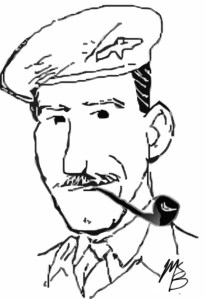
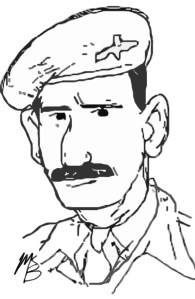
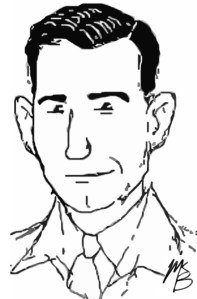
Lt-Col. K.T. Darling

Lieutenant-Colonel Kenneth Darling
12th (Yorkshire) Parachute Battalion
K.T.’s a wonderful person. A great soldiering personality and a man who won’t stand for any nonsense at all from anyone no matter who he is. I always got on extremely well with him. You always knew exactly where you stood and exactly what he wanted doing. In the very early days I always thought he had the necessary personality to rise to the top.

(CSM McCabe-Dallas quoted in Sunday Mercury, 5 May 1963, 11)

Born on 17 September 1909 in British India, Kenneth Thomas Darling was educated at Eton College and RMC, Sandhurst, after which he took a commission with the Royal Fusiliers in 1929. From 1930 to 1938, he served with the 1st Battalion in India. In 1940, he attended staff college at Camberley, becoming brigade major with the 1st London Brigade, 1st London Division. He next served as a general staff officer at the War Office until 1942.
Continue reading

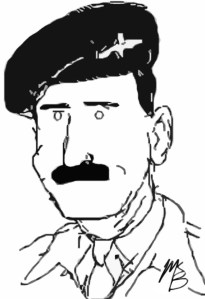
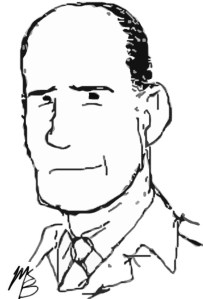
Lt-Col. W.A.B. Harris

Lieutenant-Colonel Bill Harris
12th (Yorkshire) Parachute Battalion

During the continuous fighting which took place between 27 Feb and 6 March on which day he was seriously wounded while moving forward at the head of his company under heavy M.G. fire, Binbashi Harris continually displayed the utmost coolness at all times.

(Military Cross citation, 18 Jul 1941)

Born on 14 May 1912 in British India, William Arthur Brooke Harris was the son of a British colonial official, and was a commissioned officer with the Royal Fusiliers since graduating from RMC, Sandhurst in 1932. From 1938 to 1941, he was seconded to the Sudan Defence Force and fought with the Frontier Battalion in the East Africa campaign against the Italian invasion in 1940.

Continue reading

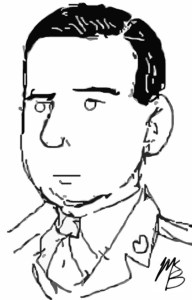
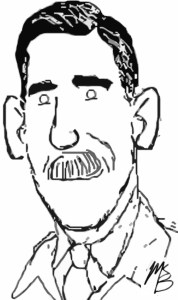
Lt-Col. N. Crookenden

Lieutenant-Colonel Napier Crookenden
9th Parachute Battalion

It was an eye-opener for me that you could never foretell how any one man or one person will react under fire. Even the toughest sportsman can collapse … In those days we hadn’t studied battle exhaustion or as they called in World War I shell shock and of course there was no question of counselling or any of these modern developments.

(IWM interview, 2 Jan 1996)

Born on 31 August 1915 in Chester, Cheshire, Napier Crookenden was the son of a First World War veteran. In his words, he “made up my mind to be a soldier when I was six years old.” After educated at RMC, Sandhurst, he took a commission with the Cheshire Regiment in 1935. The next year, he joined the 2nd Battalion on deployment to Egypt and Palestine. He first came under fire during Arab Revolt.

Continue reading

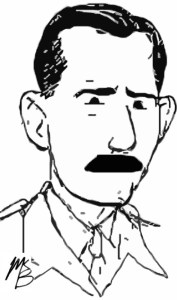
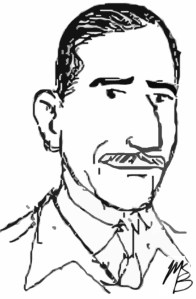
Lt-Col. G. Hewetson

Lieutenant-Colonel George Hewetson
8th (Midlands) Parachute Battalion

During this period, a glider crashed on his command post, killing the officer beside him, and wounding others. Lieutenant-Colonel Hewetson was himself very badly shaken, but he flatly refused medical aid until not only the securing of the dropping zone but also the capture of his Bn’s next objective had been completed.

(D.S.O. citation, 21 June 1945)

Born on 27 December 1910 in Ireby, Cumberland, George Hewetson was a rugby player, school headmaster and a Territorial Army Officer. He took a commission with the 5th Battalion, Border Regiment in 1938 and mobilized in 1940, serving as adjutant in the Battle of France. In 1943, he volunteered for the paratroops.

Continue reading

Lt-Col. P. Gleadell

Lieutenant-Colonel Paul Gleadell
12th Battalion, Devonshire Regiment

Having rapidly manoeuvred his battalion into assaulting positions, Lt. Col. Gleadell led it into the attack with such vigour and determination that Hamminkeln was captured in the face of heavy opposition inside half an hour … Once again he was in the forefront of the battle, where his speed of decision and determination to get forward were outstanding. Very largely due to his efforts, the operation was completely successful with heavy enemy losses and light casualties to ourselves.

(D.S.O. citation, 7 Jun 1945)

Born on 23 February 1910 in Mexico, Paul Gleadell was educated at RMC, Sandhurst and commissioned into the Devonshire Regiment in 1930. He was qualified as a translator in French and Spanish and served a tour on the North-West Frontier in India. By 1942, he was a brigade major with the 80th Indian Brigade stationed on Ceylon. On 30 November 1942, he was enroute to the United Kingdom with his family on board Llandaff Castle when a German U-Boat torpedoed the transport off the coast on Mozambique. The Gleadell family survived to continue the journey home.

Continue reading

Lt-Col. G.P. Rickcord

Lieutenant-Colonel G.P. Rickcord
1st Battalion, Royal Ulster Rifles

Never have I felt so happy about anything—it is just a wonderful adventure which at one time I though would never turn up for me. Everyone is in terrific form … We are extremely confident and could not feel better. All I want to do is to enjoy and foresee our successes—I am sure they will be—with interest and happiness and for heavens sake don’t worry. I shall be home to tell you all about it and this is something really worthwhile.

(Letter to Mother, 5 June 1944, https://paradata.org.uk/content/4639702-lieutenant-colonel-gerald-rickcord)

Born on 10 July 1913 in Portsmouth, Hampshire, Gerald Percival Rickcord was commissioned into the Royal Ulster Rifles in 1934 after education at Royal Military College, Sandhurst. He served in Hong Kong and India and was aide-de-camp to the governor of Ceylon in 1937. During the early phase of the Second World War, he was adjutant for the 10th Battalion, Royal East Kent Regiment and commanded an anti-aircraft battery during the Blitz.

Continue reading

Lt-Col. M. Darell-Brown

Lieutenant-Colonel Mark Darell-Brown
2nd Battalion, Oxfordshire and Buckinghamshire Light Infantry

After an intense bombardment lasting more than an hour the enemy put in an attack on the locality supported by tanks and self-propelled guns. Throughout the bombardment and the attack Major Darrell Brown moved freely and fearlessly round the most exposed positions held by his men encouraging them. By his magnificent example and adjusting their disposition to mete the casualties being inflicted. This officers outstanding leadership and courage were factors of the greatest importance in the successful outcome of the battle.

(D.S.O. citation, 31 Aug 1944)

Born in Elham, Kent on 8 March 1910, Mark Darell-Brown was commissioned into the Oxfordshire and Buckinghamshire Light Infantry in 1930 and before the war served in Burma. By 1944, he had become second-in-command of the 2nd Battalion, which had converted to glider infantry in 1943 and joined the 6th Airborne Division in 1943.

Continue reading

Lt-Col. P.J. Luard

Lieutenant-Colonel P.J. Luard
13th (Lancashire) Parachute Battalion

The battalion had been on the move and in action for forty-eight hours, almost without let-up, and was very tired. So, we stayed where we were. I had a company commanders meeting and in the middle of it, I was so tired that I went to sleep as I was actually talking. They left me sleeping, and left word that I was not to be disturbed. I woke up two hours later and the rest of the meeting was resumed, with my apologies.

(Quoted from Airborne Assault Museum) https://paradata.org.uk/content/4642689-lieutenant-colonel-peter-luard

Born on 6 June 1911 Warblington, Hampshire, Peter John Luard was the son of a British Navy admiral and a commissioned officer in the Oxfordshire and Buckinghamshire light infantry since 1931. He served in Burma during the early 1930s and qualified as a staff officer in 1941. Following appointments with the 6th Battalion, Ox and Bucks and to 31st Infantry Brigade, Luard volunteered to be a paratrooper in early 1942.

Continue reading

Lt-Col. A.P. Johnson

Lieutenant-Colonel Johnny Johnson
12th (Yorkshire) Parachute Battalion

Everything opened up. There was airbursts and there was machine gun fire coming right across, tracer bullets coming at us, mortars being dropped and shells … There were a few of us around there. There was the C.O., the second-in-command, the adjutant, I think there must have been about half a dozen. And there was such a bang against this wall that I wondered what it was. I didn’t know evidently it was a shell that had dropped amongst us … it killed the C.O.

(Ronald Dixon, IWM interview, 3 Sep 1999)

Born on 28 July 1911 in Maidenhead, Berkshire, Alexander Percival Johnson was commissioned into the Suffolk Regiment in 1931. He had previously been educated in Switzerland before graduating from the Royal Military College, Sandhurst. Just as he completed staff college in 1941, the British Army had started to form the new airborne forces. As an adventuring sportsman with an interest in skinning and mountain climbing, Johnson volunteered as a paratrooper.

Continue reading

Lt-Col. R.J.H. Carson

Lieutenant-Colonel Hank Carson
1st Battalion, Royal Ulster Rifles

His tactical ability has always been sound, his planning painstaking and thorough. His battalion has always maintained a high morale and in the most difficult conditions their cheerfulness has been noticeable and outstanding. This is to a very large extent due to the personality and example set by their commanding officer.

(O.B.E. citation, 29 Apr 1952)

Born on 18 July 1909 in Mussoorie, British India, Robert John Heyworth Carson was educated at Charterhouse and RMC Sandhurst. After taking a commission the Royal Ulster Rifles in 1929, he served around the world including in Northern Ireland, Palestine, Egypt and Hong Kong. Carson briefly commanded the 70th (Young Soldiers) Battalion, Royal Ulster Rifles, a unit formed in 1940 for underaged soldiers too young for conscription. In February 1943, he succeeded Lieutenant-Colonel R.J.R. Campbell in command of the 1st Battalion, RUR.

Continue reading