Lieutenant-Colonel John Mogg
9th Battalion, Durham Light Infantry
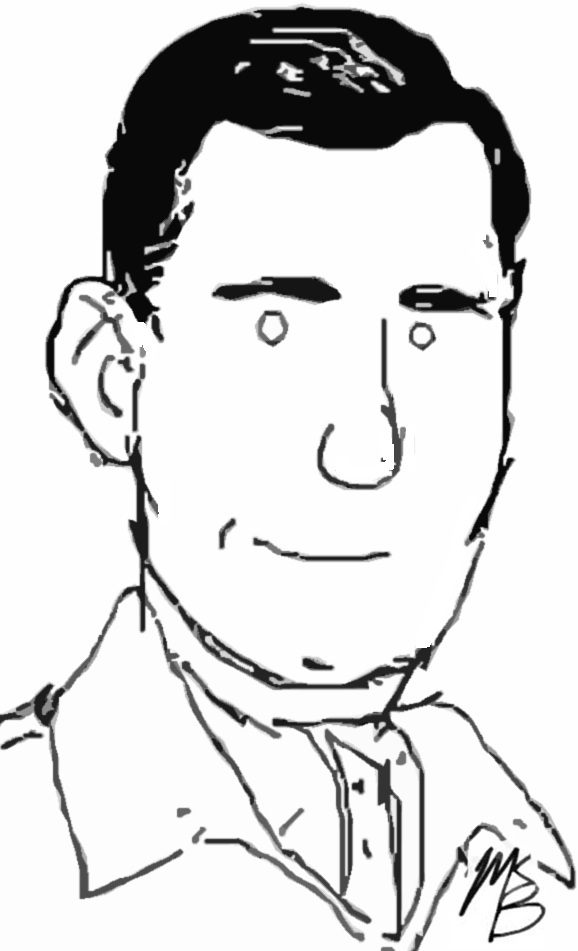
My attitude was quite different, in the actual battle, I thought I wasn’t going to be killed. And I thought anyhow if I was going to be there was nothing I could do about it. And if my name was written on whatever bullet or shell … that’s it. Bad luck.
(Maj-Gen. H.J. Mogg, IWM interview, 28 Mar 1989)
Born on 13 February 1913 in Comox, Vancouver Island, British Columbia, Herbert John Mogg began his army career as a private in the Coldstream Guards in 1933 and rose to Deputy Supreme Allied Commander Europe in 1973. After early education in Victoria, he went to public school in England, where he decided on an army career. In 1935, he was admitted to RMC, Sandhurst and afterwards took a commission in the 1st Battalion, Oxfordshire and Buckinghamshire Light Infantry.
As a Guardsman at Buckingham Palace and other sites in London, Mogg described the ordinary duties of “long periods of standing, not being allowed to smile at all the girls who try to make you smile because you knew the regimental sergeant-major was in plain clothes watching you. And if you moved your lips, you were sent to eight days in barracks when you got home.”
Following the outbreak of war in 1939, Mogg transferred to 5th Battalion, Oxfordshire & Buckinghamshire Light Infantry, rising to second-in-command. Following as posting as commandant of a divisional battle school, he was assigned to the 9th Battalion, Durham Light Infantry just prior to the invasion of Normandy.
It was in a way a shock to me … I went to a battalion that had been fighting the whole way through from the desert into Sicily into Italy … I just noticed that every solider had practically three campaign stars on his manly breast and quite a lot of them had Military Crosses, DCMs, Military Medals. And I was at a slight disadvantage over all this having not seen a shot fired in anger … I had one small medal on my chest which was a coronation medal.
Mogg, however, emphasized that the commanding officer, Lieutenant-Colonel Humphrey Wood, “couldn’t have made me more welcome and made me more at home.” A week after joining, the battalion deployed on 6 June 1944 as part of 151st Infantry Brigade, 50th Division.
Only a week later Wood was killed in action. “I suddenly realized that meant that I was the senior officer in the place and that made me the Commanding Officer,” Mogg recalled, “which filled me with utter despair to start with but I realized I must do something about it.”
Although the 50th Division was withdrawn and disbanded in December 1944, the 9th DLI was reassigned to the 131st Infantry Brigade, 7th Armoured Division. Mogg led the Battalion until the end of the war, earning the D.S.O. and Bar; the citation reading in part, “No praise is high enough for the personal courage, cheerfulness, resource and energy of this young Commanding Officer whose efforts made it possible for the amour to break out for the final capture.”
After the war, Mogg enjoyed a long army career: He commanded the 28th Commonwealth Infantry Brigade Group during the Malayan Emergency, was commandant of the Royal Military Academy Sandhurst from 1963 to 1966, culminating in Deputy Supreme Allied Commander Europe, from 1973 to 1976, when he retired from the army.
Mogg died on 28 October 2001 in Watlington, Oxfordshire.
 World War Graphic History