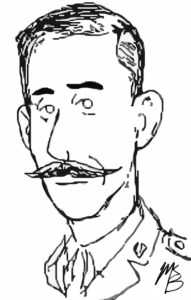
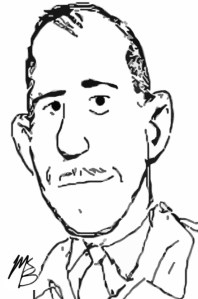
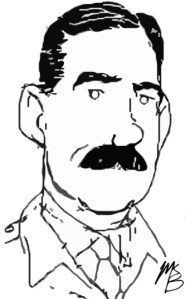
Lt-Col. I.H. Freeland

Lieutenant-Colonel Ian Freeland
7th Battalion, Royal Norfolk Regiment
1/5th Battalion, Queen’s Royal Regiment

The petrol bomb is a lethal weapon … anybody who manufactures, carries, or throws a petrol bomb is liable to most terribly tough punishment. They are liable to be shot dead in the street if, after warning, they persist. So, if you could get that across to any potential … bomb throwers, I would be grateful.

(Freeland interview, 6 Apr 1970)

Born on 14 September 1912 in Milton, Hampshire, Ian Henry Freeland was commissioned into the Norfolk Regiment after completing RMC, Sandhurst in 1932. Following service in India, he became adjutant for the 1st Battalion in 1940 shortly before it returned to the United Kingdom. He was brigade major for the 7th Infantry Brigade in 1942 and posted to the War Office in 1943. In April 1944, he was promoted to lieutenant-colonel in command of the 7th Battalion, Royal Norfolk Regiment.

Continue reading

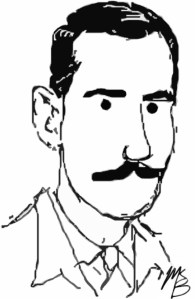
Lt-Col. G.M. Wilkins

Lieutenant-Colonel G.M. Wilkins
6th Battalion, North Staffordshire Regiment

This officer showed untiring energy and devotion to duty the during the period his company was in the line … His platoon localities were under observation and close range fire from enemy localities throughout the whole period. In addition two of his posts were subjected to continuous shell fire for long periods during which two men were killed and several wounded. Major Wilkins by continuously visiting these posts and assisting in the evacuation of wounded showed total disregard for his personal safety and set a very excellent example to his company.

(M.C. citation, 11 Jul 1940)

Born on 11 June 1901 in Bedford, Bedfordshire, Gilbert McCartney Wilkins attended Royal Military College, Sandhurst before being commissioned with the North Staffordshire Regiment in 1922. From 1926 to 1932, he was seconded to the King’s Africa Rifles, and rose to the rank of major by 1938. He commanded a company with the 2nd Battalion, North Staffordshire Regiment during the battle of France. He was wounded in action on 21 May 1941 and earned the Military Cross.

Continue reading

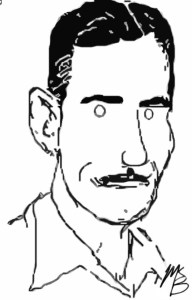
Lt-Col. J.G. Bullock

Lieutenant-Colonel J.G. Bullock
7th Battalion, South Staffordshire Regiment

Suddenly we heard the well-known sound of the ‘moaning minnies’—the attack was on again and back we went to our trenches, refreshed and ready to carry on the battle. It would be about 11 a.m. when by a stroke of bad luck, the commanding officer Lieutenant-Colonel J.G. Bullock and Lieutenant Spendlove (intelligence officer) were killed by mortar fire.

(Your Men in Battle, 1945, 33)

Born in April 1907 in Moseley, Worcestershire, James George Bullock was a rugby player, head of a building firm, and graduate of the King Edward’s School. He joined the Territorial Army and was commissioned with the 5th Battalion, South Staffordshire Regiment in 1926. He was promoted to acting lieutenant-colonel in February 1942 and led the 7th South Staffords to France in late June 1944 as part of the 59th Division.

Continue reading

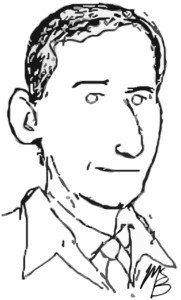
Lt-Col. J.R. Sinclair

Lieutenant-Colonel J. Roderick Sinclair
2nd Battalion, Gordon Highlanders

During the whole of this period he carried out his duties in the most gallant manner. He visited the companies frequently on foot, assisted in re-organisation and was always to be found where enemy fire was heaviest encouraging his men and exercising complete control over the most difficult situations.

(D.S.O. citation, 21 Dec 1944)

Born on 29 September 1906 in Gloucester, Gloucestershire, James Roderick Sinclair was commissioned into the Gordon Highlanders in 1926 and was promoted to captain in 1938. He served as second-in-command of the 2nd Battalion when it deployed to France with the rest of the 15th Scottish Division in late June 1944.

Continue reading

Lt-Col. E.C. Colville

Lieutenant-Colonel Edward Colville
2nd Battalion, Gordon Highlanders

There can be no doubt that the rapidity with which he assumed control in what might have been a most dangerous situation not only saved the lives of many men in his own Brigade but also ensured the success of the whole situation at a critical period in the battle.

(D.S.O. citation, 19 Oct 1944)

Born on 1 September 1905 in London, Edward Charles Colville was the son of Admiral Sir Stanley Colville (1861–1939). He was commissioned into the Gordon Highlanders in 1925 and was promoted to captain and adjutant in 1938. From 1932 to 1934 he posted to Ottawa where he served as aide-de-camp to Vere Ponsonby, 9th Earl of Bessborough, governor general of Canada.

Continue reading

Lt-Col. H.C. Baker-Baker

Lieutenant-Colonel H.C. Baker-Baker
2nd Battalion, Glasgow Highlanders

On returning to his Battalion Headquarters he suddenly found himself faced by two German Officers. He promptly shot one with his revolver and the other disappeared in the dark. As he entered his Headquarters a German Self-Propelled Gun which had entered the farmyard fired at the house at point blank range and set it on fire … Lt-Col Baker Baker led his [HQ] staff out through the opposite side of the house.

(D.S.O. citation, 7 June 1945)

Born on 11 November 1912 in Romsey, Hampshire, Henry Conyers Baker-Baker was the son of a Royal Navy admiral and educated at Eton College. After graduating from RMC, Sandhurst in 1933, he was commissioned into the Black Watch. In 1939, he was aide-de-camp to General Archibald Wavell. During the Western Desert and North African campaigns, he was a staff officer in the 51st Highland Division.

Continue reading

Lt-Col. P.U. Campbell

Lieutenant-Colonel P.U. Campbell
2nd Battalion, Glasgow Highlanders

He has at all times been an inspiration to the unit which he has now commanded for twenty months, and it has been due to his drive and persistence, at no small cost to himself, that the success of the Second Glasgow Highlanders has been such a notable one.

(D.S.O. citation, 29 Mar 1945)

Born on 7 September 1905 in British India, Patrick Usmar Campbell was commissioned with the Highland Light Infantry in 1925. He was attached to the King’s African Rifles from 1928 to 1931, served as staff captain in Egypt in 1936 and was promoted to captain in 1938. By 1940, he had risen to acting major and by early 1943, he had been appointed commanding officer of the 2nd Battalion, Glasgow Highlanders. As part of the 46th (Highland) Infantry Brigade in the 15th Scottish Division, the battalion deployed to Normandy on 13 June 1944.

Continue reading

Lt-Col. D.R. Morgan

Lieutenant-Colonel D. Russell Morgan
10th Battalion, Highland Light Infantry
2nd Battalion, Argyll and Sutherland Highlanders

Throughout the campaign this offr’s conduct in battle has been of the highest order. His personal example is magnificent and ensures the confidence of his offrs and men at all times. Whenever the situation is most difficult he is to be found encouraging and leading his soldiers who would follow him anywhere.

(D.S.O. citation, 11 Oct 1945)

Born on 26 October 1907 in British India, David Russell Morgan was commissioned into the Argyll and Sutherland Highlanders in 1928 and was promoted to captain in 1938. He became second-in-command of the 2nd Battalion in December 1942, shortly before his cousin Lieutenant-Colonel J.W. Tweedie was appointed commanding officer. As part of the 15th Scottish Division the battalion went into action in Normandy in June 1944.

Continue reading

Lt-Col. J.W. Tweedie

Lieutenant-Colonel J.W. Tweedie
2nd Battalion, Argyll and Sutherland Highlanders

His explosions of wrath, like squalls of rain soon blew over. A devout Catholic, he was in fact a sensitive and very kind-hearted man … a worrier, prone to periods of self-doubt.

(Quoted in Ian Daglish, Operation Epsom)

Born on 5 June 1907 in British India, John William Tweedie was commissioned with the Argyll and Sutherland Highlanders after graduating from RMC, Sandhurst in 1926. He was aide-de-camp to the governor-general of New Zealand in 1931 and was battalion adjutant from 1936 to 1939. He attended staff college and became staff, captain, brigade major, then general staff officer for higher formations.

Continue reading

Lt-Col. F.B.B. Noble

Lieutenant-Colonel F.B.B. Noble
10th Battalion, Highland Light Infantry

… his duties have frequently placed him in dangerous situations where his conduct was inspiring. In spite of previous recommendations he has not yet received recognition, which he richly deserves.

(O.B.E. citation, 8 Feb 1945)

Born on 20 February 1913 Havant, Hampshire, Frederick Babington Bridgeman Noble was commissioned into the Highland Light Infantry in 1933. He was stationed on the North West Frontier in India before the Second World War. He served in the Western Desert as a liaison and general staff officer for the 5th Indian Division. When it moved to the campaign Burma theatre in 1943, he became as GSO 1, for which he was awarded Order of the British Empire.

Continue reading