Lieutenant-Colonel J.H. Child Pearson
5th Battalion, Wiltshire Regiment
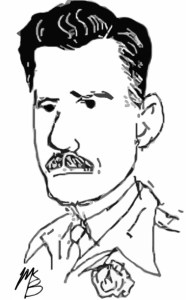
“I’ve never been so frightened in my life,” were the last words that Lt. Col. J.H.C. Pearson spoke to his signals officer striding forward alone, his customary red rose in his buttonhole and his walking stick in his hand As he crossed over the bridge, urging his men onward with the stick, he fell dead, shot by a sniper in the trees.
(Cited from Douglas Burton, BBC WW2 People’s War, 2004)
Born on 26 July 1913 in West Derby, Lancashire, John Harold Child Pearson was a graduate of Royal Military College, Sandhurst and a Regular Army officer, commissioned with the Prince of Wales Volunteers (South Lancashire Regiment) since 1933. By the invasion of Normandy, he had been assigned to the 5th Battalion, Wiltshire Regiment as second-in-command. When Lieutenant-Colonel N.C.E. Kenrick was wounded and evacuated on 1 July 1944, Pearson took over.
For leading an assault just weeks later, he would receive the D.S.O. The recommendation read in part:
… this officer’s battalion was hold up by MG fire from concealed positions. As the attacked seemed likely to come to a standstill he went forward and personally took charge of the situation. His appearance with his forward companies and his coolness and utter disregard of the MG fire so restored the confidence of his men that the attack went forward with great dash … But for his quick appreciation and daring leadership the attack which was a complete success might easily have failed.
The award, however, would be posthumous. At Mont Pinçon on 6 August, the 5th Wiltshire suffered heavy casualties trying to fight across a bridge and hesitated when again ordered to advance. To encourage his exhausted troops, Pearson pinned a red rose to his tunic and went forward himself.
In an article titled, “World Battlefronts: Rose of Mont Pinçon,” Time magazine reported on the symbolic significance of this gesture and the date: “Of all the treasured privileges of British arms, one of the most prized is a 185-year-old battle honor shared by six regiments: the wearing of a rose on Aug. 1. That day is the anniversary of the Battle of Minden in the Seven Years’ War, when those infantry regiments, outnumbered, plucked roses in the field on their way to battle and withstood the charge of the French cavalry, despite frightful losses, to carry the day.”
The article described what happened next as Pearson “stepped out, jauntily swinging his swagger stick, as casually as if he were taking a Sunday stroll in the country. He strode down the middle of the road, his men following, reached the bridge across the little stream and crossed it. There a stream of German steel caught him and he fell dead. His men went on. That night they slept in the stronghold atop Mont Pinçon” (Time, 25 September 1944).
Pearson’s D.S.O. recommendation card included a handwritten notation from the corps commander, “This was the Colonel with the Red Rose who died so gallantly later at Mt. Pincon.” He was succeeded by Lieutenant-Colonel W.Q. Roberts.

