Lieutenant-Colonel Kenneth Darling
12th (Yorkshire) Parachute Battalion
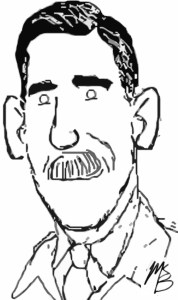
K.T.’s a wonderful person. A great soldiering personality and a man who won’t stand for any nonsense at all from anyone no matter who he is. I always got on extremely well with him. You always knew exactly where you stood and exactly what he wanted doing. In the very early days I always thought he had the necessary personality to rise to the top.
(CSM McCabe-Dallas quoted in Sunday Mercury, 5 May 1963, 11)
Born on 17 September 1909 in British India, Kenneth Thomas Darling was educated at Eton College and RMC, Sandhurst, after which he took a commission with the Royal Fusiliers in 1929. From 1930 to 1938, he served with the 1st Battalion in India. In 1940, he attended staff college at Camberley, becoming brigade major with the 1st London Brigade, 1st London Division. He next served as a general staff officer at the War Office until 1942.
In June 1942, he was appointed commanding officer of the 11th Battalion, Royal Fusiliers in the 47th London Division. Tired of being confined to England, Darling volunteered as a parachutist in 1943. He was assigned to the 1st Parachute Battalion in the 1st Airborne Division as commanding officer, but the appointment proved to be very short lived:
Frankly, I was horrified by 1 Para; they thought they knew all the answers, which they did not, and their discipline was not what I expected. The battalion did not take to me either. Perhaps this is not surprising since I had not heard a shot fired in action while the battalion had plenty of battle experience, fighting in North Africa and Sicily.
(Quoted from Julian Thompson, Ready for Anything, 103)
At the end of April 1944, he traded places with Major D.T. Dobie of the 12th (Yorkshire) Parachute Battalion, accepting a reduction in rank as second-in-command. After being wounded by a mortar bomb right after D-Day, he replaced Lieutenant-Colonel N.C. Stockwell in December. “I was horrified at what I saw,” when Darling inspected the troops, “They were a shadow of their former selves.” Discipline had broken down, and he warned that the next man to go absent without leave would be sent to the Far East. “I told them that our job was to fight the Germans, not each other … This did the trick and really got them going. Then the Ardennes operation came along, which in my view remade the battalion.”
Darling led the battalion back to the continent when the 6th Airborne Division returned to action at the end of December. For his leadership during the Rhine crossing in March 1945, he received the D.S.O.:
The landing was made in broad daylight, close behind the Rhine defences, and in the midst of the enemy gun areas. Fire was extremely heavy both during and after landing. In these circumstances the collection and organising of the bn was far from easy, as there was considerable interference not only from a large number of 88mm guns but also from accurate small arms fire.
It was entirely due to Lieutenant-Colonel Darling’s coolness and skill that 12th Para Bn was rapidly formed into a fighting force. He showed complete disregard for his personal safety and the utmost determination and resource in leading his men to their objectives. The fact that these were gained within one hour of landing, with the capture of six 88mm guns and hundreds of prisoners bears striking witness to the inflexible drive and resource of this officer. His devotion to duty was quite outstanding, and his courage inspired all ranks.
In 1946, Darling commanded the 5th Parachute Brigade in the Far East, served in Palestine until 1948, and then commanded the 16th Independent Parachute Brigade in Egypt. He steadily rose through the postwar army from chief of staff for I Corps during the Suez Crisis to general commanding II Corps to director of operations for Cyprus in 1958. Following subsequent senior appointments, he became Commander in Chief of Allied Forces Northern Europe from 1967 until retirement from the army 1969. In additional to awards and honours, he was knighted in 1963.
Darling died on 31 October 1998 in Chesterton, Oxfordshire.

