Lieutenant-Colonel Bill Harris
12th (Yorkshire) Parachute Battalion
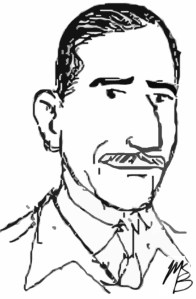
During the continuous fighting which took place between 27 Feb and 6 March on which day he was seriously wounded while moving forward at the head of his company under heavy M.G. fire, Binbashi Harris continually displayed the utmost coolness at all times.
(Military Cross citation, 18 Jul 1941)
Born on 14 May 1912 in British India, William Arthur Brooke Harris was the son of a British colonial official, and was a commissioned officer with the Royal Fusiliers since graduating from RMC, Sandhurst in 1932. From 1938 to 1941, he was seconded to the Sudan Defence Force and fought with the Frontier Battalion in the East Africa campaign against the Italian invasion in 1940.
At the rank of Binbashi, he commanded company during intense fighting in February and March 1941. He was badly wounded and his CO recommended Harris for the D.S.O. He was instead awarded the Military Cross in July. He wrote a report of the operations in East Africa titled “Guerilla War in the Gojjam.”
By 1943, he had volunteered to be a parachutist with the 6th Airborne Divsision. He was second-in-command of the 13th (Lancashire) Parachute Battalion during the Normandy landings. He replaced Lieutenant-Colonel Johnny Johnson of the 12th (Yorkshire) Parachute Battalion, who had been killed Normandy on 12 June. Just weeks later, on 7 July, Harris was wounded by a sniper and replaced by Major N.C. Stockwell.
Once recovered, Harris was assigned to be an instructor at the Parachute Training School and later at the Staff College, Camberley. He ended the war in Egypt and from there was assigned to Kenya with the King’s African Rifles. In 1952, he commanded the Somaliland Scouts and designed his own uniform for the unit. The next year, he commanded the 1st Battalion, Royal Fusiliers in Egypt and Sudan.
He retired from the army in 1955 to live in Kenya. Harris died at his home there in 2002.

