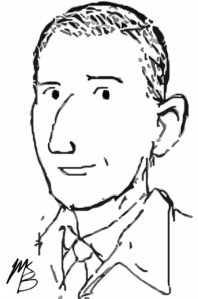
Lieutenant-Colonel Gerald Tilly
4th Battalion, Dorsetshire Regiment
Tilly and the American both got into a foxhole and, after the firing died down, Tilly told the man he had to be going.
“You wouldn’t happen to have a drink, would you?” the American asked.
As a matter of fact, Col. Till did. He had stocked his armored carrier with a couple of dozen bottles of champagne and brandy in Brussels.
“What would you like?” he asked. “Champagne or brandy?”
The American looked at him incredulously. “You must be joking,” he said finally. “But in case you’ re not, I’ll have some brandy.”
(Cornelius Ryan WWII papers, box 116, folder 4: Gerald Tilly)
Born on 30 April 1909 in Morecambe, Lancashire, Gerald Tilly was a prewar Territorial Army officer commissioned and mobilized with East Surrey Regiment at the outbreak of the Second World War. He served as a company commander in 5th Battalion, Dorsetshire Regiment during the battle of Normandy. He took over command of the 4th Battalion at the beginning of August, for which he earned the D.S.O. during heavy fighting over the next day.
Following rest to recover from loses sustained fighting from France to Belgium, the 4th Dorsets were ordered to cross the Rhine on 24 September in support of Operation Market Garden. The objective was to create a diversionary attack to enable the besieged 1st Airborne Division to withdraw. Suspecting he was being ordered to sacrifice the lives of his men, Tilly advanced with twenty officers and 300 soldiers.
Based on interviews with Tilly and second-in-command Major Jimmy Grafton, Cornelius Ryan wrote in A Bridge Too Far:
The decision was bitter. Looking at the officers and men who, he believed, “were going to certain death,” Tilly called over Major Grafton. “Jimmy,” Grafton remembers Tilly saying, “I’ve got to tell you something, because someone other than me has to know the real purpose of the crossing.” Outlining the change in plan, Tilly added quietly, “I’m afraid we’re being chucked away.” (Ryan, 569)
Once across the river in the lead boat, Tilly came under enemy fire and found no other landing craft in sight. A Germany stick grenade hit his head and exploded, knocking him unconscious. Although wounded by shrapnel, when Tilly came to, the colonel gathered a dozen other soldiers who had made it across the river. Running low on ammunition and pinned down by enemy defenders, he urged his soldiers to “get them with the bayonet.” As the situation became untenable, he ordered the group to “Scatter and run for your lives.” As they attempted to escape under cover of a smoke bomb, Tilly was quickly captured and spent the rest of the war in prisoner-of-war camps in Germany.
With Tilly and Grafton missing in action, command on the 4th Dorsets passed to Major J.S. Eyre. Their captivity would not be confirmed for over a month. While imprisoned Tilly headed intelligence and escape committees, earning a mention in despatches after liberation.
He died in Westgate-on-sea, Kent on 6 September 1987.

