Lieutenant-Colonel R.E. Osborne-Smith
1st Battalion, Worcestershire Regiment
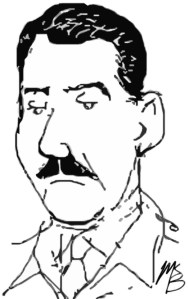
I was brought before the Colonel (R.E. Osborne-Smith) and accused of ill treating an officer POW. I was questioned and explained exactly what had happened. The Colonel listened carefully and then said, ‘I reprimand you for ill-treatment in the field, to a prisoner of war’. He then got up, shook me by the hand and said ‘Roy, why didn’t you shoot the bastard?’
(Quoted from Lt. Roy Humphreys in Rex Fellows, Fragments of Battle, 92)
Born on 18 July 1908 in Saint Helier, Jersey, Robert Edward Osborne-Smith was a cricket player and commissioned officer in the Northamptonshire Regiment since 1929. During the 1930s, he played cricket for the Indian Army, the Egypt national team and the British Army. He became adjutant in 1937 but by 1944 he had been posted 4th Battalion, Wiltshire Regiment as second-in-command.
He served during the Normandy through June and July until he was appointed commanding officer of the 1st Battalion, Worcestershire Regiment in early August 1944. He succeeded Lieutenant-Colonel Roy Harrison who had been evacuated for battle exhaustion. For leadership in operations in the Netherlands, Osborne-Smith earned the D.S.O.:
During this period his Battalion has completed successfully all the operations ordered by his Brigade Commander. In the face of determined counter-attacks by the enemy at Berjou and East of Vernonnet on the Seine, his cool courage kept his Battalion steady when the enemy had succeeded in working round his flanks. More than his share of tiresome and bloody mopping up operations has fallen to his Battalion, notably at Quesnee, Berjou and Elst. All these have been successfully performed. As a result of his inspiring and personal example, the reputation of his Battalion is worthy of the highest traditions of the Worcestershire Regiment.
He was wounded in the legs in November 1944 and replaced by Lieutenant-Colonel Bill Vickers, former second-in-command of the 4th Somerset Light Infantry. Osborne-Smith remained in the postwar army, rising to brigadier in 1957.
He died in St Aubin, Jersey on the 13 December 1972.

