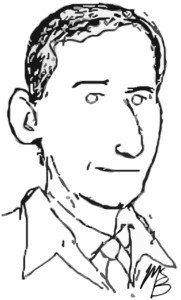
Lieutenant-Colonel I.L. Reeves
4th Battalion, King’s Shropshire Light Infantry
7th Battalion, Somerset Light Infantry
We found ourselves in the most ghastly factory area, one mass of small streets, passages, walls, walls within walls, piles of iron and waste of every description. We soon discovered some machine-gun posts and started to clear them. That started two days and a night’s street fighting, the most tiring and trying type of fighting even under the best conditions.
(Quoted in Patrick Delaforce, Marching to the Sound of Gunfire: North West Europe, 1944-5, 138)
Born on 22 September 1909 in Hanover Square, Glamorgan, Wales, Ivor Leith Reeves was commissioned into the King’s Shropshire Light Infantry in 1930. He earned the Military Cross as a company commander in the 1st Battalion during the Battle of France in May 1940. During the Normandy campaign, he took command of the 4th Battalion, King’s Shropshire Light Infantry in the 11th Armoured Division in July 1944.
He proved himself a capable commander, and one subordinate state of his leadership: “Colonel Reeves proceeded to deliver the most copybook set of orders I have ever heard, unhurried and clear.” However, within a day, he would be wounded by a shell burst and put out of action until 10 August 1944.
He led the 4th LSLI from the end of the Normandy until the liberation of Belgium, for which he earned the D.S.O. Reeves the intense fighting during the battle for Antwerp on the morning of 6 September: “The Boche found us and soon (1100) had five tanks among us. We knocked out two and then ran out of all PIAT anti-tank arms. They shot us up with machine guns, AP shot and HE, knowing we couldn’t touch them, stalking round and round day and night, blasting us out of houses as they discovered us.” Reeves was subsequently badly wounded and relinquished command to Major M.R. Robinson.
After recovery, he returned to the field in January 1945 to take command of 7th Battalion, Somerset Light Infantry in the 43rd Division. He described the slow and dangerous advance into the Rhine: “Every house, whether farm buildings, in villages or towns . . . has reinforced cellars, many of which are constructed so that their tops are just above ground level, where there are slits to fire from. Practically every house as we advance has to be cleared of enemy, which is a slow and exhausting process, but we go on.” He earned the D.S.O. Bar but would be wounded before the end of February and succeeded by Lieutenant-Colonel C. Brooke-Smith.
Reeves retired from the army in 1950 and owned race horses with his wife. He died in Gloucester on 6 February 1986.


HelloMy name is Tom Wilson. You drew my grandfather, brigadier Ernest Wilson Loyal Eddie’s ww2. Excuse the brevity and possible errors as this was sent from an I-phone.
Hi Tom,
That’s great to hear! Thanks very much for reading.