Lieutenant-Colonel Bill Vickers
1st Battalion, Worcestershire Regiment
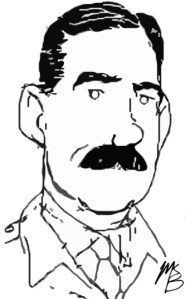
If you’re going to go and indulge in a war, you’ve got to be trained for it. And it is no use being heroic and going off fighting the 16th Panzer Grenadier Division with bows and arrows. You’ve got to have the equipment to do it. Provide you’ve got adequate equipment and provided you’re properly trained, and you’ve got a good command structure, and through your training your morale is high because you believe in your own fitness and prowess and you have pride in your unit, then I reckon you are ready for war.
(IWM interview, 6 Mar 1986)
Born on 19 January 1914 in London, Arthur William Neville Langston Vickers was a Regular Army officer, cricket player, rugby player and boxer. He attended the Royal Military College, Sandhurst and was commissioned with the King’s Own Yorkshire Light Infantry in 1934. He spent several years in India and Burma during the late 1930s, until being recalled on the eve of the Second World War. He served as a company commander in the 1st Battalion, KOYLI in France until April 1940, when his brigade was assigned to operations in Norway.
While the northern campaign would be brief and ended in withdraw, it provided Vickers with a valuable education about the psychology of combat. Speaking of a previous solid sergeant-major, Vickers explained:
… after a few days we were shelled, and I learned a hideous lesson. That great big red-faced man, who was a superb peacetime platoon sergeant major was physically incapable of going to war. He was absolutely physically incapable of being shelled. He just disintegrated physically … and that taught me a great lesson that I never forgot for the rest of the war: It’s not the people who say ‘oh let me get up and get at them,’ it’s the funny little po-faced corporal whose got a bone on the back of his neck who saves the day. It’s a lesson I learned, to judge people.
During this first action in Norway, Vickers witnessed officer breakdowns as well. He fired four shots at one lieutenant who ran away followed by most of his platoon. Vickers needed to sit on the back of another young lieutenant to prevent him from fleeing too, telling him, “if you go boy, you’ll go dead.” The battalion withdrew from Norway at the beginning of May. “I was a very disappointed officer, when I came back from Norway,” he recalled. “I reckon I personally had not been given a fair chance … The whole campaign—while I realized politically it had to happen—it really couldn’t have been mounted in a more inefficient manner … we were absolutely caught short by the Germans.”
Vickers attended staff college in 1941, and then rejoined the 4th Battalion, Somerset Light Infantry as second-in-command. He was wounded in Normandy and on recovery appointed commanding officer of the 1st Battalion, Worcestershire Regiment in November 1944. Compared to the unpreparedness for war in 1940, Vickers argued, “we certainly were in 1944, absolutely … I felt rather sorry for the Germany army in Normandy at times (I know we were a bit ponderous and slow).” He relinquished command in February 1945 due to hospitalization. Lieutenant-Colonel M.R.J. Hope Thomson, second-in-command of 5th Battalion Dorsetshire Regiment, arrived to take over.
By 1948, Vickers was a staff college instructor at Camberley, and during the Korean War was appointed assistant adjutant and quartermaster general for the Commonwealth Division. “I’m a bit euphoric about Korea,” Vickers stated in an interview over thirty years later, “because I felt it was the most important job I’d ever done. I had a divisional commander I had the utmost respect and admiration, I had a good team, a happy relationship, I enjoyed it. It was bloody uncomfortable, it was bloody dangerous, one felt miles from home but I believed in the job we were doing. And the more I did it, I knew we got a super division, which could do anything, absolutely anything. And I had complete confidence.”
During the Malaya Emergency in the late 1950s, Vickers was assigned to the Gurkha Brigade and commanded 2nd King Edward VII’s Own Gurkha Rifles (Sirmoor Rifles). He earned the Distinguished Service Order in 1957, with a citation offering the highest praise:
During his period of command Lieutenant-Colonel Vickers has added to the renown and fighting traditions of his regiment and proved himself to be a fearless, skilful and determined leader in the field. Inspired by his leadership his men achieved a large number of successes, in jungle operations, against a wary, treacherous and dangerous enemy. Within a year of his assumption of command, in 1956, he completely disrupted the communist terrorists’ organisation in the Bahu area of Negri Sembilan. Later he inspired his men to eliminate a considerable number of cunning hard-core terrorists in South Johore.
On four recent occasions he has been into the jungle accompanied only by two police officers to negotiate the surrender of six terrorists. In thus entering the jungle on foot and unescorted he repeatedly displayed a high degree of personal courage as a result of which the surrender of all six terrorists was brought about.
Vickers retired from the army at the rank of brigadier in 1967. He died in Harleston, Norfolk on 28 January 1996.

