Lieutenant-Colonel Tim Hope-Thomson
1st Battalion, Worcestershire Regiment
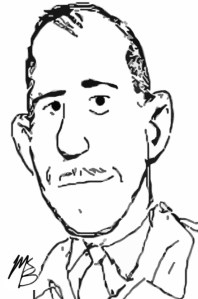
Throughout many successful battles his personal example of coolness and courage was an inspiration to his officers and men and his military judgement was invariably sound. His battalion’s successes speak for themselves.
(D.S.O. citation)
Born on 2 May 1911 in Edinburgh, Maxwell Richard Julian Hope-Thomson was commissioned into the Royal Scots Fusiliers in 1931 after attending Royal Military College, Sandhurst. He earned the Military Cross while serving with the 1st Battalion during the Arab Revolt in Palestine in 1936. He commanded a company of the 2nd Battalion in France in 1940. He attended staff college in 1941, qualified as a paratrooper, and by 1942 commanded the 4th Parachute Regiment. He was subsequently promoted to brigadier of the 50th Indian Parachute Brigade and served in the Burma campaign.
The brigade went into action in an infantry role at the Battle of Shangshak in March 1944. The underequipped and undertrained troops endured relentless Japanese counterattacks before being forced to withdraw. The defence, however, had inflicted heavy losses on the enemy delayed the Japanese advance to Kohima. During the retreat, Hope-Thomson was badly concussion from a fall, and some alleged he suffered a nervous breakdown. He was evacuated and removed from command, unfairly criticized for his leadership in the battle.
Major Harry Butchard of the 153rd Gurkha Parachute Battalion described the terrible conditions in the aftermath of intense fighting. As his band made the difficult withdrawal, one of his soldiers noticed two figures:
It was the brigadier, Tim Hope Thomson who had been injured and had a blood-stained bandage round his head, guarded by his Pathan orderly. They were entirely alone so they joined our growing party. As it was nearing nightfall we selected a convenient spot near water and were settling down to sleep when suddenly a noise of boots and movement caused some alarm. Eventually a party of about 30 soldiers led by two Indian doctors appeared from a branch nullah. Many of them were badly wounded, one hopping on home-made crutches and another with the lower part of his jaw shot away. You could smell the wounds yards away — gangrene had set in (Max Arthur, Men of the Red Beret, 115).
In November 1944, a recovered Hope-Thomson returned to action in North West Europe though at a lower rank. Remarkably for a former brigade commander, he served as major and second-in-command of the 5th Battalion, Dorsetshire Regiment. In February 1945, he succeeded Lieutenant-Colonel Bill Vickers of the 1st Battalion, Worcestershire Regiment and went on to earn the D.S.O. He was wounded in April but resumed command before VE-Day.
During the occupation of Germany, he rejoined his original regiment and commanded the 4/5th Royal Scot Fusiliers until 1947. He later commanded the 1st Battalion in Germany and Malaya for which he was mentioned in despatches. Promotion followed with elevation to colonel in 1956 and then brigadier in 1960.
Hope-Thomson was appointed aide-de-camp to the Queen in 1962 and retired from the army in 1964. He went on to be commandant of the Queen Victoria School in Dunblane, Scotland from 1967 to 1974.
He died on 20 May 1990 Kirriemuir, Angus, but lived long enough for his leadership and conduct at Shangshak to be vindicated.

