Lieutenant-Colonel Dennis Talbot
7th Battalion, Hampshire Regiment
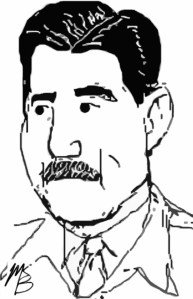
Throughout this past year the success rate in eliminations of Communist Terrorists by kills, captures and surrenders has been well maintained in Pahang when it has been dropping in all other States. Statistics show that in the past year it was twice as difficult to eliminate a Communist Terrorist as in the previous year and yet over this period his Brigade has kept up its elimination figures.
(C.M.E. citation, 31 May 1955)
Born on 23 September 1908 in Norwood, Middlesex, Dennis Edmund Blaquiere Talbot was commissioned into the Queen’s Own Royal West Kent Regiment after graduating from RMC, Sandhurst in 1928. He completed a tour in India and completed staff college at Camberley in 1940. He served as brigade major for 30th Infantry Brigade during the Battle of France, for which he earned the Military Cross.
He served as general staff officer for the Combined Operations Headquarters until the invasion of Normandy. He reverted in rank to be second-in-command for the 5th Battalion, Dorset Regiment. When the 7th Battalion, Hampshire Regiment lost two commanding officers in quick succession, Talbot went forward as the replacement. The regimental history recalled of this period:
Colonel Talbot had taken over the 7th Battalion at a most critical time in June, 1944. Newly arrived in Normandy, the Battalion had been cruelly mauled in its first days, and two Commanding Officers had been killed. The Battalion was sore and a little bewildered by its ill-fortune, but Colonel Talbot swiftly restored its old confidence and Hampshire spirit. His leadership and faith in the Battalion’s ability was exactly the tonic it needed, and under him it fought its hard and brilliant campaign with admirable elan.
(D.S. Daniell, The Royal Hampshire Regiment, 255)
Talbot went on to earn the D.S.O. and in January 1945, filled in as temporary commander for 120th Infantry Brigade. He subsequently commanded 2nd Battalion, the Queen’s Own Royal West Kent Regiment in the occupation of Germany. During the Malaya Emergency in 1953, he was brigadier of 18th Infantry Brigade, for which he was awarded Commander of the British Empire:
He has had under his command during this period British, Malay and African battalions and in spite of their diverse characteristics and capacities he has welded his brigade into a homogeneous formation with a strong espirit-de-Corps. This spirit and the operational efficiency of the Brigade has remained undiminished in spite of the fact that the British and African battalions have both changed during the past year and a newly formed Malay battalion has joined the Brigade. The credit for this is due to Brigadier Talobt’s outstanding powers of leadership.
His devotion to duty, determination to outwit, track down and destroy the elusive enemy, and his personality have been an inspiration to all ranks and have made a conspicuous contribution to the successful operations conducted in Pahang in the past year.
He held a series of commands and appointments with the British Army of the Rhine before retiring from the army as a major-general in 1964. He worked as a civil servant for the ministry of defence for the next decade. He died on 27 June 1994 in Barham, Kent.

