Lieutenant-Colonel Napier Crookenden
9th Parachute Battalion
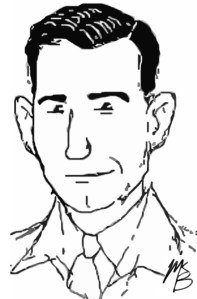
It was an eye-opener for me that you could never foretell how any one man or one person will react under fire. Even the toughest sportsman can collapse … In those days we hadn’t studied battle exhaustion or as they called in World War I shell shock and of course there was no question of counselling or any of these modern developments.
(IWM interview, 2 Jan 1996)
Born on 31 August 1915 in Chester, Cheshire, Napier Crookenden was the son of a First World War veteran. In his words, he “made up my mind to be a soldier when I was six years old.” After educated at RMC, Sandhurst, he took a commission with the Cheshire Regiment in 1935. The next year, he joined the 2nd Battalion on deployment to Egypt and Palestine. He first came under fire during Arab Revolt.
Back in the United Kingdom, in 1939, he was assigned to the 6th Battalion, Cheshire Regiment which deployed during the Battle of France. In 1942, Crookenden completed staff college and volunteered for the paratroops, joining the 6th Airlanding Brigade as brigade major. He was closely involved in Brigadier Hugh Kindersley’s planning for the brigade’s role in airborne operations for D-Day.
With a week of landing in France, a shell struck a command group, shattering Kindersley’s femur, wounding Brigadier Lord Lovet, and killing Lieutenant-Colonel Johnny Johnson of the 12th (Yorkshire) Parachute Battalion. As Crookenden later wrote, “Kindersley looked so bad that he was laid in a barn with the dead and dying and Lovat sent his priest to administer the last rites. Kindersley protested that he was both a Protestant and likely to live, so he was put on a jeep and driven down to Les Bas de Ranville.”
Lamed for life, Kindersley was replaced by Brigadier Edwin Flavell, a decorated First World War veteran with three Military Crosses. Although initial delighted to have a general with such a tremendous record, Crookenden and other staff officers “came to the conclusion after a lot of worried talk amongst ourselves that he was worn out mentally, and his stock of courage had been so run down during his military life that he had none left.”
Crookenden was relieved to be posted away from brigade headquarters to take over 9th Parachute Battalion from Lieutenant-Colonel Terence Otway in July 1944. He led the unit until the 6th Airborne Division was withdrawn to England in September, and returned with it during the Ardennes campaign in late December. He earned the D.S.O. for crossing the Rhine in March 1945. In 1948, he married the daughter of his former superior, Brigadier Kingersley.
Following time in occupied Germany, Crookenden commanded the 9th Battalion in Palestine until 1946. He was director of operations during the Malayan Emergency for which he would be awarded Order of the British Empire. He retired as at the rank of lieutenant-general in 1972. An active advocate for veterans, regimental associations and military history, he wrote three books, Dropzone Normandy (1976), Airborne at War (1978), and Battle of the Bulge, 1944 (1980).
He died on 31 October 2002 in Tunbridge Hill, Kent.

