Lieutenant-Colonel Paul Gleadell
12th Battalion, Devonshire Regiment
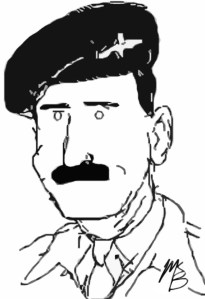
Having rapidly manoeuvred his battalion into assaulting positions, Lt. Col. Gleadell led it into the attack with such vigour and determination that Hamminkeln was captured in the face of heavy opposition inside half an hour … Once again he was in the forefront of the battle, where his speed of decision and determination to get forward were outstanding. Very largely due to his efforts, the operation was completely successful with heavy enemy losses and light casualties to ourselves.
(D.S.O. citation, 7 Jun 1945)
Born on 23 February 1910 in Mexico, Paul Gleadell was educated at RMC, Sandhurst and commissioned into the Devonshire Regiment in 1930. He was qualified as a translator in French and Spanish and served a tour on the North-West Frontier in India. By 1942, he was a brigade major with the 80th Indian Brigade stationed on Ceylon. On 30 November 1942, he was enroute to the United Kingdom with his family on board Llandaff Castle when a German U-Boat torpedoed the transport off the coast on Mozambique. The Gleadell family survived to continue the journey home.
Back in the UK, Gleadell joined the 12th Battalion, Devonshire Regiment, which had been converted to glider infantry in the 6th Airborne Division. He served as second-in-command during the landings in Normandy for D-Day, earning the French Croix de Guerre:
On the evening of June 9th, when the battalion came under heavy shelling and mortar fire, Lt-Col. Gleadell, being Second-in-Command battalion, went round the forward companies encouraging and cheering the men, the majority of whom were in action for the first time. This was invariably his habit during the whole time the battalion was in action, and his example did much to maintain the morale of the men over a difficult period.
In August 1944, he succeeded Lieutenant-Colonel Dick Stevens, who had ben reassigned to 21st Army Group headquarters. The 6th Division withdrew for regrouping the next month but would return to battle during the Ardennes offensive in January 1945. Gleadell earned the D.S.O. for leadership in the subsequent crossing of the Rhine in March.
After the war, Gleadell held several posts before taking command of the 1st Battalion, Devon Regiment from 1951 to 1953. He was next commander of the 24th Independent Infantry Brigade until 1957, when he attended the Imperial Defence College. From 1958 to 1959, he was chief of staff in Cyrpus. He retired as a major-general in 1965.
He died in Weymouth, Dorset on 3 August 1988.

