Lieutenant-Colonel G.P. Rickcord
1st Battalion, Royal Ulster Rifles
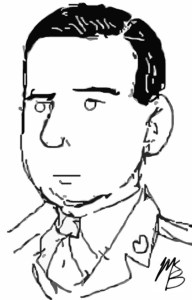
Never have I felt so happy about anything—it is just a wonderful adventure which at one time I though would never turn up for me. Everyone is in terrific form … We are extremely confident and could not feel better. All I want to do is to enjoy and foresee our successes—I am sure they will be—with interest and happiness and for heavens sake don’t worry. I shall be home to tell you all about it and this is something really worthwhile.
(Letter to Mother, 5 June 1944, https://paradata.org.uk/content/4639702-lieutenant-colonel-gerald-rickcord)
Born on 10 July 1913 in Portsmouth, Hampshire, Gerald Percival Rickcord was commissioned into the Royal Ulster Rifles in 1934 after education at Royal Military College, Sandhurst. He served in Hong Kong and India and was aide-de-camp to the governor of Ceylon in 1937. During the early phase of the Second World War, he was adjutant for the 10th Battalion, Royal East Kent Regiment and commanded an anti-aircraft battery during the Blitz.
Following senior officer courses and staff college, Rickord returned to the 1st Battalion, Royal Ulster Rifles in 1943. The battalion had converted to gilder infantry two years earlier and joined the 6th Airborne Division in April 1944. Two months later, the division landed over Normandy for D-Day. He rose to second-in-command and succeeded Lieutenant-Colonel R.J.H. Carson when he was wounded in March 1945. By the end of the war, Rickcord earned the D.S.O.:
During the whole period of Airborne Operations, this officer has shown himself consistently a first class leader of men, the possessor of great personal courage and an officer who at all times is reliable, conscientious and painstaking. Largely due to his efforts as Battalion Second-in-Command and then as Commanding Officer, the Battalion has become a first rate fighting team with the utmost confidence in itself and its leaders.
He commanded the 1st RUR in Germany and Palestine before taking up other appointments in the late 1940s. Meanwhile in 1950, the 1st Royal Ulsters were dispatched to Korea in 1950. After served as second-in-command Major Tony Blake was captured and executed by Chinese forces in January 1951, Rickcord arrived as his replacement. With the commanding officer on sick leave in Japan, soon Rickord was once again in command of the 1st RUR in a war zone. He led the battalion most notably during the Battle of the Imjin River for which he was awarded the US Silver Star.
He relinquished command of the 1st RUR in 1952 to take over 2nd Battalion, Gurkha Rifles fighting guerillas in Malaya. He retired from the army in 1961 and went on to have a second career working for Guinness. He died on 24 August 1990.

