Lieutenant-Colonel G.P.L. Weston
2nd Battalion, Middlesex Regiment (MG)
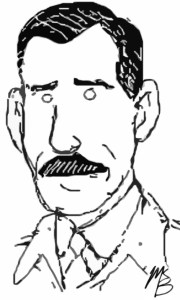
During my daily visits to Platoons I still see men unnecessarily miserable under quite moderate and sporadic shell fire. Very often I am greeted by the remark “It’s murder up here” but found shells dropping 200 years or more away. I want All Ranks to realise that, except for a few isolated instances, we have not yet experienced the really heavy shellfire which we have inflicted frequently upon the Hun and which we must expect when he mounts a large scale attack against us. A little shelling is good for the soul.
(Weston in War Diary, 11 Jul 1944)
Born on 21 August 1910, Gerald Patrick Linton Weston was a cricketer player, commissioned into the Middlesex Regiment (Duke of Cambridge’s Own) in 1931 and promoted to captain in 1939. As a qualified pilot, he was seconded to the Royal Air Force and served as a flight lieutenant with a bomber squadron. By June 1943, he returned to the infantry and succeeded Lieutenant-Colonel J.E.F. Willoughby in command of the 2nd Battalion, Middlesex Regiment, the machine gun unit attached to 3rd Infantry Division.
Weston led the battalion from D-Day until the end of the war in Europe. After five weeks in France, Weston expressed to his troops, “Although few of us are quite the brave heroes into which the Daily Mirror is determined to turn us, there have been several instances of extremely gallant conduct, which I hope will be duly rewarded when honours lists are published.”
By the end of the campaign, Weston earned the D.S.O.: “Throughout this long period Lt-Col Weston has been the personification of gallant and inspiring leadership. Always cheerfully optimistic. his fearlessness has become a tradition in the Regt; the occasions on which he as personally swayed a difficult situation in his company’s battles are too numerous to related.”
Weston was next assigned to Java to command the 161st Indian Infantry Brigade and then commanded 6th Parachute Brigade from 1947 to 1949. Following a posting in Malaya, he became commandant for the Army Air Corps in 1957 and then director of the Land/Air Warfare War Office from 1960 to 1964.
He died on 26 October 1977 in North Warnborough, Hampshire.

