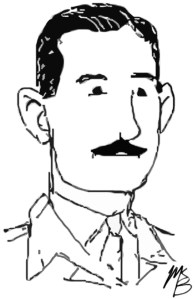
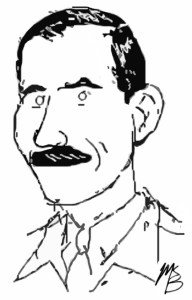
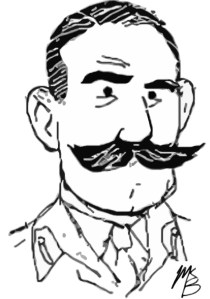
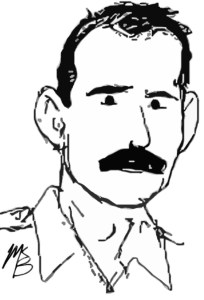
Lt-Col. J.G. Carew Pole

Lieutenant-Colonel Sir John Carew Pole
5th Battalion, Duke of Cornwall’s Light Infantry
2nd Battalion, Devonshire Regiment
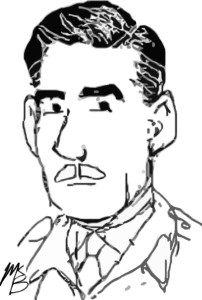
At one time his wireless was knocked out, but he continued to personally direct the advance from a tank despite the fact that they were under very accurate fire from enemy A tk guns. His courage was an inspiration to all.

(D.S.O. citation, 1 Mar 1945)

Born on 4 March 1902 in London, John Gawen Carew Pole was educated at Eton College and the Royal Military College, Sandhurst. He was the son of Lieutenant-General Reginald Pole-Carew (1849–1924), and became 12th Baronet of Shute House in 1926. Commissioned into the Coldstream Guards since 1923, Carew Pole served as aide-de-camp to the commander-in-chief, India in 1925 and aide-de-camp to the commander-in-chief, South Africa in 1935. He retired from the Guards in July 1939.
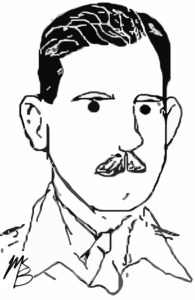
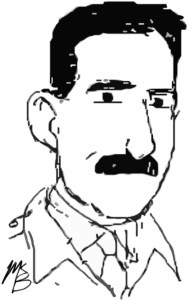
Continue reading

Lt-Col. C.A.R. Nevill

Lieutenant-Colonel C.A.R. Nevill
2nd Battalion, Devonshire Regiment

The landing craft grounded amid a certain amount of mortar and rifle fire. The ramps were let down, and we jumped into 4 1/2 feet of water. It was very wet, very cold. However, it had its funny side. The bed of the beach was very uneven, presumably as a result of shelling. Wading through the deep and rough water became a task of the first magnitude and, curiously enough led to a good deal of laughter. Then we were ashore directly in front of a German pill-box; the gun had fortunately been knocked out, and a number of German soldiers lay dead beside it.

(Nevill, “We Landed on D-Day: The Story of the 2nd Battalion the Devonshire Regiment”)

Born on 14 July 1907 in Bordon, Hampshire, Cosmo Alexander Richard Nevill was commissioned with the Royal Fusiliers (City of London Regiment) after graduating from Royal Military College, Sandhurst in 1927. He transferred to the 1st Battalion in India in 1934 and by 1941 had been promoted to lieutenant-colonel on the staff of General Archibald Wavell, commander-in-chief, India. Neville was made Officer of the Most Excellent Order of the British Empire in the King’s 1944 New Year Honours.

Continue reading

Lt-Col. E.S. Scott

Lieutenant-Colonel E.S. Scott
2nd Battalion, Essex Regiment


At all times since D day up to the present moment he has cheerfully accepted responsibility and worked long hours to ensure that the formations and units fighting the battle had all the assistance and support they required. He has supervised with great care the training and work of his subordinate Staff Officers and liaison officers so that operation instructions emanating from Div HQ have been coordinated, clear and accurate.

(M.B.E. citation, 29 Mar 1945)

Born on 20 May 1912 Uckfield, Sussex, Eric Surtees Scott was a golfer and commissioned officer with the Essex Regiment (The Buffs) since 1932. Having qualified as a staff officer, in mid-1943, he was appointed GSO 1 for the 49th (West Riding) Division. He helped with the planning and training before the Normandy invasion, and following the division’s landing after D-Day continued to “shoulder a great deal of responsibility during these stages.”

Continue reading

Lt-Col. G.L. Wood

Lieutenant-Colonel G.L. Wood
6th Battalion, Durham Light Infantry

The 6th Battalion has built up during the course of this War a very fine reputation, second to none in the British Army. It has taken part in many Battles—it has never failed to gain its objective or in any other task which it has been given. This is a very fine record.

A Battalion is judged by the behaviour and achievements of the men in that Battalion. So it is with us and I would like each one of you to always bear in mind that you have played a great part in making this Battalion what it is …

(G.L. Wood, farewell message, Dec 1944, war diary)

Born on 15 November 1911 in Newcastle Upon Tyne, Northumberland, George Leslie Wood was a timber company representative and Territorial Army officer, commissioned with the Durham Light Infantry since 1933. He mobilized with the 9th Battalion and earned the Military Cross fighting a rearguard action in France in May 1940. He transferred to the 6th Battalion and served in the North African campaign, earning a Military Cross Bar for actions on 21 March 1943.

Continue reading

Lt-Col. A.E. Green

Lieutenant-Colonel A.E. Green
6th Battalion, Durham Light Infantry

The dash and vigour displayed in this attack and the excellent information which was being continuously passed back as it progressed was due to the magnificent leadership and control of Lt Col Green, and by his energy and enthusiasm inspired all ranks of his Bn and thus ensured the complete success of the operation.

(D.S.O. citation, 1 March 1945)

Born on 24 December 1908 in Hastings, Sussex, Arthur Ernest Green was a commissioned officer with the Middlesex Regiment since 1929. He was promoted to captain in 1937 and became battalion adjutant two years later. In September 1943, succeeded Lieutenant-Colonel W.I. Watson in command of the 6th Battalion, Durham Light Infantry just as the unit along with the 50th Division was recalled to the United Kingdom.

Continue reading

Lt-Col. H.R. Woods

Lieutenant-Colonel Humphrey Woods
9th Battalion, Durham Light Infantry

Humphrey said to me, ‘I haven’t said this to anybody else but I know I’m going to be killed when we get over to the other side … I feel it in my bones.’ Here’s a chap who’s been through it all, and been blown up on mines and everything else. But he somehow felt that he was going to be killed … supernatural or whatever you’d like to call it, he knew he’d come to the end … That was the epitome of courage, to know you’re going to be killed but go on.

(Maj-Gen. H.J. Mogg, interview, 28 Mar 1989)

Born in Lewes, Sussex, on 15 September 1915, Humphrey Reginald Woods joined the Kings Royal Rifle Corps as second lieutenant in 1936 after attending Royal Military College, Sandhurst. He served with 1st Battalion from Burma to the Middle East at the outbreak of the Second World War. He was twice wounded in North Africa and earned the Military Cross for gallantry in 1941. He earned a M.C. Bar for actions on 16 July 1942: “The determination of this officer to to engage the enemy more closely has been an inspiration to those fortunate enough to command him as well as those happy enough to serve under him.”

Continue reading

Lt-Col. A.B.S. Clarke

Lieutenant-Colonel A.B.S. Clarke
9th Battalion, Durham Light Infantry

Both were extremely popular with the officers and men of the battalion and the loss was strongly felt by all. Lieutenant Colonel Clarke had always led from the front and there is little doubt he would have reached higher rank had he lived. Major Robinson was equally well liked. Tall and well built, he was easily recognisable and had built a fine reputation within the battalion.

(Harry Moses, The Gateshead Gurkhas, 253)

Born on 11 September 1906 Cuckfield, Sussex, Andrew Board Stephenson Clarke was a commissioned officer in the King’s Own Scottish Borders since 1926. He mobilized with the 8th Battalion, Durham Light Infantry as adjutant in September 1939. He was wounded by enemy bombing during the Blitz but continued to serve with the 8th DLI through to its deployment to the Middle East as part of 151st Infantry Brigade, 50th Division. He rose to second-in-command during the North Africa campaign.

Continue reading

Lt-Col. J.E.S. Percy

Lieutenant-Colonel Joss Percy
9th Battalion, Durham Light Infantry

To my distaste now, Montgomery sacked Joss Percy. Joss Percy declined any other posting as said ‘I’m going home.’ On the way home on a troop ship, he died of a broken heart. And the Durhams who were there will always say, that was the loss of a very gallant battalion and brigade commander. Certainly, I blame Montgomery.

(William Henry Partridge, IWM interview, 20 Apr 2001)

Born in Western Australia, on 10 October 1897, Joscelyn Edward Seymour Percy served with the Durham Light Infantry during the First World War. He earned the Military Cross in 1917: “For conspicuous gallantry and devotion to duty. He led his men with great determination and himself killed two of the enemy. Later, although severely wounded, he remained in the enemy’s trenches until the last man of his party had withdrawn.” Twenty-three years later, Percy took command of the 9th Battalion, Durham Light Infantry during the battle of France in June 1940.

Continue reading

Lt-Col. R.P. Lidwill

Lieutenant-Colonel Bob Lidwill
8th Battalion, Durham Light Infantry

We had our C.O., Bob Lidwill—a great character. He was a regular soldier who had been in GHQ in Cairo, a staff job, who dropped his rank to get back to an infantry battalion, which not many headquarters staff did. And he became our C.O., and a very brave man. He never seemed to be shaken at all. Very bold, very cool and calm despite how much stuff was flying around.

(George Pearson Chambers, IWM interview, 1988)

Born on 26 July 1914 in County Galway, Ireland, Robert Peisley Lidwill was the son of a British Army colonel and commissioned officer in the King’s Regiment since 1934. He was promoted to captain in summer 1940. His older brother Captain George Ronald Lidwill died during the Norway campaign in April 1940. Lidwill joined the 8th Battalion, Durham Light Infantry in July 1942 and fought in the North African campaign.

Continue reading

Lt-Col. P.D. Daly

Lieutenant-Colonel P.D. Daly
2nd Battalion, King’s Shropshire Light Infantry

From the start to the finish of the campaign Lt Col Daly has been magnificent first as a staff officer and then as Bn commander. His inspiring leadership and personal bravery have been an inspiration to all ranks.

(D.S.O. citation, 24 January 1946)

Born on 22 November 1912 in Exeter, Devon, Patrick Dunsandle Daly was a commissioned officer with the Duke of Cornwall’s Light Infantry since 1932. During the Normandy campaign, he was brigade major for 185th Infantry Brigade in 3rd Division. In this role, “he distinguished himself as a first class staff officer and earned the respect and admiration of all those with whom he came in contact.”

Continue reading