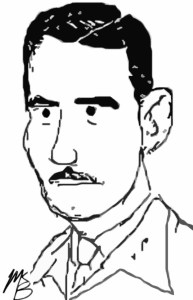
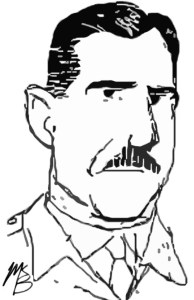
Lt-Col. F.B.B. Noble

Lieutenant-Colonel F.B.B. Noble
10th Battalion, Highland Light Infantry

… his duties have frequently placed him in dangerous situations where his conduct was inspiring. In spite of previous recommendations he has not yet received recognition, which he richly deserves.

(O.B.E. citation, 8 Feb 1945)

Born on 20 February 1913 Havant, Hampshire, Frederick Babington Bridgeman Noble was commissioned into the Highland Light Infantry in 1933. He was stationed on the North West Frontier in India before the Second World War. He served in the Western Desert as a liaison and general staff officer for the 5th Indian Division. When it moved to the campaign Burma theatre in 1943, he became as GSO 1, for which he was awarded Order of the British Empire.

Continue reading

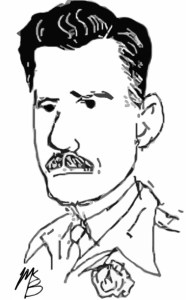
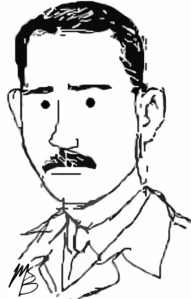
Lt-Col. R.A. Bramwell-Davis

Lieutenant-Colonel R.A. Bramwell-Davis
10th Battalion, Highland Light Infantry

These successful operations were due to the magnificent leadership determination and courage of Lt-Col Bramwell Davis. He was always seen wherever there was trouble, quietly giving orders and encouragement. During the fight for the village, he twice organized and personally led attacks against enemy strong points holding up his advance. When organizing a section stalk to eliminate a SP gun, he was wounded. He refused to be evacuated until such time as the Battalion was consolidated and he had hand over to his Second in Command who had to be brought forward.

(D.S.O. citation, 7 Jun 1945)

Born on 8 October 1905 in Scotland, Ronald Albert Bramwell-Davis was commissioned into the Highland Light Infantry after graduating from the Royal Military College, Sandhurst in 1925. In addition to army service, he played cricket and polo. He served in Hong Kong and in India on the North West Frontier. From 1941 to 1942 and 1943 to 1944, he was attached to the British Joint Staff Mission in Washington, D.C.

Continue reading

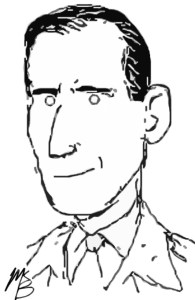
Lt-Col. H.P. Mackley

Lieutenant-Colonel H.P. Mackley
10th Battalion, Highland Light Infantry

Lieutenant-Colonel Mackley accepted responsibility for any casualties that the concentration might cause. Down it came—on scale 5 from every gun in the Division— and it was repeated more than once. There was not a loose round or a British casualty, but the wood was so thoroughly plastered that the enemy ever after gave it a wide berth.

(H.G. Martin, The History of the Fifteenth Scottish Division 1939–1945, 198)

Born on 22 July 1903 in Woodford, Cheshire, Hugh Pelham Mackley was educated at RMC, Sandhurst and commissioned into the Cameronians (Scottish Rifles) in 1924. He served overseas in Hong Kong. He was promoted to captain in 1936, and the next year posted to the War Office as general staff officer for physical training. In February 1942, he was appointed commanding officer of the 12th Battalion, Cameronians. The unit took up garrison duty in British occupation of the Faroe Islands in May 1942.

Continue reading

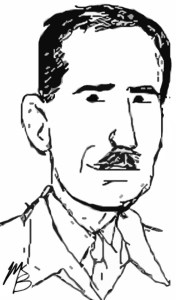
Lt-Col. J.D.S. Young

Lieutenant-Colonel J.D.S. Young
10th Battalion, Highland Light Infantry

Captain Young remained with the Battalion to the end of the fighting and celebrated his twentieth birthday on 27th December 1918 after 4½ years in the front line! He enlisted at the commencement of the War when fifteen years of age, but as he stood 6 feet 4 inches he doubtless had little trouble in hoodwinking the doctors as to his real age.

(Herbert G. Sotheby, The 10th Battalion Argyll and Sutherland Highlanders, 1914-1919 [1931], 104)

Born in 1899 in Troon, Ayrshire, John Douglas Starforth Young was a highly decorated First World War veteran. Although still underage, he had enlisted in August 1914 and was commissioned with the 10th Battalion, Argyll and Sutherland Highlanders. While only a lieutenant, in 1918, he earned the Military Cross and the Distinguished Service Order, rare honours for a junior officer.

Continue reading

Lt-Col. E. Remington-Hobbs

Lieutenant-Colonel E. Remington-Hobbs
9th Battalion, Cameronians (Scottish Rifles)

The Colonel as he liked to be known, was Colonel Edward Remington-Hobbs, DSO, and he was the company chairman. He was a fascinating character, a real ladies’ man and, unfortunately, a chain smoker. He had the rare distinction of being the sole survivor of an aeroplane crash …

(Tony Shelton, Diary of a North London Lad, 2011, 117)

Born on 7 February 1916 in Cranbrook, Kent, Edward Remington-Hobbs was commissioned with the Royal Scots Fusiliers after graduating from the Royal Military College, Sandhurst in 1936. He transferred to a Territorial Army battalion of the Argyll and Sutherland Highlanders after the outbreak of war in 1939. He attended Staff College, Camberley in 1941 and subsequently became an instructor.

Continue reading

Lt-Col. E.M.A. Bradford

Lieutenant-Colonel Sir Edward Bradford
9th Battalion, Cameronians (Scottish Rifles)

From his first action it was apparent that he was an outstanding leader, and his continual coolness under fire became a byword in the battalion … Lt-Col Bradford was always conspicuous in the battles, and his complete disregard of danger was largely responsible for his successful leadership.

(Chevalier of the Order of Leopold with palm and Croix de Guerre 1940 with palm, citation, 8 December 1945)

Born on 30 November 1910 in London, Edward Montagu Andrew Bradford inherited the 3rd baronetcy of South Audley Street in September 1914 on the death of his father Lieutenant-Colonel Sir Evelyn Ridley Bradford at the First Battle of the Aisne. The younger Bradford grew up to also pursue an army career and took a commission with the Cameronians (Scottish Rifles) in 1932. Like his father, he also played cricket as well as polo and raced horses.

Continue reading

Lt-Col. R.M. Villiers

Lieutenant-Colonel Dick Villiers
9th Battalion, Cameronians (Scottish Rifles)

By his careful planning and his personal example in the deplorable conditions, his Brigade secured all their objectives. He was always to be found well forward, skillfully directing his Brigade and assisting to control the forward move of his supporting arms.

(D.S.O. Bar citation, 10 May 1945)

Born on 10 September 1905 in London, Richard Montagu Villiers was educated at Winchester College and the Royal Military College, Sandhurst, before taking a commission in the Cameronians (Scottish Rifles) in 1925. He was promoted to captain in 1937 and then major in 1942. He assumed command of the 9th Battalion, Cameronians in January 1943.

Continue reading

Lt-Col. P.M. Hunt

Lieutenant-Colonel E.H.G. Grant
5th Battalion, Queen’s Own Cameron Highlanders

7th Battalion, Seaforth Highlanders

Peter Hunt was a typical example of the best sort of traditional British general: brave, upright, straightforward, cheerful, friendly and with a sympathetic understanding of the needs, interests and emotions of all ranks, whether Scottish, English, Welsh, Irish or Gurkha.

(Michael Carver, The Independent, 7 Oct 1988, 17)

Born on 11 March 1916 in London, Peter Mervyn Hunt was a graduate of Royal Military College, Sandhurst and commissioned into the Queen’s Own Cameron Highlanders in 1936. In summer 1939, he was captain and adjutant of the 2nd Battalion, Liverpool Scottish before transferring to the 1st Battalion, Queen’s Own Cameron Highlanders following the declaration of war. He was wounded during the evacuated from Dunkirk and four years later returned to France as a reinforcement officer for the 5th Battalion, Queen’s Own Cameron Highlanders.

Continue reading

Lt-Col. E.H.G. Grant

Lieutenant-Colonel E.H.G. Grant
7th Battalion, Seaforth Highlanders

During the recent ops from 26 Jun onwards until wounded on night 29 Jun, Lt-Col. Eneas Henry George Grant has displayed high qualities of leadership and has inspired his Bn by his personal courage and example at all times.

(D.S.O. citation, 19 Oct 1944)

Born on 14 August 1901 in Scotland, Eneas Henry George Grant was educated at Wellington College, Berks and Royal Military College, Sandhurst. In 1920, he took a commission with the Seaforth Highlanders, the regiment generations of his family had joined. Grant served with the 1st Battalion in Northern Ireland, Cyprus and Egypt. While stationed in Palestine during the Arab Revolt of 1936, he earned the Military Cross.

Continue reading

Lt-Col. C.W.P. Richardson

Lieutenant-Colonel C.W.P. Richardson
6th Battalion, King’s Own Scottish Borderers

I’m now getting on to rather dangerous ground because we wished to—as I say it’s no good trying to stop Scottish soldiers when they’ve had a drop to drink chasing women. And so the best thing to do is to recognize it and take precaution. And what we wanted to do, and we had the full approval of the general, was to start our own regimental brothel … And then who should step in but the bishop [of Hong Kong] … and he said “no” and that was that.

(Richardson, IWM museum, 5 Aug 1982)

Born on 8 June 1905 in Belfast, Ireland, Charles Walter Philipps Richardson attended Royal Naval Colleges at Osborne and Dartmouth but decided to make a career in the army instead. After transferring to Royal Military College, Sandhurst he was commissioned into the King’s Own Scottish Borderers in 1924. He served with the 2nd Battalion in Hong Kong, India, and Egypt during the late 1920s and 30s before the Second World War.

Continue reading