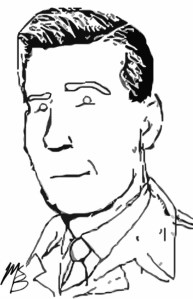
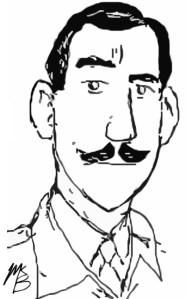
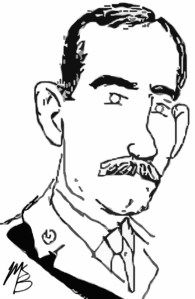
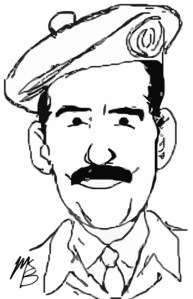
Lt-Col. J.A. Hopwood

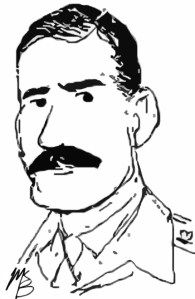
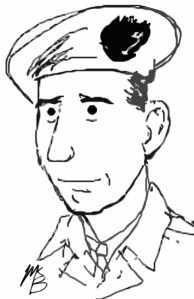
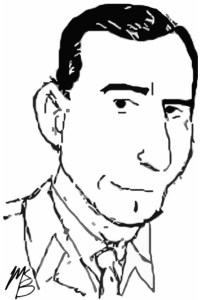
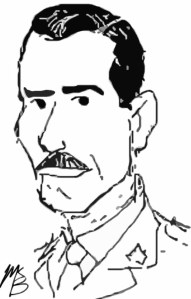
Lieutenant-Colonel John Hopwood
1st Battalion, Black Watch

I was standing there on top of this bloody tank and suddenly I felt a red hot pain in my chest and I was on the ground. Horrible noise. And I thought hell … I thought that’s the death rattle isn’t it [laughs] and I thought I was dead. And I felt very sorry for everybody at home, they’d miss me, that sort of thing. And then I realized I wasn’t dead, fortunately.

(J.A. Hopwood, interview, Feb 1987)

Born on 26 January 1910, John Adam Hopwood joined the Black Watch in 1930 after attending Eton College and Sandhurst. “I think I might have gone to the Royal Navy,” he later reflected, “but being me of course I put it off too late – procrastinated— so army was the next best thing.” He served as second-in-command of the 7th Battalion, Black Watch and earned the D.S.O. for heroism at Wadi Akarit in April 1943. When one company wavered after its officers were knocked out, Hopwood took charge of the advance. The citation credited his “actions which were carried out with the highest degree of resourcefulness, courage and determination were undoubtably responsible for the forward Coy reaching its objective.”

Continue reading

Lt-Col. G.W. Dunn

Lieutenant-Colonel George Dunn
2nd Battalion, Seaforth Highlanders

Major Dunn as Bn 2nd in command was with me at the former Bn HQ. As bn HQ was about to advance it was shelled and many personnel were casualties … I was wounded also. Maj. Dunn was a tower of strength during that crisis and throughout the rest of the night. He re-organised a scratch Bn HQ, re-organised communications, re-organised people to deal with casualties, and by his calmness and coolness in very difficult circumstances was of outstanding help in getting things going again.

(D.S.O. Bar citation, 21 Dec 1944)

Born in Lanarkshire on 27 March 1914, George Willoughby Dunn was a graduate of Glasgow University, a solicitor and Territorial Army officer, commissioned into Royal Scots Fusiliers in 1935. He served with the 5th Black Watch as a company commander in North Africa and was wounded at the Second Battle of El Alamein in October 1942. He then earned the Military Cross for leading an assault on a hill strongpoint at Wadi Akarit in April 1943: “He exposed himself continuously without fear for his own life and his complete disregard for his own safety made possible the taking and holding of this feature. Throughout Major Dunn has been an inspiration to all who serve under him.”

Continue reading

Lt-Col. A.J.A. Arengo-Jones

Lieutenant-Colonel Tony Arengo-Jones
1/4th Battalion, King’s Own Yorkshire Light Infantry

Commanders at every level up to battalion will be required to pay attention to such tactical principles as the need to bring maximum, accurate fire on enemy positions from as many different directions as practicable; bold flanking and infiltration movements undertaken whenever the circumstances are propitious; reducing the risk of casualties by having as few men as possible moving in the attack at any one time, and the employment of deception to conceal the direction from which the final assault is launched

(Arengo-Jones, “An Exchange of Ideas,” Infantry, Sep-Oct 1966, 6)

Born on 17 August 1915 in Somerset, Gloucestershire, Anthony James Arengo Arengo-Jones was a graduate of Cheltenham College and rugby player. After attending Royal Military College, Sandhurst he took a commission with the Gloucestershire Regiment in 1936. He served at Dunkirk in command of an anti-tank company. He returned to France after the Normandy invasion as brigade major with the 160th Infantry Brigade.

Continue reading

Lt-Col. T.W.A.H. Harrison-Topham

Lieutenant-Colonel T.W.A.H. Harrison-Topham
1/4th Battalion, King’s Own Yorkshire Light Infantry

On New Year’s Day Lieut.-Colonel Harrison Topham, who had led the Battalion so gallantly from Normandy to Nijmegen, was unfortunately compelled to relinquish command owing to ill-health

(Harold Carmichael Wylly, History of the King’s Own Yorkshire Light Infantry, 156)

Born on 23 August 1903 in Greenwich, London, Thomas William Amyas Harrison Harrison-Topham was the son of Colonel Thomas Harrison-Topham who won the D.S.O. as a captain in Burma during the 1891-92 campaign. The younger Harrison-Topham took a commission with the King’s Own Yorkshire Light Infantry in 1924, served on the North West frontier in India, was promoted to captain in 1935. and became acting major in April 1940.

Continue reading

Lt-Col. E.D. Wardleworth

Lieutenant-Colonel E.D. Wardleworth
1/4th Battalion, King’s Own Yorkshire Light Infantry

Wuzzle Wardleworth had taken over as C.O. He was very good; why he was several times replaced after temporary command I shall never know. He moved the companies around fairly frequently in order to give everyone a turn in the comparatively quiet rear positions.

(Lewis Keeble, “A Worm’s Eye View: The 1/4 K e View: The 1/4 KOYLI in Normandy YLI in Normandy,” CMH, 6)

Edmund Douglas Wardleworth was born on 24 October 1914 in Sheringham, Norfolk, the same day his father, a Royal Army Medical Corps lieutenant, mysteriously drowned while on active service in France. The younger Wardleworth was commissioned into the King’s Own Yorkshire Light Infantry in 1935. He was aide-de-camp to the governor of Burma from 1938 to 1941. He fought as a company commander with the 2nd Battalion, KOYLI during the Japanese invasion of Burma in the 1941-42 campaign. When the commanding officer and second-in-command became casualties, Captain Wardleworth took over during fierce fighting in late February 1942.

Continue reading

Lt-Col. C.D. Barlow

Lieutenant-Colonel C.D. Barlow
1/4th Battalion, King’s Own Yorkshire Light Infantry

Colonel Barlow is personally responsible for the initiation and development of an entirely new form of warfare which may well play an important part in future campaigns … His own immediate military advancement may well have been prejudiced by the time he has devoted to this special subject, but he has never permitted personal considerations to stand in the way of bringing his organisation to fruition.

(OBE citation, 1944)

Born on 4 February 1905 in Somersham, Cambridgeshire, Cecil Disney Barlow was commissioned into Shropshire Light Infantry after graduating from Royal Military College, Sandhurst in 1925. While part of the Army of Occupation on the Rhine in Germany, he named in a divorce suit by a British colonel, who alleged that his wife had an affair with the young lieutenant. During the early 1930s, Barlow served with the King’s African Rifles in Kenya. He completed staff college at Camberley in 1939 just as the Second World War began.

Continue reading

Lt-Col. R.G. Pine-Coffin

Lieutenant-Colonel Geoffrey Pine-Coffin
3rd Parachute Battalion,
7th (Yorkshire) Parachute Battalion

Lieutenant-Colonel Pine Coffin, he was—and I’m not saying this because I’m being taped—he was the finest officer that any man can wish for … He was for the men. He wasn’t one of those ‘oh because I’m an officer, I’m above you’ … He never degraded you.

(Walter Tanner, IWM interview, 31 Jul 1990)

Born on 2 December 1908 in Portledge Manor, Bideford, Devon, Richard Geoffrey Pine-Coffin graduated from Eton and Trinity College, Cambridge. He was commissioned into the Devonshire Regiment in 1928 and mobilized with the 2nd Battalion, Duke of Cornwall’s Light Infantry. He served in the Battle of France and after Dunkirk joined the 11th Devons as a major.  His compound family name led soldiers to dub him “Wooden Box” as the dead were typically buried in simple coffins made of pinewood.

Continue reading

Lt-Col. T. Otway

Lieutenant-Colonel Terence Otway
9th Parachute Battalion

The more I think about it the more I wonder how in the devil we did it … It was this fantastic training that saved us. I can’t believe we could have pulled it off otherwise … It was an appalling shambles and only Good knew what lay in store for us. I asked myself, do I pack up or do I go on? It had been stressed to me how vital it was to see the thing through. So I really had no option but to have a go.

(Quoted in Brimingham Post, 6 Jun 1969, 24)

Born on 15 June 1914 in Cairo, Egypt, Terence Brandram Hastings Otway was educated at Royal Military College, Sandhurst and took a commission with 2nd Battalion, Royal Ulster Rifles in 1934. He served overseas in Hong Kong, Shanghai, and on the North West frontier in India. Following staff college and War Office duties in London, he transferred to the airborne forces in August 1943 and later became second-in-command of the 9th Parachute Battalion under Lieutenant-Colonel Martin Lindsay. Just months before D-Day, Otway had taken commander under inscrutable circumstances.

Continue reading

Lt-Col. A.S. Pearson

Lieutenant-Colonel Jock Pearson
1st Parachute Battalion
8th (Midlands) Parachute Battalion

I do not believe that there is any man, who, in his heart of hearts, would not rather be called ‘brave’ than any other virtue attributed to him. This elemental and reasoning attitude is a good one. Because courage is not merely a virtue but is THE virtue. Without courage, there are no other virtues. Faith, hope and charity, and all the rest, don’t become virtues unless you have the courage to exercise them.

(Pearson lecture quoted in Julian James, A Fierce Quality, 118)

Born on 1 June 1915 in Glasgow, Scotland, Alastair Stevenson “Jock” Pearson was educated at Kelvinside Academy and worked as a baker during the Great Depression before joining the Territorial Army. He rose to become one of the youngest battalion commanders in the British Army. “Gentlemen, do what you are told and stay alive,” he would stress to his officers. “Remember, there will be no bloody medals in this battalion.” Yet with four D.S.O.’s and one Military Cross, Pearson ended the war as one of the most highly decorated officers.

Continue reading

Col. W. Dec

Colonel Wladyslaw Dec
3rd Rifle Brigade

‘To hell with women just now — what I need is a bridge! Report your discovery to the General.’ I shouted somewhat un-gallantly. I forgot that the world is small and while a mountain might not meet up with another, people are in fact likely to meet again. Also, I didn’t think that one day people would remember that I preferred a bridge to women.

(Quoted in Dec, Narvik and Falaise, 377-9)

Born on 13 February 1898 in Sokołów Małopolski, Władysław Dec was drafted into the Austro-Hungarian Army during the First World War and was commissioned a second lieutenant in 1916. He joined the newly formed Polish Army in November 1918 and fought during the wars of independence. After the September 1939 campaign, Major Dec escaped with his brigade to France via Hungary and the Balkans.

Continue reading