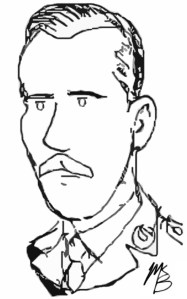
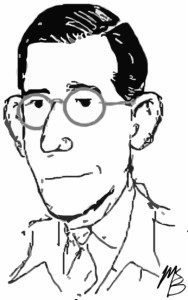
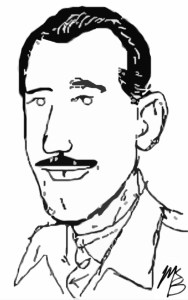
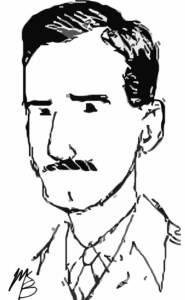
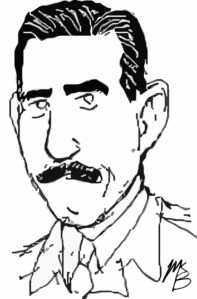
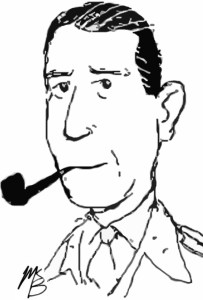
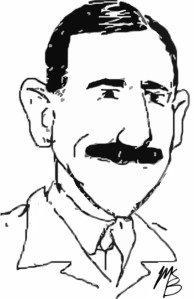
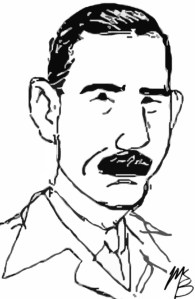
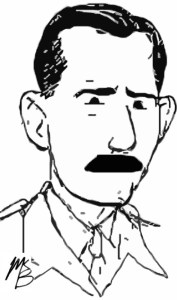
Lt-Col. F.F.E. Allen

Lieutenant-Colonel Freddie Allen
1st Battalion, Suffolk Regiment (The Buffs)
1st Battalion, East Lancashire Regiment

Throughout the long and anxious period of 27 hours, Lt-Col Allen, in spite of his wound, lack of sleep and his heavy responsibilities, continued to command his battalion with great skill, calm confidence and outstanding personal gallantry. His personal example and superb fighting qualities ensured beyond any doubt that his battalion’s objective was held firm, and that by their offensive spirit whey were able to destroy very large number of the enemy who were equally determined to regain the vital ground captured and held secure by this battalion.

(D.S.O. Bar citation, 19 Apr 1945)

Born on 30 December 1912 in Middlesex, London, Frederick Fernley Edmund Allen was an insurance broker educated at Brighton College. He joined the Territorial Army in 1937 and took a commission with the Oxford and Buckinghamshire Light Infantry. He became a replacement second-in-command for the 1st Battalion, Suffolk Regiment a month after the D-Day landings. He took command in August 1944 and October when successive commanding officers were wounded in action.

Continue reading

Lt-Col. J.G.M.B. Gough

Lieutenant-Colonel Kit Gough
1st Battalion, Suffolk Regiment (The Buffs)

The role of 1st Suffolk on D day was: 1st to capture a Battery of guns covering beach 2nd To clear the village of Coalville 3rd To capture strong point “Hillman.”

First two were easy, but “Hillman” proved difficult nut to crack, & was finally taken about 7 PM “D” day. The slowness has been the subject of severe criticism in the Book (forgotten name!) concerning the whole campaign in N.W. Europe. When I visited “Hillman” last year, (most of the concrete works remain) I pondered over the problem again, and realised what a tough egg it was.

(Gough questionnaire, Cornelius Ryan WWII papers, box 021, folder 04, 1958)

Born on 30 August 1907 in Pocklington, Yorkshire, James Gordon Milestone Boulter Gough was commissioned into the Lincolnshire Regiment in 1928. During the 1930s, he served overseas with the 1st Battalion in Gibraltar, Shanghai, Hong Kong, and India. He was a company commander with the 2nd Battalion during the Battle of France in 1940. Afterwards he became second-in-command, then at the end 1942 was instructor at the school of infantry. In October 1943, he was posted to the 1st Battalion, Suffolk Regiment as second-in-command.

Continue reading

Lt-Col. R.E. Goodwin

Lieutenant-Colonel Dick Goodwin
1st Battalion, Suffolk Regiment (The Buffs)

I am just writing this letter to you before setting out on the great adventure … There is very little else to say as one can’t say much. I expect you will hear all about everything before you get this. Don’t worry too much because it won’t do anyone any good! … There will be much to tell you when I see you next.

(Goodwin to wife, 5 Jun 1944) https://ve-vjday80.gov.uk/letter/lt-col-dick-goodwin-to-anthea-goodwin/

Born on 17 August 1908 in London, Richard Elton Goodwin was commissioned with the Suffolk Regiment in 1928 after education at Cheltenham and Royal Military College, Sandhurst. While serving in India, he became aide-de-camp to the Governor of Madras in 1935. After the outbreak of war, Goodwin was second-in-command of 9th Battalion, Royal Warwickshire Regiment before returning to the Suffolks as commanding officer of the 1st Battalion in June 1943.

Continue reading

Lt-Col. P.J. Luard

Lieutenant-Colonel P.J. Luard
13th (Lancashire) Parachute Battalion

The battalion had been on the move and in action for forty-eight hours, almost without let-up, and was very tired. So, we stayed where we were. I had a company commanders meeting and in the middle of it, I was so tired that I went to sleep as I was actually talking. They left me sleeping, and left word that I was not to be disturbed. I woke up two hours later and the rest of the meeting was resumed, with my apologies.

(Quoted from Airborne Assault Museum) https://paradata.org.uk/content/4642689-lieutenant-colonel-peter-luard

Born on 6 June 1911 Warblington, Hampshire, Peter John Luard was the son of a British Navy admiral and a commissioned officer in the Oxfordshire and Buckinghamshire light infantry since 1931. He served in Burma during the early 1930s and qualified as a staff officer in 1941. Following appointments with the 6th Battalion, Ox and Bucks and to 31st Infantry Brigade, Luard volunteered to be a paratrooper in early 1942.

Continue reading

Lt-Col. A.P. Johnson

Lieutenant-Colonel Johnny Johnson
12th (Yorkshire) Parachute Battalion

Everything opened up. There was airbursts and there was machine gun fire coming right across, tracer bullets coming at us, mortars being dropped and shells … There were a few of us around there. There was the C.O., the second-in-command, the adjutant, I think there must have been about half a dozen. And there was such a bang against this wall that I wondered what it was. I didn’t know evidently it was a shell that had dropped amongst us … it killed the C.O.

(Ronald Dixon, IWM interview, 3 Sep 1999)

Born on 28 July 1911 in Maidenhead, Berkshire, Alexander Percival Johnson was commissioned into the Suffolk Regiment in 1931. He had previously been educated in Switzerland before graduating from the Royal Military College, Sandhurst. Just as he completed staff college in 1941, the British Army had started to form the new airborne forces. As an adventuring sportsman with an interest in skinning and mountain climbing, Johnson volunteered as a paratrooper.

Continue reading

Lt-Col. R.J.H. Carson

Lieutenant-Colonel Hank Carson
1st Battalion, Royal Ulster Rifles

His tactical ability has always been sound, his planning painstaking and thorough. His battalion has always maintained a high morale and in the most difficult conditions their cheerfulness has been noticeable and outstanding. This is to a very large extent due to the personality and example set by their commanding officer.

(O.B.E. citation, 29 Apr 1952)

Born on 18 July 1909 in Mussoorie, British India, Robert John Heyworth Carson was educated at Charterhouse and RMC Sandhurst. After taking a commission the Royal Ulster Rifles in 1929, he served around the world including in Northern Ireland, Palestine, Egypt and Hong Kong. Carson briefly commanded the 70th (Young Soldiers) Battalion, Royal Ulster Rifles, a unit formed in 1940 for underaged soldiers too young for conscription. In February 1943, he succeeded Lieutenant-Colonel R.J.R. Campbell in command of the 1st Battalion, RUR.

Continue reading

Lt-Col. G.R. Stevens

Lieutenant-Colonel Dick Stevens
12th Battalion, Devonshire Regiment

And I am doubly certain that we can never achieve either leadership or friendship in India if we depend upon the crumbling façade of caste which has protected Englishmen in India in the past. We must either make India a willing associate or else get out … we are prepared to relinquish our status as superior beings and are willing to become partners and associates in the business of living in India.

(Col. G.R. Stevens to East India Association, 13 Dec 1944)

Born on 4 October 1908 in Boyle, County Roscommon, George Richard Stevens was educated at Cheltenham and Royal Military College, Sandhurst. He took a commission with Royal Fusiliers (City of London Regiment) in 1928, and served tours of duty with the 1st Battalion in India during the 1930s. He commanded a company in the Western Desert campaign and then in 1942 went to the Staff College, Camberley as an instructor. Following a GSO 1 appointment to the airborne forces, in 1943, he became second-in-command of 12th Battalion, Devonshire Regiment.

Continue reading

Lt-Col. M.W. Roberts

Lieutenant-Colonel M.W. Roberts
2nd Battalion, Oxfordshire and Buckinghamshire Light Infantry

In the actual operation Lieutenant-Colonel Roberts showed outstanding gallantry. After a hazardous landing, he showed great determination in setting up and maintaining Divisional Headquarters in the face of the enemy. His services on that day and in the long advance which followed were carried out without thought for his personal safety and were of the very greatest value to me and the division.

(D.S.O. citation, 24 Jan 1946)

Born in Devonport on 15 December 1907, Michael Wace Roberts was educated at Marlborough College and was commissioned in the King’s Own Yorkshire Light Infantry in 1927. After overseas postings in India and Burma during the 1930s, he attended staff college and during the Second World War served with the Home Guard. In December 1943, he was appointed commanding officer of the 2nd Battalion, Oxfordshire and Buckinghamshire Light Infantry, which two years earlier had converted to glider infantry.

Continue reading

Lt-Col. R.W.M. De Winton

Lieutenant-Colonel R.W.M. De Winton
5th/7th Battalion, Gordon Highlanders
1st Battalion, Tyneside Scottish
2nd Battalion, Gordon Highlanders

I did not mean to hit the man or the uniform. I wanted to hit only the major representatives of the Big Four at Pola. Unfortunately he was a man and a soldier. If I had had the occasion, I would have hit the Big Four—as a symbol of the injustice to my country.

(Maria Pasquinelli in Associated Press, 19 Mar 1947)

Born on 16 September 1908 in Edinburgh, Scotland, Robert William Michael De Winton was a graduate of Royal Military College, Sandhurst and a commissioned officer in the Gordon Highlanders since 1932. He temporarily took over 5/7th Battalion in Sicily in August 1943 and then commanded 1st Battalion, Tyneside Scottish from January 1944 until it deployed to France after D-Day.

Continue reading

Lt-Col. R.K. Exham

Lieutenant-Colonel Roy Exham
6th Battalion, Duke of Wellington’s Regiment
6th Battalion, Green Howards

I will not attempt to describe another action which we fought as all I can remember is a bloody time when three soldiers were killed at my side. Again we captured our objective. It was an unpleasant time and my sympathies went to the forward companies, which were dug in close to the Germans and could not see anything, were unable to move and were shelled most of the time. There was a wondaful feeling of relief when at last we were on the move.

(Exham quoted in Mike Morgan, D-Day Hero)

Born on 25 January 1907 in Readlynch, Wiltshire, Robert Kenah Exham took as commission in the Duke of Wellington’s Regiment (West Riding) in 1926 after graduating from Royal Military College, Sandhurst. He served on the North West Frontier in India before the Second World War. As a staff officer with 3rd Infantry Brigade in June 1940, he earned the Military Cross for invaluable assistance during the evacuation from Dunkirk.

Continue reading