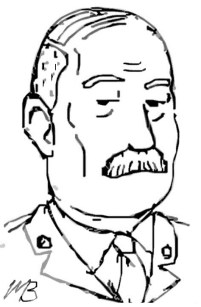
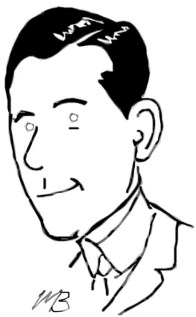
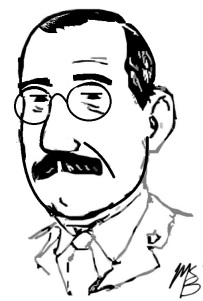
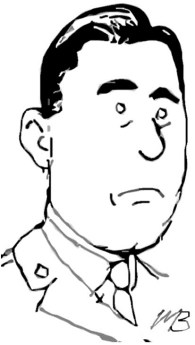
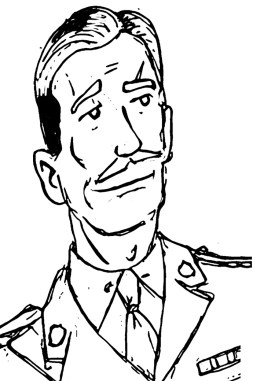
Lt. Col. Fearman

Lieutenant Colonel G.D. Fearman
120th (City of Hamilton) Battalion

Fearman

This Officer is still suffering from the above debility. In addition the worry incidental to rearrangement of his Unit and its breaking up prevented him taking his previous three weeks leave and rather increased the condition. At present he suffers from insomnia being awake from 1 to 4 almost every morning. His condition persists without definite signs and his general condition has depreciated.

 (Proceedings of a Medical Board, 7 Feb 1917)

Born on 21 August 1867 in Hamilton, Ontario, George Douglas Fearman was an accountant with twenty-six years’ experience in the 13th Royal Regiment. When authorized to raise the 120th Battalion in November 1915, he expressed dissatisfaction with the indifferent attitude of the Government in the poor response to appeals for recruits.

Continue reading

The Scoundrel

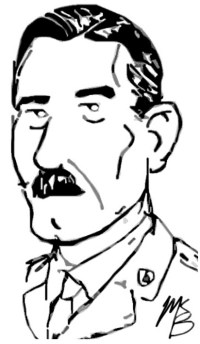
Lieutenant Colonel W.H. McKinery, D.S.O.
66th (Edmonton Guards) Battalion
McKinery

All rotters are eventually found out and you will be glad to hear that McKinery has been cashiered for using his Battalion funds for his own purposes and we have heard the last of him in the B.E.F.

 (Agar Adamson to Mrs. Mabel Adamson, 2nd Feb 1916, 138)

When William Herbert McKinery enlisted in Princess Patricia’s Canadian Light Infantry, he claimed to have been born in Waterford, Ireland on 5 April 1878. He also used his father’s first name, John, when filling out the attestation papers. McKinery was actually born on April 5, 1875 in Melbourne, Australia. Believing that he would be rejected as overage, the forty-year old Australian had falsified personal information in order to fight overseas.

Continue reading

Lt. Col. Mersereau

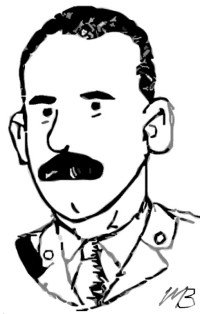
Lieutenant Colonel G.W. Mersereau
132nd (North Shore) Battalion
Mersereau

At no time since the 132nd Battalion began to recruit have there been any disturbances of any nature whatsoever, and to say that there has been rioting or other similar disturbances is an utter absurdity and a grave injustice to the young men whom we all should honour.

 (Campbellton Mayor A. A. Andrews to MP Charles Marcil, 16 Feb 1916)

George William Mersereau was a graduate of the University of New Brunswick, an educator for thirty years and provincial inspector of public schools since 1884. He was born in Blackville on 9 July 1852. He had belonged to the 73rd Regiment for twenty-five years until his retirement several years before the First World War. In November 1915, Mersereau was appointed to command the 132nd Battalion mobilized from Chatham.

Continue reading

Lt. Col. Pratt

Lieutenant Colonel Arthur C. Pratt, MPP
133rd (Norfolk’s Own) Battalion
Pratt

One of my sergeants put it cleverly when he said that, while the Canadians make the best fighting men in the world, they are not soldiers, and he was right when he said it. The Canadian fighters are citizens. The war was merely an interlude in their citizenry. During the fighting they bore all manner of hardship because they were part of the fighting but when the fighting had ended they unconsciously became citizens again and not amendable to the strict discipline of military life. They wanted to get back to the life to which they belonged.

(Pratt, Toronto Star, 19 March 1919)

Arthur Clarence Pratt was a Conservative member of the Ontario legislature for Norfolk South from 1905 to 1919. He was born 6 February 1871 in Lynedoch, Ontario. In November 1915, he joined with Hal B. Donly, his Liberal opponent from the June 1914 provincial election, to raise the 133rd Battalion from Norfolk County.

Continue reading

Lt. Col. Vicars

Lieutenant Colonel J.R.O. Vicars
172nd (Rocky Mountain Rangers) Battalion
Vicars

The duty of all Canadians is to shed their last drop of blood in defence of the dear old Motherland. But why ask such a question? Is there a cur with a drop of British blood in his veins who doubts his duty? As for myself and Rangers, we are ready. Only let Colonel Sam. [Hughes] give the word. I speak for my men. They know me, and I know them.

(Vicars to Montreal Daily Star, 3 Aug 1914)

Too bad they broke us up for had they not we would have been in Berlin by this time or all in Heaven …  Although the latter place has already many of our poor fellows and every day adds to the number.

(Vicars to Kamloops Standard-Sentinel, 21 Sept 1917)

Despite his enthusiastic offer to volunteer on the outbreak of war in August 1914, sixty-year-old John Richard Odlum Vicars did not receive authorization to raise an overseas battalion until January 1916. Vicars was a British Columbia land surveyor and commanding officer of the 102nd Rocky Mountain Rangers. Born in Dublin, Ireland on 16 April 1855, he immigrated to Canada with his family in 1858 and moved west in the 1880s.

Continue reading

Lt. Col. Dawson

Lieutenant Colonel H. J. Dawson, D.S.O.
59th (Eastern Ontario) & 46th (South Saskatchewan) BattalionsDawson

During the recent fighting Lieut.-Colonel Dawson gave out and was sent down to the Hospital. I think he has gone on down the line and, as the strenuous fighting is likely to continue for some time, I would like very much to have another man in command of the Battalion and give Dawson a good chance to rest. He has been recommended as an Officer fit to command a Brigade in the Field, and is one of the best Commanding Officers I have. He has been hard at it now since the Fourth Division came to France.

(Gen. Arthur Currie, 17 Aug 1918)

Born in Birkenhead, England on 21 November 1876, Herbert John Dawson was an associate professor at the Royal Military College and militia officer with the 14th (The Princess of Wales’ Own Rifles) Regiment since 1901. He was appointed lieutenant colonel in May 1915 when he began to organize the 59th Battalion from Eastern Ontario and Hull, Quebec.

Continue reading

Lt. Col. Weaver

Major C. Y. Weaver, D.S.O.
49th (Edmonton Regiment) BattalionWeaver

Weaver was a man without a spark of vanity and had a wonderful sense of humor. He used to pretend to be suspicious of very clever men and argued at length that clever men were unstable, indeed dangerous. On the other hand he suggested that he himself was stupid, and contended that there were many advantages in being considered stupid. In point of fact, Weaver was a deep thinker and a student in the subjects in which he was interested.

(Gen. Griesbach, The Forty-Niner, 3 Jan 1931, 12)

Charles Yardley Weaver was an Edmonton barrister, justice of the peace and prominent cricket player. Born in Liverpool England on 9 June 1884, he moved to Canada and built a homestead in Alberta at the age of nineteen. He joined the Edmonton Fusiliers in 1908 and was selected by Lieutenant Colonel W. A. Griesbach to be his second-in-command when he raised the 49th Battalion in January 1915.

Continue reading

Lt. Col. Milne

Lieutenant Colonel Charles Milne
158th (Milne’s Men) Battalion

Milne

When the boys go marching through that mud, filth and slime under their pack, singing with that forced and indefinable gaiety which is the spirit of the troops, a lump comes into my throat and I can’t talk about it. I think that the devil when he sees it must laugh with glee and the angels weep tor sheer pity.

 (Milne’s interview, Vancouver World, 12 Sept 1917, 1)

Charles Milne was a gentleman militia officer with the 6th Duke of Connaught’s Own Regiment. Born in Huntly, Aberdeenshire, Scotland on 25 September 1866, he had served several years in the Gordon Highlanders before moving to Canada. In January 1916, he was authorized to raise the 158th Battalion from Vancouver.

Continue reading

Lt. Col. McMeans

Lieutenant Colonel Lendrum McMeans
221st (Bulldogs) Battalion McMeans

I desire to reiterate what the honourable gentleman [Mr. Sharpe] has just said. I too have lost of my substance and of my blood in this war; I too went out and did my best to raise men; and this honourable gentleman [Mr. Bennett] has no right to get up and sneer at men who have done that.

 (McMeans, Senate Debates, 26 May 1920, 434)

Born on 1 August 1859 in Brantford, Canada West, Lendrum McMeans was Conservative member of the Manitoba Legislature (1910—1914) and civic leader in Winnipeg. In April 1916, McMeans was authorized to raise the 221st Battalion. His oldest son, thirty-one year old Major Vivian Arthur Vinton McMeans returned from the front in August to join in his father’s battalion. The colonel’s youngest son, twenty-six year old Captain Ernest D’Harcourt McMeans, had been killed in battle on 22 May 1915.

Continue reading

Lt. Col. Ewing

Lieutenant Colonel Royal Ewing, D.S.O., M.C.
42nd (Royal Highlanders of Canada) BattalionEwing

They were looked on as a necessary evil. War diaries were presumably for the benefit of historians, if you will, and were prepared as carefully as could be under the circumstances.

 (Ewing’s testimony at Currie Libel Trial, 25 Apr 1928, 1)

 Royal Lindsay Hamilton Ewing enlisted in the 42nd Battalion as a subaltern, rose from platoon leader to adjutant, and returned home as the commanding officer in 1919. Born in Montreal on 12 November 1878, he was a real estate agent and member of the Black Watch regiment. Having served with the 42nd throughout the war, Ewing was twice mentioned in dispatches, received the Distinguished Service Order and Bar, and won the Military Cross.

Continue reading