Lieutenant-Colonel R.G.F. Frisby
4th Battalion, Welch Regiment
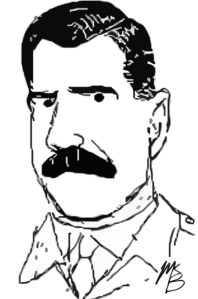
On the evening of 9th May, 1939, Lieut. Frisby in charge of a Platoon was returning from Kadourie to Acre. In the neighbourhood of Indur he saw an Arab Woman lying at the side of the road. Lieut. Frisby stopped his Platoon, and as a result of questioning the women learnt that a gang of 12 rebels was in the village. He at once surrounded it, and captured the complete gang, six of whom were in a secret underground hiding place. His prompt and intelligent action, on this, and on many other occasions, has resulted in the capture of rebels or in the obtaining of most useful information.
(Military Cross citation, 24 Nov 1939)
Born on 17 December 1911, Richard George Fellowes Frisby was commissioned into the Hampshire Regiment after graduating from RMC, Sandhurst in 1931. His father commanded the 1st Battalion in India. Frisby also served in India during the early 1930s, and earned the Military Cross during the Arab Revolt in Palestine in 1939. From 1941 to 1942, he was stationed in Washington, DC on the British Army staff.
During the North West Europe campaign, he took command of the 4th Battalion, Welch Regiment in October 1944, succeeding Lieutenant-Colonel J.M.K. Spurling on his promotion to brigadier. For heroic leadership during the Battle of Reichswald Forest on 12 February 1945, Frisby received the D.S.O.:
In these difficult circumstances Lt-Col Frisby’s coolness was an inspiration to all around. By the encouragement of his example of personal fearlessness and supreme confidence, he helped ‘B’ Coy to stabilise their position and organise quick defensive ‘stop’ … There is no doubt whatever but that for the resolute determination, cool leadership, quick thing and magnificent example of Lt-Col Frisby in personal directing an extremely difficult situation, it would not have been brough to a successful conclusion.
At the end of the war in Europe, commanding officer of the 1st Battalion, the Royal Hampshire Regiment. In 1949, he was appointed CO of 14th Battalion the Parachute Regiment and then from 1951 to 1953, he again commanded of the Royal Hampshire Regiment. As head of 24th Infantry Brigade, Frisby served in various African countries during the late 1950s. He was awarded the C.B.E. in 1958.
He was promoted to major-general of 53rd Division in 1961. While stationed in West Germany, his 21-year-old son, a private in the Royal Army Ordnance Crops attached to the division, was court martialled for attempted rape. Prior to the assault, the general’s son had been drinking heavily with a group of Canadian soldiers. His defence counsel argued that his development had always been slow and had at times been institutionalized as a “social misfit.” He had “joined the Army, without consulting anybody, in a desperate effort to prove that he was fit to take his place in society.” Private Frisby was sentence to dishonorable discharge and eighteen months in prison.
General Frisby was appointed chief of staff at Allied Forces Northern Europe in 1963, and two years later retired from the army. He collapsed and died while attending church services in Swanmore, Hampshire on 7 February 1982.

