Lieutenant-Colonel G.P. Henderson
Algonquin Regiment
Royal Highlanders of Canada (The Black Watch)
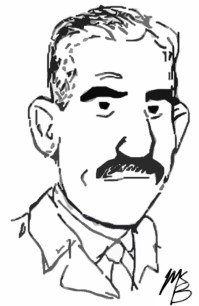
When war broke out medical officers turned him down because he was missing a toe, resulting from exposure in the north country … son of a British Consul in Italy, where he was partially educated, and speaks fluently English, French, and Italian.
(Quoted in Jarymowycz, The History of the Black Watch, Vol. 2, 56)
Gavin Paterson Henderson was born on 2 June 1904 in Livorno, Italy, where his Scottish family had operated a shipping business for three generations. Educated in Italy, Edinburgh and Switzerland, he moved to Canada as a young man, married in Montreal in 1930, and joined The Black Watch. Following overseas duties in the infantry and an anti-tank unit in 1941, he returned to be a senior instructor at RMC.
By early 1942, he was back in the United Kingdom on the general staff of the 2nd Division headquarters. Promoted to lieutenant-colonel in April, he was appointed as a general staff officer for Operations, First Canadian Army. By summer 1943, Henderson was briefly attached to Canadian forces in Sicily on special employment in the Mediterranean theatre before taking over the Algonquin Regiment, recently arrived in England under the temporary command of Major Leo Troy.
Two months later, in October 1943, Henderson rejoined the Black Watch succeeding Lieutenant-Colonel S.S.T. Cantlie, who had been assigned to the general staff with First Canadian Army as liaison officer. Finding Henderson more suited to staff work and Cantlie better fitted in command, they switch roles at the end of January 1944. Within a few months Henderson was promoted to colonel with the civil affairs staff and for a time shortly after D-Day was most senior Canadian civil affairs officer in France. Cantlie landed with the regiment a month later and was killed on 25 July.
Henderson served with civil affairs throughout the Northwest Europe campaign and served as a military governor and deputy director of the military government in occupied Germany. By the end of the war, he had been promoted to brigadier and was awarded with multiple honours including Member of the Order of the British Empire, Officer of the Order of the British Empire, and Commander of the Order of the Orange Nassau with Swords by the Dutch government. He retired from the Canadian Army in 1946 to live in the United Kingdom, divorcing his wife who had served in the Women’s Transport Corps.
He remarried the next year and in the 1950s went to live and work in Kenya. He died in Malindi on 23 September 1979.

