Lieutenant-Colonel Don Cameron
Hastings and Prince Edward Regiment
Stormont, Dundas and Glengarry Highlanders
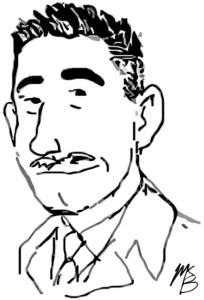
Cameron had managed a hard task with skill. He had commanded the unit through some of its best days, and through its darkest hours, and he had not failed the Regiment which had adopted him, and of which he had become a living part. His personality, with those of Kennedy, Graham, Tweedsmuir, Sutcliffe and Salmon, was deeply woven into the fabric of the unit.
(Farley Mowat, The Regiment, 369)
Born on 5 April 1911 in Lochiel, Ontario, Donald C. Cameron enlisted with the Stormont, Dundas and Glengarry Highlanders in 1926 and gained a commissioned two years later. He went overseas as a major in June 1940 and served as second-in-command of the Highlanders in England until he requested a posting to the front. He transferred to Italy in late 1943.
With frontline units suffering terrible casualties, he joined the Hastings and Prince Edward Regiment as a reinforcement officer in December 1943. Within a few months, Lieutenant-Colonel Bert Kennedy was wounded by a mine, and Cameron took command. Although regarded as “yet another outlander” newly arrived from another regiment, Farley Mowat explained that “Cameron found full acceptance within a few days after his arrival.”
Over the next ten months, he led the Hasty Ps in the hard advance up the Italian Peninsula from the Hitler Line to the Gothic Line, earning the Distinguished Service Order and Bar. His second citation read in part:
Throughout each of these actions, Lt Col Cameron handled his command with coolness, skill and great determination. As a result of the disregard for personal safety, sound judgement and inspiring leadership of this officer, the battalion under his command carried out its tasks with precision and determination which brought success to their operations, and very materially contributed to the achievement of Brigade and Divisional plans.
Following an unusually long period as a frontline battalion commander, Cameron was recalled to England in February 1945. Command passed to Major G.A. Ross, shortly before the regiment redeployed to Northwest Europe along with I Canadian Corps. After Germany’s surrender, in early May, Cameron returned to his old militia regiment, the Stormont, Dundas and Glengarry Highlanders, as commanding officer of the 3rd Battalion. Still overseas a year later, Cameron led the Canadian Army as part of the victory parade in London on 8 June 1946.
Cameron remained in the army, was appointed commanding officer of the PPCLI in August 1948, and served as a brigadier in Germany during the 1950s. He filled a term as commandant of RMC from 1962 until retirement in 1966.
He died on 3 May 1970 in Kingston, Ontario.
For more on Cameron’s biography and war service, see
http://glengarryhistoricalsociety.com/doku/doku.php?id=d.c.cameron_and_the_gothic_line

