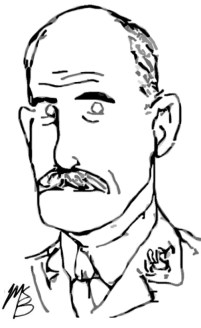
Lieutenant-Colonel R.M. Raynsford
1st Bn., Leinster Regiment (Royal Canadians)
As you are no doubt aware we, the “Royal Canadians” together with other Irish regiments are being disbanded. I am hoping you may see your way to use your powerful influence to assist us in our efforts to be retained in the British army as the Prince of Wales’s Royal Canadian Regiment, our original title.
While all ranks desire the honor of still representing Canada, I have a personal interest as my wife is the grand daughter of Sandfield Macdonald, the first Prime Minister of Ontario.
(R. M. Raynsford to the prime minister, Ottawa Journal, 14 Mar 1922, 6)
Born in London on 19 May 1877, Richard Montague Raynsford married twenty-three-year-old Daphne Mildred Pemberton in England in April 1911. The daughter of an Indian Army colonel, she was the granddaughter of John Sandfield Macdonald (1812–1872), Ontario’s first premier after Canadian Confederation in 1867. The son of a Madras Army colonel, Raynsford was commissioned a second lieutenant in the Leinster Regiment in 1897, served in the Boer War and was adjutant in the 4th Battalion until 1908.
In February 1916, he transferred from the Leinsters to take command of the 5th Connaught Rangers on the Salonika front. He transferred again in March 1917 to the Western Front and joined the 9th Devonshire Regiment as second-in-command. He assumed command in May. In September 1917, he transferred once more to be second-in-command of the 6th Connaught Rangers under Lieutenant-Colonel Richard Feilding.
During the German Spring Offensive in March 1918, as a result of high command’s failure to call off a counterattack, Raynsford led the 6th Connaught Rangers in a futile advance. They were cut to pieces. Feilding described seeing Raynsford’s condition during the retreat:
he had been shot through the body, and was being carried back under considerable difficulty on a ground-sheet. Four men, each holding a corner, were staggering under his weight, and one of these, as he saw me coming up, called out: “It’s all right, sir, you can trust us to get him out”; and so they did. They carried him under fire a mile or two.
By the end of the war, Raynsford was deputy assistant director general of transport for the British Armies in France. In September 1919, he rejoined his original regiment before the 1st Leinsters’ tour of duty in India. While Colonel-Commandant E.T. Humphreys organized the British response to the Malabar Rebellion in August 1921, command of the Leinsters passed to Raynsford. By February, troops had suppressed what colonial authorities deemed a local rebellion and executed the leaders.

Col-Comdt. Humphreys (left), Edward, Prince of Wales, Maj. Raynsford (right). NAM. 1991-02-61-1
Soon thereafter the regiment learned it would be disbanded as the British Army dissolved its southern Irish regiments. In February 1922, as acting commanding officer, Raynsford petitioned Canada’s prime minister to save the regiment, citing his personal connection to the dominion through is wife’s grandfather. Canada demurred until the War Office declared such a proposal impossible. With the old regiment dissolved in July 1922, Raynsford assumed command of the 1st Battalion, Northamptonshire Regiment. He retired from the army in 1926 and became editor of The Fighting Forces magazine, a position he held until 1950.
His perspective on war and peace appeared to be deeply affected by his wartime experience. In a 1928 letter to Basil Liddell Hart, he stressed: “We don’t want analogies of the past to emphasize the one essential: ‘there bloody well must and shall not be another Somme and Passchendaele in the future.’”
In editorials for The Fighting Forces in the 1930s, Raynsford expressed skepticism about rearmament, optimism about peace with Germany, and repudiation of RAF aerial bombing in the Middle East. In 1935 he advocated a League of Nations international force as a form of peacekeepers. He elaborated, “From what I know of the average staff officer, of our own and other countries, he will in future be as ready to work for peace instead of for war, if only he gets sufficient encouragement and becomes really interested in the idea. When that happens, we may say that all danger of a war is past.”
Raynsford died in Northamptonshire, England on 5 March 1965.

