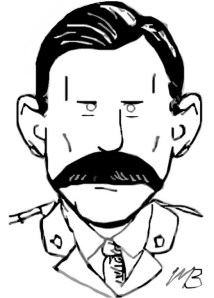
The Boer Beater

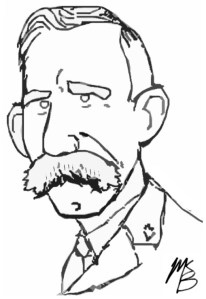
Lieutenant Colonel P. J. Daly, D.S.O.
27th (City of Winnipeg) BattalionDaly
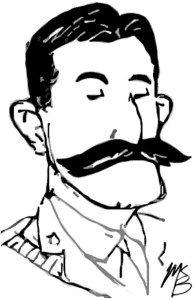
Mayor Davidson received a communication today from Lieut.-Col. P. J. Daly, commanding the City of Winnipeg battalion, now somewhere in France, stating that he had rounded up two more guns, making a total of six. He said he would donate them to the city, if desired. His worship promptly accepted the offer. Congratulations were sent to the officer. The guns will be placed eventually on historic spots in the city.

(Winnipeg Tribune, 9 Aug 1917, 5)

Patrick Joseph Daly took command of the 27th Battalion on 15 April 1916 following Lieutenant Colonel Irvine R. Snider’s nervous breakdown during the battle of St. Eloi. A native of Ireland, Daly had fought with the 6th Western Australian Mounted Infantry during the Boer War. He was seven times wounded in the South African campaign, nominated for a Victoria Cross and awarded the Distinguished Service Order. In one engagement, despite having both arms broken, Daly rode for a mile and captured over forty enemy prisoners.
Continue reading

The Accountant

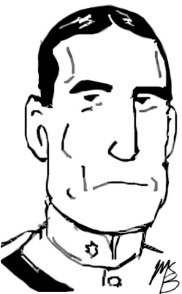
Lieutenant Colonel Walter R. Brown, D.S.O.
26th (New Brunswick) BattalionWRBrown

I see in my mind many bright, cheery figures, some of the best of our county’s stock, soldiers every inch of them—how sorry I am they are not returning with us today, and how I feel for their people. But though they are sleeping in some military graveyard in France or Belgium, I know they are not forgotten…

(Brown to People of N.B., St. John Telegraph, 1919)

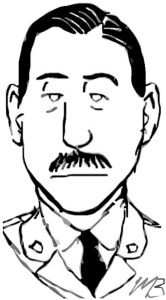
A member of the 62nd Fusiliers and Boer War veteran, Walter Richard Brown enlisted with the 26th Battalion in February 1915. He was born on 3 June 1872 in London, England. After the removal of Lieutenant Colonel James L. McAvity in May 1916 and the departure of Lieutenant Colonel A. E. G. McKenzie to an officer’s course in summer 1917, Brown assumed command of the battalion.

Continue reading

Father Christmas

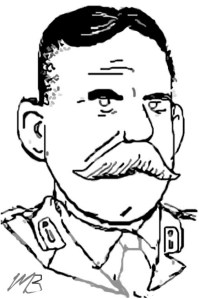
Lieutenant Colonel George B. Laurie
1st Battalion, Royal Irish RiflesLaurie

I used to be up at cockcrow when a small child on Christmas Day, to see what Santa Claus had brought me, and I shall be up early enough to-morrow in all conscience too, but for a different reason—standing to arms—so that I shall not get my throat cut.

Best of love to you for Christmas. Whilst you are in church I shall be in the trenches, but both doing our rightful duty, I trust.

(Lt-Col. Laurie to Wife, 24 Dec 1914)

On 25 December 1914, George Brenton Laurie was one of the few Canadian-born officers to witness the so-called Christmas truce in No Man’s Land. He recorded the encounter in a letter to his wife: “Then we saw both sides, English and German, begin to swarm out to meet each other; we thought it wiser to keep our men in, because we did not trust the Germans.” Suspicious, Laurie initially held his men back before going to investigate himself. As both side met, the Germans complimented the colonel on his battalion’s marksmanship and were eager to learn if the Canadian Division had arrived to the front yet. The armistice held for two days until both sides resumed the fighting.

Continue reading

The Shell Shocked

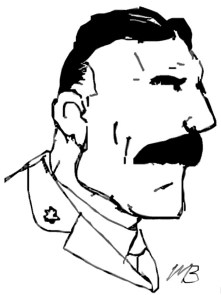
Lieutenant Colonel Irvine R. Snider
27th (City of Winnipeg) Battalion

… this officer as the result of service in France and severe nervous strain has become very emotional and is unable to sleep well except for a short time each night. He is easily exhausted and has some muscular tremor. At present he is quite unfit for any mental or physical exertion and must have prolonged rest.

(Proceedings of Medical Board, 18 May 1916)

Irvine Robinson Snider was a Manitoba farmer, long-time militiaman and veteran of the Northwest Rebellion and the Boer War. He was born on 1 January 1864 in Nobleton, Canada West. In spring 1885, the twenty-one year old Snider joined the 90th Winnipeg Rifles as a private to put down Louis Riel’s insurrection. Fifteen-years later, he served with Lord Strathcona’s Horse in South Africa.

Continue reading

The Old Soldier

Lieutenant Colonel Robert Belcher
138th (Edmonton) Battalion
Belcher

I have in mind a man who has served for many years, first in the British Army, and afterwards in the Northwest Mounted Police and then in the South African war. Finally he was authorized to raise a battalion at Edmonton. On strength of his military experience and on the strength of his personal standing, he did raise a battalion without any serious difficulty. Surely such a man with such a battalion, raised under such circumstances—surely it would be right and proper that that battalion should go to the front intact under such leadership.

(Frank Oliver, Debates, 23 Jan 1917, 76)

Criticizing the breakup of the Canadian battalions, Frank Oliver, Liberal MP for Edmonton, alluded to the experience of Colonel Robert Belcher. Born on 23 April 1849 in London, England, the sixty-seven year old soldier and policeman was “one of the real old-timers in the west.”

Continue reading

The Hockeyist

Lieutenant Colonel Francis J. Murray
61st (Winnipeg) Battalion
Murray

The local soldier hockeyists completely outclassed the Saskatchewan champions in the two-game series and proved themselves worthy holders of the coveted mug.

This performance of Colonel Murray’s men is certainly remarkable, as the cup-seekers are a redoubtable squad of players but they were unable to cope with the sensational close checking and speed of the Winnipeggers. Only in the first fifteen minutes of the first game were the Westerners really in the running, as after that they were outplayed and seldom looked dangerous.

(Winnipeg Tribune, 20 Mar 1916, 10)

Born on 23 June 1876 in Portsmouth, England, Francis John Murray was a professional soldier and twenty-two year veteran of the Imperial Army. Having fought in the Boer War, Murray was appointed to raise the 61st Battalion from Winnipeg in spring 1915.

Continue reading

The Professional

Brigadier General A. H. Bell, D.S.O.
31st (Bell’s Bulldogs) BattalionBell

Do not allow any factors to induce you to take an action contrary to the dictates of your own judgment and conscience. In many long years of military life my experience has taught me that a soldier who does so spends the balance of his career in making a series of errors, each in the vain attempt to correct the one immediately preceding, and all resulting from his first violation of sound practice.

(A.H. Bell to H.W. McGill, Medicine and Duty, 2007, 21)

Arthur Henry Bell was a professional soldier and veteran of the Boer War. Born on 16 September 1871 in King’s County, Ireland, Bell served with the Leinster Regiment, the Cape Mounted Police, the Matabele Relief Force, and the Imperial Yeomanry in South Africa. At the outbreak of the First World War, he was the commanding officer of Lord Strathcona’s Horse in Calgary.

Continue reading

The Fighter

Lieutenant Colonel Russ Boyle †
10th (Canadians) BattalionBoyle

Words will not express the absolute sense of calamity which has struck every officer and man in the battalion since we have lost him. He was our ideal of a man and a leader and I can assure you that there was not one of us who did not feel to the very limit his loss.

(Captain Ross, 10th Bn. to Mrs. Laura Boyle [wife], 27 May 1915)

Russell Lambert Boyle was one of three CEF colonels killed in action during the second battle of Ypres in April 1915. Born on 29 October 1880 in Port Colbourne, Ontario, Boyle was active in the militia from a young age. He joined the Canadian Field Artillery in 1894 and served with the 15th Light Horse. During the Boer War, he volunteered and fought in South Africa. As a resident of Crossfield, Alberta, Boyle sat on the town council and owned a ranch.

Continue reading

The Rancher

Lieutenant Colonel Norman Lang
65th (Saskatchewan) BattalionLang

No doubt, the graves of the men who have fallen in France will be as well looked after as is possible, but those who have been over there know that numbers of men have been blown to atoms. Something should be done in their honor, something that would serve as a permanent reminder of their sacrifice.

(Col. Lang, Saskatoon Daily Star, 21 Jan 1919, 17)

Born on 4 August 1879 in Exeter, Ontario, Norman Lang was a farmer and rancher in Allan, Saskatchewan. The grey-eyed, moustachioed, six-foot-three Lang was a member of the 29th Light Horse and veteran of the Boer War. In April 1915, he was authorized to raise the 65th from the Saskatoon area.

Continue reading