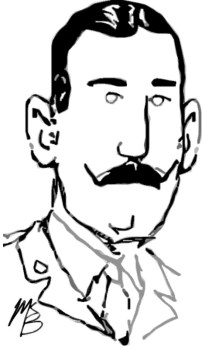
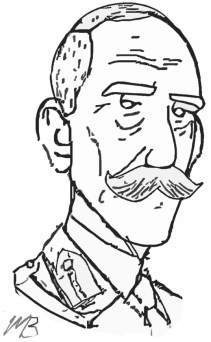
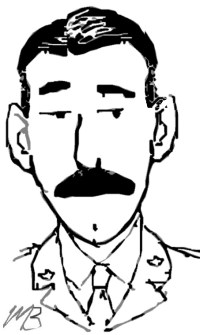
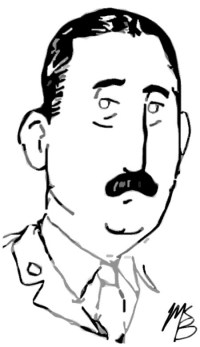
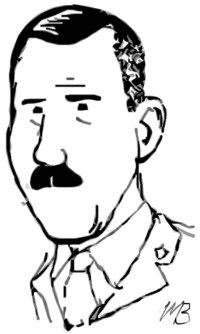
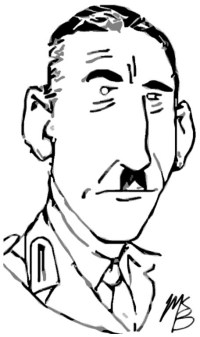
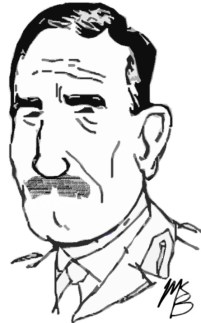
Lt. Col. Mathias & Maj. Bernard

Lieutenant Colonel T.G. Mathias
&
Major Adolph E. Bernard, M.C.
Royal Newfoundland Regiment
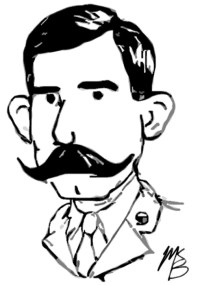
Bernard

Life is made up of meetings and partings, and we, who served side but side in the Great War, shall ever bear the memories of bitter partings from good and better friends. Those who have died have welded us together with unbreakable bonds, and it is up to those of use who are left to stand firm together.

 (A.E. Bernard, The Veteran, 1920)

Born on 12 August 1878, Thomas Gilbert Mathias had been commissioned with the Welsh Regiment since 1899. On 27 June 1918, he transferred to Royal Newfoundland Regiment to relieve Major A.E. Bernard, who had temporarily replaced Lieutenant Colonel J.S. Woodruffe. Mathias remained in command until the armistice when he was succeeded by Bernard, the first Newfoundlander to officially lead the regiment.
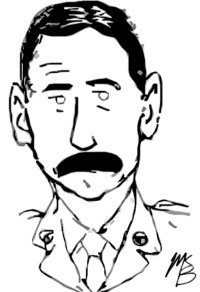
Continue reading

Lt. Col. Woodruffe

Lieutenant Colonel J.S. Woodruffe, D.S.O.
Royal Newfoundland Regiment

The new C.O., who soon gained the respect of all ranks, was with the Battalion for only six months. As might be expected, he was not the first British officer to find in the Regiment certain preferences, particularly in the matter of diet, which were unfamiliar to him.

 When invited to sample some capelin – the small, smelt-like fish which a true native of the island enjoys nibbling in an uncooked state after it has been salted, dried, and smoked – “our C.O. … tasted a bit and it nearly made him sick!”

 (G.W.L. Nicholson, Fighting Newfoundlander, 441)

On 1 January 1918, John Sheldon Woodruffe of the Royal Sussex Regiment assumed command of the Newfoundland Regiment, which had just been granted the Royal designation by the King. He was born in Hastings, Sussex, England on 2 February 1879. He had been commissioned in the Royal Sussex Regiment since 1899 and served in the Boer War.

Continue reading

Lt. Col. Burton

Lieutenant Colonel R. de H. Burton
Newfoundland Regiment
de H Burton

Lt Col. Burton was also with them and he was looking remarkable well and his hand was now quite well though one of his fingers has been slightly bent. He said he was pleased to be among us again, and I must say he certainly looked it.

(Lt. O.W. Steele, diary, 11 Jan 1916)

Born in England on 8 September 1861, Reginald de Hardwicke Burton, was a former major with the Middlesex Regiment and Boer War veteran. He had been severely wounded at the Battle of Spion Kop in January 1900 and was placed on retired army pay in 1909. On 13 November 1914, he came out of retirement to take command of the Newfoundland Regiment. In August 1915, the unit left England for Egypt before deploying to the Gallipoli Front.

Continue reading

Maj. Gen. Burstall

Major General Sir Henry Burstall
2nd Canadian Division
Burstall

General Sir H.E. Burstall who commanded the Canadian artillery in the late war, was reputed to have an iron nerve, and, in action, to have been one of the coolest men in the army. Nothing, it was said of him so quickly aroused his anger as to see a man give way to fear, even momentary fear, and he seldom let such action pass in silence.

 (Vancouver Daily World, 28 Oct 1922, 22)

Born on 26 August 1870 in Sillery, Quebec, Henry Edward Burstall was a graduate of the Royal Military College, Boer War veteran and Permanent Force artillery officer. He commanded the 1st Division Artillery from September 1914 until September 1915 when he was elevated to GOC of the Royal Canadian Artillery Corps. In December 1916, Burstall replaced Major General Richard Turner of the 2nd Canadian Division.

Continue reading

Lt. Col. Docherty

Lieutenant Colonel M. Docherty
Lord Strathcona’s Horse
Docherty

We had 200 men, the Germans about 2,000. We had no artillery support, but the Huns had all kinds. But we stopped their counter-attack. Colonel Docherty fell a few feet from me, shot dead, clean through the head.

  (LdSH soldier’s letter, Winnipeg Tribune, 29 Dec 1917)

Born in Scotland on 1 May, 1877, Malcolm Docherty was a Boer War veteran, marksman and polo player in Winnipeg. A prewar sergeant in the Lord Strathcona’s Horse, he went to France as a lieutenant in May 1915. Six months later, he received a promotion to captain and the Distinguished Service Order for gallantry.

Continue reading

Maj. Gen. Macdonell

Major General Archie Macdonell
Lord Strathcona’s Horse
MacdonnellAC

“Batty Mac, our brigade commander, was crazy as a coot in many ways, I saw him actually get wounded one day … Somebody said ‘Be careful, sir, there’s a sniper’ and he said ‘Fuck the sniper,’ climbed up to get a look and the sniper took him through the shoulder and he went ass over applecarts into his shellhole from which he had emerged … My god, his language! You could hear him for miles around!”

(G.R. Stevens PPCLI, In Flanders Field interview, 1964)

Born on 6 October 1864 in Windsor, Canada West, Archibald Cameron Macdonell earned the nickname “Batty Mac” for his disregard of danger under fire. He graduated from the Royal Military College of Canada in 1886 and joined the Canadian Militia before transferring to the North-West Mounted Police. He volunteered during the Boer War and was commanding officer of the Lord Strathcona’s Horse at the outbreak of the First World War.

Continue reading

The Boer Veteran

Lieutenant Colonel W.H. Moodie
9th Canadian Railway Troops
MoodieWH

Then the agony began. There we lay in fatal range, many had been killed outright in the charge, and all who had not good cover were in fearful danger and the groans from different points all over the field told too plainly how they were picking off our men. Those of us who had good cover had to stick to it though it was fearful to be there and listen to the calls of the wounded for help.

(W.H. Moodie letter, 13 Dec 1899)

Born in Quebec City on 22 September 1871, Walter Hill Moodie was a British Columbia civil engineer and Boer War veteran. He volunteered with the Royal Canadian Regiment of Infantry and arrived to South Africa in December 1899. In letters home to Kelso, British Columbia he recounted his journey and remarked on his and comrades’ frustration “kicking our heels impatiently for our first engagement.” Two months later he experienced the full agony of modern warfare on Blood Sunday, 18 February 1900.

Continue reading

Lt. Col. G.H. Kirkpatrick

Lieutenant Colonel G.H. Kirkpatrick
11th Canadian Mounted Rifles & 72nd Battalion
GHKirkpatrick

The outstanding fearlessness of the new C.O., Lieut-Col. G. H. Kirkpatrick, D.S.O., also calls for special notice. This was the first occasion on which he had complete command of the Battalion in an action, and his courage and coolness were an inspiration to all ranks.

(History of the 72nd Battalion, Seaforth Highlanders of Canada, 1920, 150)

Guy Hamilton Kirkpatrick succeeded Lieutenant Colonel J. A. Clark in command of the 72nd Battalion on 5 September 1918. Born on 5 November 1875 in Kingston, Ontario, he graduated from the Royal Military College in 1896 and fought in South Africa with Lord Strathcona’s Horse. His father, Sir George Airey Kirkpatrick (1841—1899), had been a Conservative MP and Lieutenant Governor of Ontario.

Continue reading

Lt. Col. Willets

Lieutenant Colonel C.R.E. Willets, D.S.O.
Royal Canadian Regiment

Willets

For conspicuous gallantry and devotion to duty. He went forward to the front line under very heavy fire and organized the defence of the position with great skill. He has at all times displayed the greatest courage and initiative.

(Willets, D.S.O. citation, 26 July 1917)

Born in Windsor, Nova Scotia on 21 May 1880, Charles Richard Edward Willets had left the Royal Military College early to serve in South Africa in 1901. After five years with the South African Constabulary, he was gazetted as a lieutenant in the Royal Canadian Regiment.

Continue reading

Brig. Gen. Hayter

Brigadier General Ross Hayter
10th Infantry Brigade
Hayter

He was a splendid example of the Royal Military College graduate, and, although all his service before the war was with the British forces, he never lost touch with Canada and never lost his Canadian spirit.

(Arthur Currie, 19 Dec 1929, 3)

Ross John Finnis Hayter was a graduate of the Royal Military College and Boer War veteran with nearly twenty years’ service in the British Army. He was born in Assam, India on 28 February 1875. He served as a brigade major with the 1st Infantry Brigade during the second battle of Ypres and later joined the staff of the 3rd Division under the command of General Louis Lipsett. Continue reading