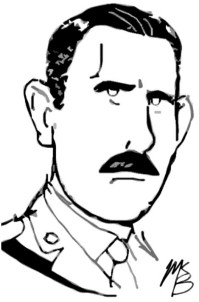
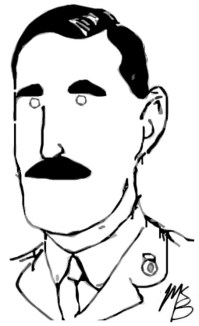
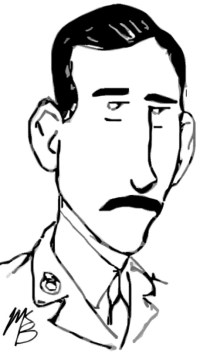
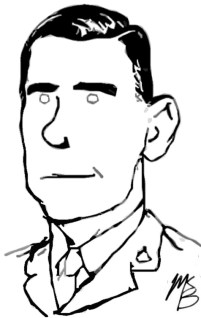
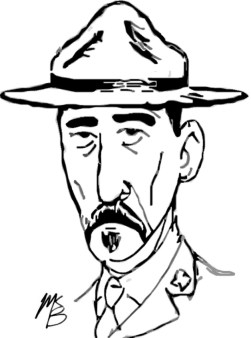
Lt. Col. Flick

Lieutenant Colonel Charles Flick
1/7th Bn., Essex Regiment & 1/6th Bn., Devonshire Regiment
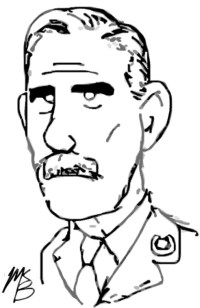
Flick

Dear Kate,— I must write you a few lines to say how much I regret my conduct towards you last evening. I can only say in my defence that a serious money loss made me ill-tempered and impatient. I hope I have not hurt you very much. Write and say you forgive me, and when you will meet me again. —Charlie

 (Illustrated Police News, 18 June 1898, 10)

In June 1898, London tailor Daniel O’Sullivan sued Lieutenant Charles Leonard Flick of the Honourable Artillery Company “for damages for the seduction of his twenty-five-year-old daughter, Kate,” with whom Flick had had an illegitimate daughter. The above letter was entered into the court record by the plaintiff’s counsel. As a result of pregnancy and alledged assault, Kate O’Sullivan had been unable to assist her father’s tailoring work. The jury found in favour of the plaintiff for £150.

Continue reading

Brig-Gen. Sweny

Brigadier-General W.F. Sweny
4th Bn., Royal Fusiliers (City of London)
Sweny

The marriage of my father to Alice Roy took place October 28, 1885, and would have occurred at an earlier day had not opposition been made to this step on the ground of the deceased wife’s sister’s relationship, which in England, though not in Canada, was then a legal bar … [she wrote] “I consider that for me there can be no higher ideal than to become a mother to my sister’s two boys and to make their home what no other woman in the world could make it.” She always called herself our mother, instead of our aunt. 

(W.F. Sweny quoted in Montreal Gazette, 20 Feb 1925, 6)

Born in Belfast on 25 June 1873, William Frederick Sweny was the son of Colonel George Augustus Sweny, a veteran of the Indian Mutiny. After the death of his mother in 1880, he and his brother were cared for by his aunt who married his father in Toronto in 1885. After Sweny graduated from RMC, in 1893, he was commissioned in his father’s old regiment, the Royal Fusiliers (City of London). He served in South Africa and Egypt before he was attached to the Canadian militia in January 1914. He transferred back to the British Army at the outbreak of the Great War.

Continue reading

Lt. Col. Wilson

Lieutenant Colonel Alex Wilson
33rd (London) Battalion

Wilson

I know more about Colonel Wilson, as a military man, than his own brother does. To my mind, he is one of the finest fellows living, even though he is a Grit … I picked him out against the wishes of everyone in London, and I am afraid they have made the old man’s road somewhat hard. He is very hard of hearing which, to my mind, accounts for all the trouble on his part.

 (Sam Hughes to Robert Borden, 12 Nov 1915)

Born on 17 November 1855 in Seaforth, Canada West, Alexander Wilson was pharmacist with thirty-five years’ experience with 33rd Huron Regiment. A noted marksman, Wilson was a five-time member of Canada’s Bisley team and won several Dominion Rifle Association awards. By the time he was appointed to lead the 33rd Battalion in late 1914, he was, however, past his prime.

Continue reading

Lt. Col. Jamieson

Lieutenant Colonel Fred Jamieson
260th Battalion, Siberian Expeditionary Force
Jamieson

I do not think that the war will end in any way but as the Allies wish. It is impossible for it to end otherwise but to accomplish this end it will require the assistance of all available men between the ages of eighteen and forty. With the magnificent army of men that have gone to the front there are needed the additional half million …

It isn’t really boasting when I say that nearly every good idea since 1925 has come from the Conservatives.

(Northern Tribune, 20 June 1935, 1)

Born on 18 May 1875 in North Gower Township, Ontario, Frederick Charles Jamieson was commanding officer of the 19th Alberta Dragoons and veteran of the Boer War. He moved to Edmonton in 1895 and started a law firm with Alexander Rutherford, who became the first premier of Alberta. In August 1914, Jamieson led the 19th Dragoons to Valcartier and took command of the 1st Divisional Calvary Squadron.

Continue reading

Lt. Col. Goodday

Lieutenant Colonel C. Goodday
Lord Strathcona’s Horse

The Regiment saddled up & “stood to” ready if needed to assist in or take advantage of a counter attack being delivered on the eastern side of the river. At 8 pm orders were given to oft-saddle and rest for the night. Major C. Goodday having rejoined from leave took over the command of the Regt.

(LdSH war diary, 31 March 1918)

Born in London, England on 25 October 1880, Claud Goodday was a British Columbia cricket player and self-styled gentleman. He had been commissioned as a lieutenant and adjutant with the Fort Garry Horse in 1913 and went overseas with Lord Strathcona’s Horse in October 1914. He swiftly rose through the officer ranks and was a major by August 1916. He temporarily assumed command after Lieutenant Colonel D.J. MacDonald was wounded on 30 March 1918

Continue reading

The Golfer

Lieutenant Colonel A.E. Griffin, D.S.O.
5th Battalion, Canadian Railway Troops
Griffin

His hobby is golf. In it he finds physical exercise and mental relaxation from the enterprises, some of which have been the most important railway construction jobs in the British Columbia mountains.

(Vancouver Sun, 16 Jan 1921, 11)

Born in Ontario on 17 September 1877, Atholl Edwin Griffin was a Vancouver civil engineer and contractor in the firm of Jack Stewart. In November 1916, he was commissioned in Stewart’s Canadian Railway Troops and given command of the 5th C.R.T. For two years service in France carrying out important construction operations, he received the Distinguished Service Order. The experience, however, wore down his health and required rest leave. particularly spring 1918 following the German offensive.

Continue reading

Maj. Pearson

Major A.G. Pearson
Princess Patricia’s Canadian Light Infantry
Pearson

After practically all the garrison at the front trenches had been killed or wounded by enemy shell fire, L/Cpl Pearson with a few men still held on and fortunately although wounded himself managed to bring out the survivors in safety after a new position had been taken up.

(Pearson, DCM citation, 14 Jan 1916)

Born in Endon, Staffordshire, England on 16 August 1880, Alfred Glynn Pearson was shipping agent who enlisted as a private in Winnipeg in December 1914. He was one of the few non-commissioned volunteers to rise through the ranks and command a battle by the end of the war. While serving as a corporal with the PPCLI, he received the Distinguished Conduct Medal and a promotion to lieutenant. After recovering from shrapnel wounds, Pearson rejoined the PPCLI in spring 1916.

Continue reading

Lt. Col. Phinney

Lieutenant Colonel E.C. Phinney
85th (Nova Scotia Highlanders) Battalion
Phinney

Nothing is so picturesque or evokes so much human interest as the rapid rise of a young man to high and important positions. This is true of a civilian and truer of a soldier … A six-footer, every inch of his body compacted of sound bone and muscle, it might have been expected that he was born to be a stalwart athlete and a leader of men. His career is proof of the fact.

(Evening Mail, 11 Mar 1916, 7)

Born in Bear River, Nova Scotia on 16 May 1886, Earle Caleb Phinney was an all-round athlete and graduate of Dalhousie Law School. He joined the 40th Battalion as a lieutenant and by March 1916 was a major in the 85th under Lieutenant Colonel Allison Hart Borden. When Borden was elevated to command the Highlander Brigade (85th, 185th, 193rd, 219th Battalions), Phinney assumed command of the 85th. After arriving in England in October 1916, the brigade was broken up. Only the 85th Battalion would go to France.

Continue reading

The Scout Master

Lieutenant Colonel J.A. Hesketh
Lord Strathcona’s Horse

Among the citizens of Winnipeg, such men as Col. Hesketh is deserving of special praise and honor for his interest in our boys. His objective was not to teach them war, nor turn their thoughts in enmity towards any people. But he was one of the men who taught them the national need of rigid adherence to paths of duty.

(Winnipeg Tribune, 3 May 1921, 4)

Born in Aldershot, England on 20 November 1863, James Arthur Hesketh was a graduate of the Royal Military College and a Canadian Pacific Railway engineer in Winnipeg. He was a early leader of the Boy Scout movement and helped to organize the first scout council in Manitoba. With over thirty years in the Canadian militia and as commander of the Corps of Guides, Major Hesketh went to overseas with Lord Strathcona’s Horse in October 1914.

Continue reading

Brig. Gen. MacBrien

Brigadier General James H. MacBrien
12th Canadian Infantry Brigade

The ending of war involves the most fundamental modification of the whole structure of society, and can only be brought about by a reversal of the general method of human life and the general method of nature which up to this time has been manifested in the survival of the fittest. I think that until we see a complete change of heart in human society we should prepare our sons to fight and quickly organize that they may have as chance of success. The league of nations as a means of definitely preventing war is about as likely to succeed as a proposal to abolish hunger and death.

(Maj. Gen. MacBrien in the Weekly Albertan, 1 Dec 1920, 2)

Born in Myrtle, Ontario on 30 June 1878, James Howden MacBrien was a North-West Mount Police constable when he joined the South African Constabulary during the Boer War. A few years after he returned to Canada, he was commissioned in the Royal Canadian Dragoons in 1910. In September 1914, he joined the 1st Canadian Division headquarters as a staff officer at the rank of lieutenant colonel. Two years later he replaced Lord Brooke in command of the 12th Infantry Brigade.

Continue reading