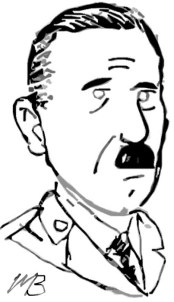
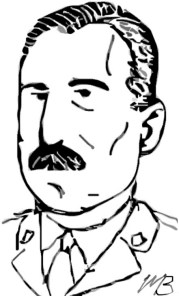
Colonel Runaway

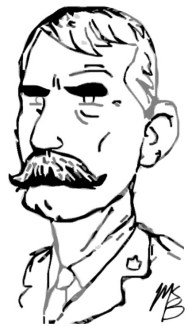
Colonel Jack Currie, M.P.
15th (48th Highlanders) Battalion
CurrieJA

As was the case to be in many Canadian battalions, Lt.-Col. Currie was an M.P. and very much more of a politician than an officer.

 He was one of the type of civilian-soldier who is simply worshipped by the poorer element among the ranks, but to serve under whom, for an officer, is sheer misery.

(Lt. Ian Sinclair, 13th Bn. personal diary)

The conduct of John Allister Currie at the second battle of Ypres in late April 1915 was the subject of much controversy and insinuation. According to some of his men in the 15th Battalion, he had fought “like a hero” with rifle and bayonet. However, by most accounts, Currie remained in a dugout well behind the lines, shell shocked and possibly drunk during the German gas attack on his unit at St. Julien.

Continue reading

The Councillor

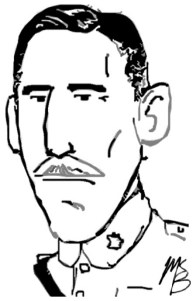
Lieutenant Colonel Dan McLean
101st (Winnipeg Light Infantry) Battalion
McLean

If Canada, a self-governing nation, as part of the British Empire, but free and independent, should be attacked, what would Great Britain do? Every one knows she would fly to our assistance with all her forces. Canada will not do less. Every Canadian should be prepared, and I believe is prepared, to stand shoulder to shoulder for the unity of the Empire.

 (McLean to Montreal Daily Star, 3 Aug 1914)

 In anticipation of war with Germany, Daniel McLean, commanding officer of the 106th Winnipeg Light Infantry transmitted the above message vowing to support the Empire. McLean was a Winnipeg city councillor and Conservative member of the Manitoba legislature (1914—1915). Born on 4 January 1868 in Scotch Block, Ontario, he had moved to Winnipeg in 1893 and organized the 106th in 1912.

Continue reading

The Court Martialled

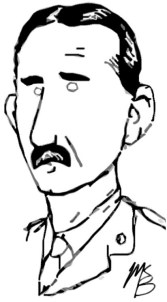
Lieutenant Colonel V. V. Harvey
54th (Kootenay) BattalionHarvey

In view of this incident I no longer have confidence in Lt-Col. HARVEY and I recommend that he be removed from the command of the 54th Battalion and returned to England where he may be otherwise employed. I would not again send the Battalion into action under his command.

(Gen. Odlum, 11th Brig. to 54th Bn., May 1917)

Between 11:00am on 21 May and 8:00am 22 May 1917, Valentine Vyvian Harvey, his acting second-in-command, Jesse Wright, and the battalion adjutant went absent without leave from camp. For nearly a full day, the 54th Battalion was without its commanding officer. When General Odlum attempted to contact the 54th CO for a 11th Brigade meeting, Harvey was nowhere to be found.

Continue reading

The Conducting Officer

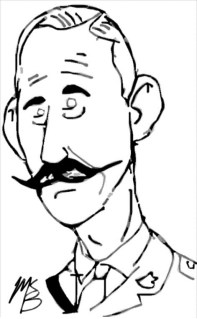
Lieutenant Colonel Percy Domville
164th (Halton and Dufferin) Battalion
Domville

He has been a faithful officer for many years. I have had no report as to what his misdeeds were as Conducting Officer… His is a sad and serious case as he has a wife and two children and his job with the Westinghouse people was filled when he was away.

(Gen. Mewburn to Gen. Ashton, 8 Apr 1918)

 A native of Belfast, Ireland, Percy Domville was born on 4 June 1867. After immigrating to Canada, he became a mechanical engineer in Hamilton and joined the 13th Regiment. He spent thirty years in the militia and was appointed to the Shell Commission in Ottawa after the outbreak of the Great War.

Continue reading

The Enabler

Lieutenant Colonel Dr. David C. McKenzie
141st (Border Bull Moose) Battalion
DCMcKenzie

It is unfortunately clear that members of the battalion are using drugs, and I am of the opinion that neither Lieut. Col. McKenzie nor Captain George are making any effort to check this pernicious and demoralizing habit.

(Gen. H. N. Ruttan to GOC, MD 10, 21 Apr 1917)

 Born on 30 October 1871 in Hamilton Ontario, David Croal McKenzie was a militiaman, municipal politician and physician. He started a medical practice in the Rainy River District after graduating from the University of Toronto in 1897 and established the first private hospital at Fort Frances in 1902. He was later a six-term mayor of Fort Frances (1906, 1913, 1914, 1915 and 1919).

Continue reading

The Auditor

Lieutenant Colonel A. C. Kemmis
13th Canadian Mounted Rifles
Kemmis

Confidentially Kemmis is a drunken incompetent and his appointment will be regarded [as a] joke.

(R.B. Bennett to Borden, 14 Dec 1914)

The son of a British Army officer, Arthur Charles Kemmis was born in Fredericton, New Brunswick on 10 February 1874. He spent his youth in England and Ireland before returning to Canada in the 1890s. He moved west to establish a law practice at Pincher Creek. He formed the 23rd Alberta Rangers in 1910. In December 1914, Kemmis was authorized to organize the 13th Mounted Rifles based in his hometown.

Continue reading

The Governor General

Major Georges Vanier, D.S.O., M.C.
22nd (Royal French Canadians) Battalion
Vanier

I need not tell you that after the shock of losing a leg and the consequent inaction I am not in good condition.

 I am happy at the thought that I had the courage to return to my boys in 1916 and that God gave me the strength of body and mind to do my duty under fire. It is a tremendous consolation that will comfort me until my dying day.

 (Vanier to Mother, 13 May 1919)

Georges-Philéas Vanier was one of Canada’s most well-known veterans of the First World War. He became a high-ranking military officer, diplomat and 19th Governor General of Canada. Born in Montreal on 23 April 1888, Vanier was a graduate of Université Laval and a lawyer. In early 1915, he helped organize the 22nd Battalion under the command of F. M. Gaudet. After four years in the trenches, he had been shell shocked, multiple times wounded and lost his right leg.

Continue reading

The Banker’s Son

Lieutenant Colonel Hugh F. Osler
174th (Cameron Highlanders) Battalion
Osler

It makes me mad to see hundreds of fit men, a great many of whom can undoubtedly be spared, walking about and going to picture shows, without any thought of enlisting, when ten thousand of their fellow Canadians are either giving up their lives or being wounded every month.

(Hugh Osler to Edmund Osler, 8 Nov 1916)

Born in Toronto on 17 November 1881, Hugh Farquharson Osler was the son of Edmund Boyd Osler (1845—1924), prominent financier, banker and Tory politician. The elder Osler was Conservative MP for Toronto West between 1896 and 1917. After graduating from the Royal Military College, Hugh moved to Winnipeg where he worked for a corporate investment firm.

Continue reading

The Athlete

Lieutenant Colonel C. W. MacLean
207th (MacLean’s Athletes) Battalion
MacLeanCW

We are about to enter into that phase of our career for which we were organized. Our next step takes us overseas where we shall await the call that sends us to the front. When the call comes—it will find us ready and eager, and fit—due to the hard work and enthusiasm of every member of the Battalion.

(MacLean, The Whiz Bang, 18 Nov 1916, No. 20, 1)

Born in Lachine, Quebec on 18 November 1876, Charles Wesley MacLean was a farmer in Pointe Claire and mayor of Brockville. A member of the 13th Scottish Light Dragoons, he first raised the 2nd Reserve Park, C.A.S.C., which he took to England in May 1915. After returning back to Canada, in February 1916 he was authorized to organize the 207th Battalion from Ottawa-Carleton. A noted athlete, football player, swimmer and champion oarsman before the war, MacLean encouraged sports and competition for the 207th.

Continue reading

The Francophone

Brigadier General Tommy Tremblay
22nd (Royal French Canadians) Battalion
Tremblay

I am confident that the French Canadians will defend all their trenches with fierce vigour and will hold on at any price, even the price of death. Let us not forget that we represent an entire race and that many things—the very honour of French Canada—depend upon the manner in which we conduct ourselves. Our ancestors bequeathed to us a brave and glorious past that we must respect and equal. Let us uphold our beautiful old traditions.

 (Tremblay, Diary, 1916)

Thomas-Louis Tremblay would prove to be the 22nd Battalion’s most famous commanding officer. Notorious for his strict discipline, he was determined to prove the only all French-Canadian unit serving in the field was the finest in the CEF. Born in Chicoutimi, Quebec on 16 May 1886, he was a graduate of the Royal Military College, a civil engineer and member of the 1st Canadian Field Artillery.

Continue reading