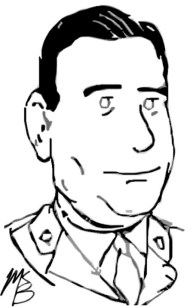
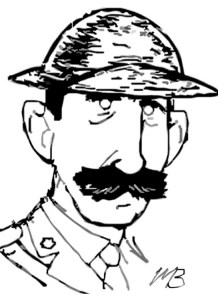
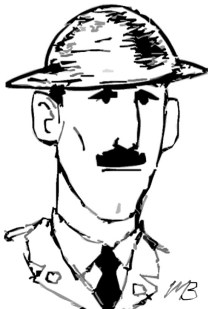
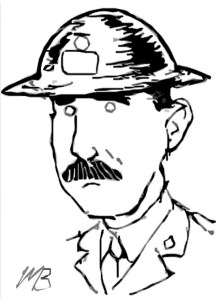
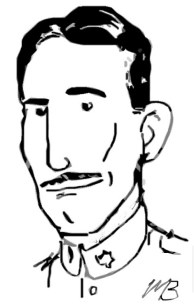
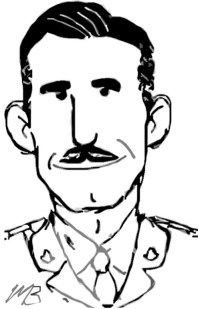
Lt. Col. Wright

Lieutenant Colonel Jesse Wright
169th (109th Regiment) Battalionwright

“Vote for King,” shouted a man.

 “There is a friend over there that says he is going to vote for Mr. King,” said Col Wright, pointing to a man in the hall. “But one King is enough for Canada. That is his majesty King George and not Mackenzie King who claims his ancestry from a man who was a blooming traitor” and Col. Wright sat down amid a storm of cheers and jeers.

(Toronto Star, 3 Dec 1921, 9)

 Born on 9 July 1877 in Collingwood, Ontario, Jesse Green Wright was a Toronto druggist, member of Loyalist Orange Lodge No. 900 and militiaman. He had belonged to the Queen’s Own Rifles and the 12th York Rangers. After outbreak of the Great War, he joined the new 109th Regiment organized by William Thomas Stewart. In January 1916, Wright received authorization to raise the 169th Battalion from Toronto.

Continue reading

Lt. Col. DesRosiers

Lieutenant Colonel H. J. M. R. DesRosiers
163rd (Canadien-Français) and 22nd Battalionsdesrosiers

I do not believe a more competent O.C. than Lieutenant Colonel DesRosiers could be found in the C.E.F. The breaking up of the battalion would demoralize us. If allowed to go to the front as a unit, we will try our best to be a source of pride to our race and credit to Canada.

(Maj. Asselin to Arthur Mignault, Nov 1916)

Henri Joseph Marie Romeo DesRosiers was born in Vaudreuil, Quebec on 11 July 1880. A prewar member of the 65th Regiment, DesRosiers enlisted with the 14th Battalion in August 1914. A veteran of Second Ypres, DesRosiers was recalled to Canada in early 1916 to take command of a new French-Canadian battalion.

Continue reading

The Clerk

Major John P. Girvan
15th (48th Highlanders) Battalion

girvan

He personally attacked and captured an enemy machine gun, shooting the gunner and turning the gun on the enemy. He went on and assisted in capturing Chapel Corner and the village of Marquion, and then gained his final objectives. His courage and dash were a fine example to his command.

(Bar to D.S.O., 4 Oct 1919, 12218)

Born in Kingarth, Scotland on 27 November 1887, John Pollands Girvan was a champion rower and mail sorter in the Toronto general post office. He enlisted with the 15th Battalion as a private and rose through the ranks to end the war as a major and second-in-command.

Continue reading

The Cricketer

Lieutenant Colonel Billy Marshall, D.S.O.
15th (48th Highlanders) Battalionmarshall

The list of honors for the second battle of Ypres was out and my name had been omitted.

 I was pleased, however, to see that Major Marshall, my second in command whom I had recommended for “mention in dispatches,” had received a D.S.O. He was a professional soldier and this meant much more to him than it did to me. He was later to fall in the front line trenches the victim of a German sniper. A great athlete, a splendid soldier, a universal favorite, Canada and the Empire could ill spare such a man. His solicitude for his men was such that I have known him to give his clothing to some ailing private. He was one of the bravest, truest and kindest of Canadians.

(J.A. Currie, The Red Watch, 1916, )

William Renwick Marshall was an amateur athlete and Boer War veteran with over twenty years’ service in the militia. Born in Hamilton on 20 March 1875, he played cricket while a student at Upper Canada College and toured the United States and Britain with the Canadian Zingari between the 1890s to the 1910s. He fought bravely at the second battle of Ypres and shortly thereafter assumed command of the 15th Battalion.

Continue reading

The Chief

Lieutenant Colonel A. T. Thompson
114th (Brock’s Rangers) Battalionthompson

The ancestors of these men fought for Great Britain in every battle on the Niagara frontier in the War of 1812, and were with General Brock in large numbers when he fell at Queenstown Heights. To this day they venerate his memory, and the name for which I ask, Brock’s Rangers would greatly add to our prestige with them, and gratify them exceedingly.

(A.T. Thompson to Militia Department, 25 Mar 1916)

 Andrew Thorburn Thompson was editor of the Canadian Military Gazette and Liberal MP for Haldimand and Monck (1900—1904). Born on 27 May 1870 in Indiana, Ontario he belonged to a prominent Ontario Liberal Party. His father had been a provincial politician and his grandfather had fought in the War of 1812. A member of the 37th Haldimand Rifles since 1893, Thompson took command of the 114th Battalion after the death of the original colonel, E. S. Baxter on 15 February 1916.

Continue reading

The Idler

Lieutenant Colonel Donald Sharpe, M.P.P.
176th (Niagara Rangers) Battalion

dsharpe

A large number of officers who will not go to the front, who it is known do not intend to go to the front, and who are deriving pay from the Government simply as officers being practically on a holiday.

(W. M. German, Debates, 6 Feb 1917, 560)

Criticizing the Borden Government’s recruitment system, William Manley German, Liberal MP for Welland referred to the conduct of Donald Sharpe’s 176th Battalion, based in St. Catharines. Sharpe was the Conservative member for Welland in the Ontario provincial legislature. He had won a by-election on 29 June 1914, one day after the assassination of Archduke Franz Ferdinand of Austria.

Continue reading

The Voter

Lieutenant Colonel Joseph Glenn
96th (Canadian Highlanders) Battalion

Col. Glenn’s record in the House has been excellent. A quiet man, and not to be considered in any sense one of the orators of the House, he has nevertheless contributed not a little to its progressive spirit …

Col. Glenn is overseas now. He took over a fine battalion of men. When he found that he was unable to get into the trenches in the capacity of a commanding officer he managed somehow to revert to the rank of Lieutenant and as lieutenant he is in the trenches today. How he managed it will remain probably a military secret. He is not a young man by any means but he is doing his duty in a way that shames many a young man in Canada.

(Saskatoon Daily Star, 20 Jun 1917, 4)

Joseph Glenn was the Conservative member for South Qu’Appelle in the Saskatchewan legislature from 1912 to 1921. Born on 29 August 1860 in Owen Sound, Canada West, he moved to the North West Territories during the early 1880s. Settling in Indian Head, he built a farm, imported horses, worked in the lumber trade, acted as the local mail carrier and operated a grain elevator. During the 1885 Rebellion, he volunteered as a dispatch rider for General Middleton and Major Sam Steele.

Continue reading

The Prohibitionist

Lieutenant Colonel J. E. Hansford
203rd (Hard and Dry) Battalionhansford

He has also on different occasions intimated that he does not want to return to Canada, and has given the impression that he would “stall” off his return as long as possible.

 He is the most unsatisfactory officer I have had to deal with, and since he has wilfully disobeyed an order and made a false statement, I think that disciplinary action should be taken … should he again return to this area, he will be placed under arrest.

(Col. Smart, Officer Commanding, Shorncliffe, 19 Oct 1917) 

The son of Reverend William Hansford of Quebec, Jeffrey Ellery Hansford was born on 17 November 1864. He graduated from the University of Toronto and belonged to Loyal Orange Order No. 1307. A member of the 90th Winnipeg Rifles and major with the 144th Battalion, Hansford received authorization to raise the 203rd in February 1916.

Continue reading

The Vilified

Lieutenant Colonel W. E. Seaborn
210th (Frontiersmen) BattalionSeaborn

While from the nature of the case the fact is difficult to prove, this man Seaborn is also by common reputation at Camp Hughes, and even among the Headquarters Staff at Camp Hughes, known to be a sexual pervert (Sadist), which in itself constitutes every reason why he should not be permitted to retain an important military appointment and remain in command of men.

(Maj. Erskine-Tulloch to Borden 26 Dec 1916)

Born on 25 January 1880 in London, Ontario, Walter Ernest Seaborn was a Saskatchewan barrister and insurance broker. He also had the distinction of owning the first automobile in Moose Jaw in 1906. He originally enlisted with Lieutenant Colonel Francis Pawlett’s 128th Battalion before transferring to command the 210th in March 1916.

Continue reading

Canadian Military History Article

Link to my most recent publication in CMH:

“Absolutely Incapable of ‘Carrying On:’”
Shell Shock, Suicide, and the Death of Lieutenant Colonel Sam Sharpe

Sam Sharpe

Abstract

This article examines Canadian social and medical responses to nervous breakdown and suicide in the First World War through the case study of Lieutenant Colonel Sam Sharpe, a Member of Parliament and commander of the 116th Battalion. An historical analysis of Sharpe’s experiences and reaction to war trauma provides wider insights into how shell shock and military suicide represented a potential threat to prewar masculine ideals. Medical and political interpretations of Sharpe’s breakdown initially aimed to preserve social stability and validate the war’s moral justifications but contradictory understandings of shell shock ultimately made for a complicated and unstable process of commemoration.

Barrett, Matthew (2016) ““Absolutely Incapable of ‘Carrying On:’” Shell Shock, Suicide, and the Death of Lieutenant Colonel Sam Sharpe,” Canadian Military History: Vol. 25: Iss. 1, Article 19. Available at: http://scholars.wlu.ca/cmh/vol25/iss1/19