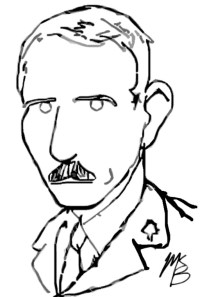
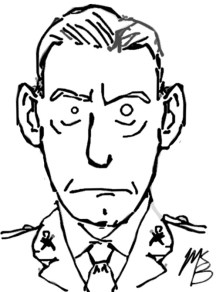
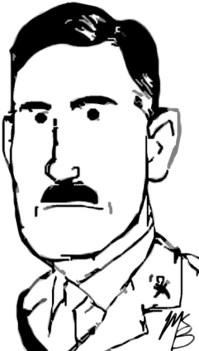
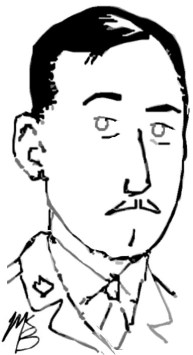
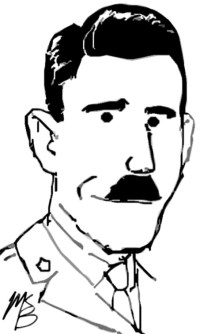
Lt. Col. Malone

Lieutenant Colonel W.P. Malone
208th (Irish Fusiliers) Battalion
Malone

The principal feature of yesterday’s casualty lists was the number of correction which had to be made, some unhappily, for the worse, others for the better.

(Toronto Globe, 8 June 1916)

On 5 June 1916, the Toronto press reported Captain Willard Park Malone of the 15th Battalion killed in action. Born in Owen Sound, Ontario on 3 March 1883, he was reputedly the first man to enlist from his district. Several days after his reported death at the battle of Mont Sorrel, his wife received a cable from Malone stating he was “quite well.” Continue reading

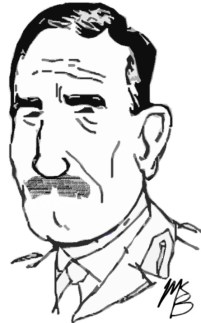
Lt. Col. Beaubier

Lieutenant Colonel Dave Beaubier
181st (Brandon) Battalion
Beaubier

Dave Beaubier had a genius for friendship, and a love of all classes and creeds, which bespeak that broad-minded type of charity, religion and friendship which enriches life.

(R. J. Manion, Debates, 13 Jan 1939, 7)

David Wilson Beaubier was born in St. Mary’s, Canada West on 21 May 1864. He was an early pioneer to Manitoba in the 1880s and established himself as a farmer. A captain with the 99th Manitoba Rifles, Beaubier assumed command of the 181st Battalion after the death of Lieutenant Colonel G. W. Bruce, who had succumbed to injuries from an accident in April 1916.

Continue reading

The Logger

Colonel J.B. White
242nd (Foresters) Battalion
JBWhite

He came to me and told me he would guarantee to raise me a French Canadian battalion inside of two weeks. I said “God bless you my boy, go ahead, I will give you every help I can.” But I never dreamt he would get them.

Inside of two weeks Colonel White came to me and said: “The jig is up; we cannot raise the men.”

(Hughes, Debates, 5 Apr 1918, 411)

John Burton White was a lumberman and sawmill manager in the Ottawa Valley. He was born on 1 January 1874 in Aylmer Road, Quebec. A senior officer with the 17th Hussars, he enlisted as a major with Alexander McDougall’s 224th Battalion in April 1916. He left with the forestry unit for England but was recalled home two months later to raise a new lumber battalion from Quebec.

Continue reading

The Lumber King

Major General Aleck McDougall
224th (Lumbermen’s) Battalion
Macdougall

Many of these men have left families at home, and are looking forward to rejoining them at the end of the war, and it is a scandal that the minds of these people should be disturbed by the thoughts that our soldiers are in the midst of dire temptation and are falling victims to it, when as a matter of fact the behaviour of the men of this corps since its formation has been exceptionally satisfactory and it is my opinion when they return home they will demonstrate that their overseas activities have improved them in every way.

(MacDougall to Montreal Gazette, 25 Apr 1918, 10)

In February 1916, British Colonial Secretary Bonar Law requested the Canadian Government provide a special battalion of lumbermen for overseas service. Ottawa timber magnate Alexander McDougall, who had proposed a forestry unit, was quickly appointed commander of the 224th Battalion. Born in Renfrew, Ontario in January 1878, McDougall was an experienced woodsman and leading figure in the North American lumber industry. Continue reading

Lt. Col. Gordon

Lieutenant Colonel H.D.L. Gordon
4th Canadian Mounted Rifles
Gordon

Canadian accounting principles are whatever Clarkson Gordon does.

(Col. Gordon quoted in Stephen Azzi, Walter Gordon and the Rise of Canadian Nationalism, 16)

Harry Duncan Lockhart Gordon was born in Toronto on on 29 July 1872. After attending Upper Canada College and the Royal Military College, Gordon trained as an accountant in England. By the outbreak of the Great War, he had become a prominent Toronto businessman in the accounting firm Clarkson Gordon & Co and commanding officer the 9th Mississauga Horse. He joined the 4th CMR as a major in December 1914.

Continue reading

Lt. Col. S.F. Smith

Lieutenant Colonel Sandford F. Smith
4th Canadian Mounted Rifles
SmithSF

This Officer while on training duty in France was thrown by his horse and sustained a fracture of the head of the left humerus. He was evacuated to England June 10th 1917, and has been a patient at Helena Hospital until to-day, when he was discharged as completely recovered.

(Proceedings of Medical Board, 1 July 1917)

Born in Peterborough, Ontario on 4 May 1873, Sandford Fleming Smith was the grandson of famed Scottish-Canadian engineer Sir Sandford Fleming. Smith was a Toronto architect, former member of the Queen’s Own Rifles and commanding officer of the Governor-General’s Body Guard.

Continue reading

Lt. Col. Patterson

Lieutenant Colonel W.R. Patterson
4th Canadian Mounted Rifles
Patterson

MISTAKEN IDENTITY

J.M. Patterson, ex-Mayor of Paris this morning expressed doubt that it is his son, Lt.-Col. W.R. Patterson who was yesterday reported to have been raised to the rank of Brigadier. Lt.-Col. Patterson is in command of the 4th CMR, while another officer, Lt.-Col. R.W Paterson, attached to the Fort Garry Horse, is the on who has received promotion. Similar confusion has arisen before as both officers have won the D.S.O.

(Brantford Courier, 5 June 1918)

William Reginald Patterson was born on 1 December 1884 in Paris, Ontario where he father was later three time mayor. The younger Patterson worked in his father’s grocery and glassware store before enlisting in the 4th Canadian Mounted Rifles, which by the end of the war he would command. Their very similar last names and reversed initials meant he was frequently confused with Brigadier Robert Walter Paterson of the Canadian Cavalry Brigade.

Continue reading

Lt. Col. Stevenson

Lieutenant Colonel H.I. Stevenson
1st Canadian Mounted Rifles and Fort Garry Horse
Stevenson

When our line was temporarily pierced, he led a charge with great skill and dash, by which the enemy were driven back and a new line established. He succeeded in establishing communication with the troops on his right flank, and though heavily outnumbered maintained this line until relieved by fresh infantry units. His prompt action and cool leadership were the means of allowing two battalions of infantry, who were in danger of being cut off, to withdraw safely to our line.

 (D.S.O. Citation, Gazette, 22 June 1918)

Herbert Irving Stevenson was in Richibucto, New Brunswick on 17 July 1878. After serving in the Boer War he moved west to Manitoba in 1903. He began working for the Dominion Forestry Service in 1912. He organized the 1st Canadian Mounted Rifles in December 1914 but was replaced a year later when the mounted rifles became infantry.

Continue reading

The Chronicler

Lieutenant Colonel G.C. Johnston
2nd Canadian Mounted Rifles
GCJohnston

I had the honour of a visit from General Currie, one I did not at all appreciate, as he at once proceeded to reduce me to a nervous wreck by putting me through a whole catechism of questions as to where I was to go, and what I would do with my company in the event of the Huns breaking through the front line. At this point, when I was thoroughly uncomfortable, the Bosche commenced to shell the hill and some shrapnel, coming through the roof, wounded one of our batmen, Hawkins, broke a window and ended the interview, much to my relief.

(G. Chalmers Johnston, 2nd CMR in France and Flanders, 18)

George Chalmers Johnston was born in London, England on 21 April 1874. A general agent in British Columbia with the 30th B.C. Horse, Johnston enlisted as a captain with Lieutenant Colonel J.C.L. Bott’s 2nd Canadian Mounted Rifles. After their first tour of duty in the trenches in October 1915, Johnston described the soldiers, “Weary, unshaven and plastered with mud as they were, they looked a very different lotbut in those few days in the line, green troops as they were, they had found themselves and laid the foundation for the traditions and success in action which have made the reputation of the battalion second to none in the war.” Continue reading

Lt. Col. G.H. Kirkpatrick

Lieutenant Colonel G.H. Kirkpatrick
11th Canadian Mounted Rifles & 72nd Battalion
GHKirkpatrick

The outstanding fearlessness of the new C.O., Lieut-Col. G. H. Kirkpatrick, D.S.O., also calls for special notice. This was the first occasion on which he had complete command of the Battalion in an action, and his courage and coolness were an inspiration to all ranks.

(History of the 72nd Battalion, Seaforth Highlanders of Canada, 1920, 150)

Guy Hamilton Kirkpatrick succeeded Lieutenant Colonel J. A. Clark in command of the 72nd Battalion on 5 September 1918. Born on 5 November 1875 in Kingston, Ontario, he graduated from the Royal Military College in 1896 and fought in South Africa with Lord Strathcona’s Horse. His father, Sir George Airey Kirkpatrick (1841—1899), had been a Conservative MP and Lieutenant Governor of Ontario.

Continue reading