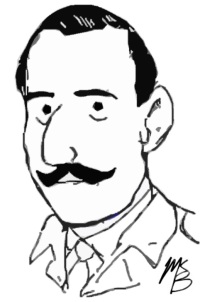
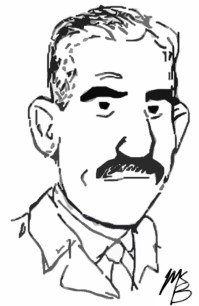
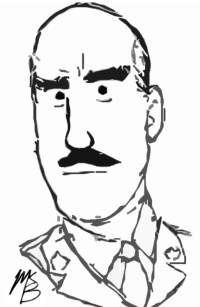
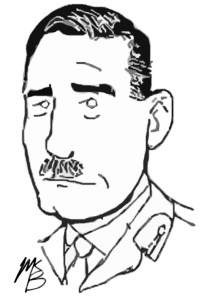
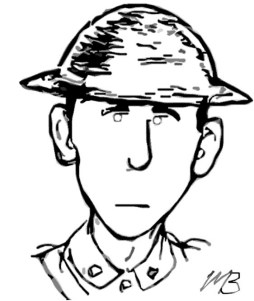
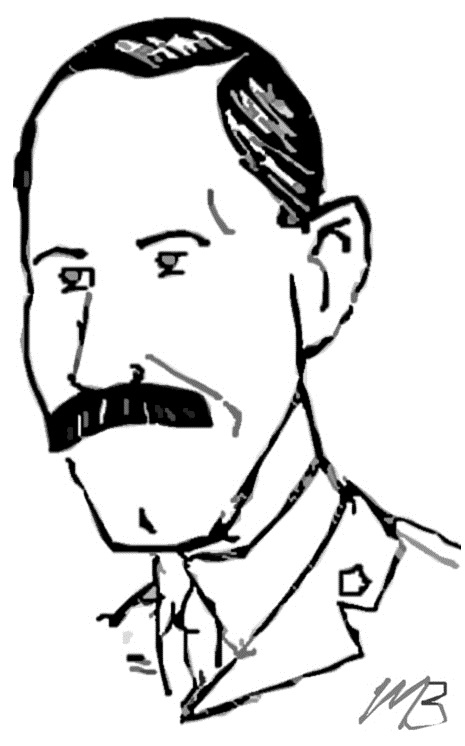
Lt-Col. V.E. Traversy

Lieutenant-Colonel Val Traversy
Royal Highlanders of Canada (The Black Watch)
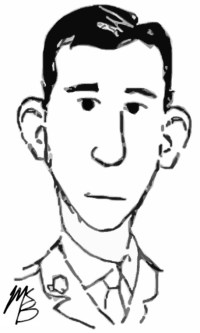
Val Traversy

There is no greater honour that could be bestowed on a soldier than to command a regiment, and there is no higher honour for a commanding officer than to command a unit of The Black Watch.

(Field Marshall Lord Wavell to Traversy, 31 Oct 1949)

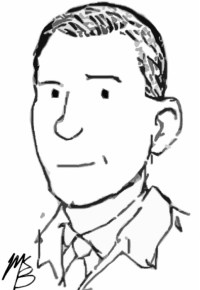
Born in Montreal on 16 February 1916, Valmore Eric Traversy graduated from Lower Canada College and worked in advertising before enlisting with the Black Watch as a lieutenant. He served as adjutant and later command the unit’s support company in France. He was wounded on 25 July 1944 in the action that killed Lieutenant-Colonel S.S.T. Cantlie and decimated the battalion. Out of action for several months, he rejoined the Black Watch in February 1945 as a commanding commander and then acting second-in-command.
Continue reading

Lt-Col. U.J. Motzfeldt

Lieutenant-Colonel Eric Motzfeldt
Royal Highlanders of Canada (The Black Watch)
Motzfeldt

It was a Scot—and a vain one—who said there were only two classes of people in the world: those who were Scots and those who would like to be Scots. That explains why Napier Moore, editor of The Financial Post, searching through “Clans and Tartans of Scotland” … was unable to find any reference to the Clan MacMotzfeldt. But there is such a tartan. It is of recent creation and the story of its coming into being is very interesting.

(Reprinted in Windsor Star, 3 Nov 1949, 4)

Born in Denmark on 8 June 1908, Ulric Johan (Eric) Motzfeldt graduated from the University of Copenhagen and in 1929 immigrated to Canada where he worked as an insurance broker in Montreal. He joined the Black Watch as a lieutenant on the declaration of war and rose to company commander by the time the regiment deployed to Normandy in July 1944. As a member of the Royal Highlanders, he jokingly called himself MacMotzfeldt and others knew the six-foot-two officer as “the Great Dane.”

Continue reading

Lt-Col. B.R. Ritchie

Lieutenant-Colonel Bruce Ritchie
Royal Hamilton Light Infantry
South Saskatchewan Regiment
Royal Highlanders of Canada (The Black Watch)
Ritchie

When the battalion went into action after D-Day, they guys had had three or four years’ training. But after the first big slap in the ass at St. Andre, we were never able to get organized with trained troops. Even when we got replacements, the battalion had been knocked down with such strength that they weren’t a fighting entity any more.

(Ritchie quoted in Denis Whitaker, Tug of War, 172)

Born in Regina, Saskatchewan in 1912, Bruce Rowlett Ritchie graduated from RMC and McGill University, and work for Sun Life Insurance in Montreal. He originally served as signals officer with the Black Watch but after the Normandy campaign began, he found himself moved around to several units before finally returning to the Royal Highlanders. While attached to the Algonquin Regiment as second-in-command, Ritchie rejoined his old regiment at the request of Lieutenant-Colonel Frank Mitchell who had taken command after the death of Lieutenant-Colonel S.S.T. Cantlie on 25 July 1944.

Continue reading

Lt-Col. F.M. Mitchell

Lieutenant-Colonel Frank Mitchell
Royal Highlanders of Canada (The Black Watch)
Mitchell

I greatly regret that I found it necessary to take the actions I did on September 22, 1944 but I’m afraid that when I arrive at a calculated decision, it is providential that it be carried out. I assure you that I have made no mistake other than possible the method of handing, and I tried to be loyal to both the Regiment and higher authority.

(Mitchell to Col. Hutchinson, 25 Oct 1944)

Born in Montreal in June 1908, Francis Murray Mitchell graduated from RMC and McGill University, where he excelled in sports. Having belonged to the Black Watch since 1930, he went overseas with the regiment as a captain in 1940 and by 1943 had been promoted to lieutenant-colonel while seconded for special duty with First Canadian Army. He reverted to major to serve as second-in-command when the Black Watch landed in France under Lieutenant-Colonel S.S.T. Cantlie.

Continue reading

Lt-Col. G.P. Henderson

Lieutenant-Colonel G.P. Henderson
Algonquin Regiment
Royal Highlanders of Canada (The Black Watch)
Henderson

When war broke out medical officers turned him down because he was missing a toe, resulting from exposure in the north country … son of a British Consul in Italy, where he was partially educated, and speaks fluently English, French, and Italian.

(Quoted in Jarymowycz, The History of the Black Watch, Vol. 2, 56)

Gavin Paterson Henderson was born on 2 June 1904 in Livorno, Italy, where his Scottish family had operated a shipping business for three generations. Educated in Italy, Edinburgh and Switzerland, he moved to Canada as a young man, married in Montreal in 1930, and joined The Black Watch. Following overseas duties in the infantry and an anti-tank unit in 1941, he returned to be a senior instructor at RMC.

Continue reading

Lt-Col. S.S.T. Cantlie

Lieutenant-Colonel Stuart Cantlie
Royal Highlanders of Canada (The Black Watch)
CantlieSST

You allowed the CO and the Adjutant to both be captured once and I got shot in the stomach as well—as the general said, “you must take better care of the CO even though you might not like him because he is the fellow who has to run the show.”

(Quoted in Jarymowycz, The History of the Black Watch, Vol. 2, 55)

Born in Winnipeg on 5 October 1907, Stuart Stephen Tuffnel Cantlie was a Montreal salesman, RMC graduate, and militia captain in the Royal Highlanders of Canada, which his uncle Lieutenant-Colonel G.S. Cantlie had commanded in the First World War. He went overseas as adjutant but returned in January 1942 for instructional work at RMC and general staff duties. Seven months later he returned to the United Kingdom, where he was attached to 3rd Division headquarters. In April 1943, he succeeded his cousin, Lieutenant-Colonel S.D. Cantlie in command of the Black Watch.

Continue reading

Lt-Col. S.D. Cantlie

Lieutenant-Colonel Stephen Cantlie
Royal Highlanders of Canada (The Black Watch)
CantlieSD

Stephen Cantlie was le Dauphin. His father, Colonel GS Cantlie, was a living legend whose accomplishments, military and civilian, could only have been a double yoke – great responsibility coupled with greater expectations. Militarily, Cantlie could not have been better prepared.

(Roman Jarymowycz, The History of the Black Watch, Vol. 2, 39)

Born in Montreal in September 1903, Stephen Douglas Cantlie was the son First World War 42nd (Royal Highlanders of Canada) Battalion commander Lieutenant-Colonel George Stephen Cantlie. A graduate of RMC, the younger Cantlie pursued a career as a stockbroker though joined his father’s regiment, nicknamed the Black Watch after the famed British Army Scottish regiment. He succeeded Lieutenant-Colonel K.G. Blackader on his promotion to brigadier in January 1942.

Continue reading

Brig. K.G. Blackader

Brigadier K.D. Blackader
Royal Highlanders of Canada (The Black Watch)
8th Infantry Brigade
Blackader

Throughout the initial and subsequent phases, Brigadier Blackader ceaselessly and tirelessly fought his brigade with skill and great determination. Without regard to his person, he visited all his units and by his word and deed was an inspiration to his command. Brigadier Blackader’s example is worthy of the best traditions of the army.

(D.S.O. citation, 31 Aug 1944)

Born on 19 December 1898 in Montreal, Kenneth Gault Blackader enlisted in 1916 as a lieutenant in a reinforcing draft for the Royal Highlanders of Canada. He joined the 13th Battalion in France, was wounded in September 1918, and earned the Military Cross. He became commanding officer of the 1st Battalion, Royal Highlanders of Canada in 1934 and was elevated to regimental commandant of the Black Watch in 1938. The next year he reverted to take the 1st Battalion overseas following mobilization.

Continue reading

Lt. Col. Sinclair

Major Ian Sinclair, D.S.O., M.C.
13th (Royal Highlanders of Canada) Battalions

Sinclair

I thought my nerves might give if I ever ran into an affair of that sort, but something seemed to change in me and I saw without any particular sensation things happen, which in my previous state of mind would have driven me mad. One of my men actually did go crazy this morning after we got out. Every battalion in the division suffered about as much and the whole is pretty wrecked.

(Sinclair, 13th Bn., to Mother, 28 Apr 1915)

Ian MacIntosh Roe Sinclair sailed for England as a subaltern with the 13th Battalion in October 1914. Over four years later, he returned to Canada at the head of the battalion. Though wounded in the fighting at the second battle of Ypres, he was promoted to company commander. After Lieutenant Colonel Eric McCuaig was elevated to the 12th Brigade on 14 September 1918, Sinclair became temporary commanding officer.

Continue reading

The Burnt Out

Lieutenant Colonel Peers Davidson
73rd (Royal Highlanders of Canada) Battalion
Davidson

Word received that Col. Davidson was unable to return to his battalion owing to nervous physical breakdown. He was examined by a medical board in London and declared unfit for further service.

(73rd Bn. War Diary, 12 December 1916, 5)

Born on 7 November 1870 in Montreal, Peers Davidson was the son of Quebec Chief Justice Charles Peers Davidson (1843—1925). His hockey player brother, Shirley (1872—1907) won multiple Stanley Cups with the Montreal Vicrorias in the 1890s. Another brother, Thornton (1880—1912), died during the Titanic sinking. A graduate of McGill, Peers Davidson was an advocate with a Montreal law firm, commodore in the Royal St. Lawrence Yacht Club and commanding officer of the 5th Regiment, Royal Highlanders of Canada.

Continue reading