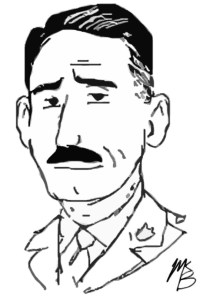
Lt-Col. J.F.R. Akenhurst

Lieutenant-Colonel Jack Akenhurst
2nd Regiment, Special Service Force
1st Regiment, Special Service Force
Algonquin Regiment
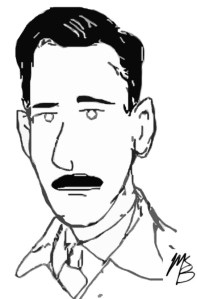
It hardly seems possible that I should be back with the old unit and in the thick of things less than 36 hours after leaving the former haunt at 3 CITR. It has been quite strenuous too since my arrival but we are still winning.

(Akehurst to wife, quoted in Joyce, The True story of the 1st Special Service Force, 276)

Born on 24 February 1908 in Kamloops, British Columbia, John Fenton Richardson Akehurst was chief mining engineer in northern Ontario. He was commissioned with the Algonquin Regiment in July 1940. Two years later he transferred to the newly formed joint American-Canadian First Special Service Force (FSSF), nicknamed The Devil’s Brigade. “I felt old at thirty-four, and was told I should have been rejected at that age except from my experience in cold climate,” he recalled, “… In fact, I was asked how tall, how heavy, how old, and to each I was a reject. But when asked where did I come from, I said ‘Kirkland Lake, Ontario,’ and I was in. It certainly made me curious and I felt the Force was not formed for any tropical venture.”
Continue reading

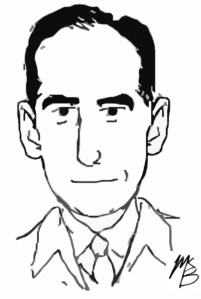
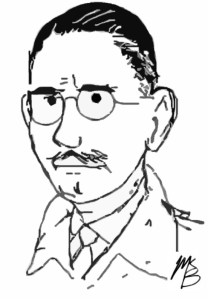
Lt-Col. R.A. Bradburn

Lieutenant-Colonel Bob Bradburn
Algonquin Regiment

Right now the score is still about the second down with a few yards to go—wish we could hand the ball to Bob Fritz because we can’t well carry the ruddy thing some other way. Never was the goal line surer and soon we’ll be home again.

 (Edmonton Bulletin, 23 Dec 1944, 14)

Born in Edmonton in 1909, Robert Archibald Bradburn was a golfer, sportsman, president of the city’s athletic club and militia officer. Commissioned in the 19th Alberta Dragoons since 1929, he mobilized for active service with the Edmonton Regiment in 1939 and went overseas as a captain in the South Alberta Regiment in 1942. The unit deployed as the 29th Armoured Reconnaissance Regiment to Normandy with the 4th Division in July 1944.

Continue reading

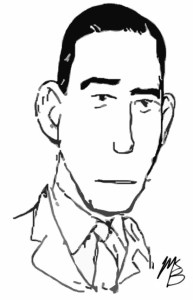
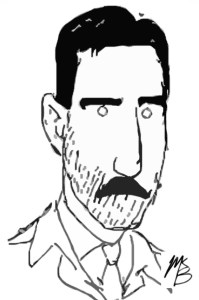
Lt-Col. A.J. Hay

Lieutenant-Colonel Art Hay
Argyll and Sutherland Highlanders of Canada
Algonquin Regiment

I knew when we landed in Normandy last July that I had with me the “fightingest” outfit in the Canadian Army and you have exceeded all my expectations. Though, to my bitter regret, I was not able to be with you after the middle of August last year, my thoughts and heart at least went with you.

(Hay, Teepee Tabloid, 19 Jul 1945, 2)

Born on 8 April 1909 in Killarney, Manitoba, Arthur John Hay was a Hamilton salesman and adjutant for Argyll and Sutherland Highlanders of Canada (Princess Louise’s). In September 1941, the battalion was dispatched for garrison duty in Jamacia, where Hay acted as instructor at the island’s tactical school. In May 1943, the A&S Highlanders were recalled to Canada in preparation of overseas service. As First World War veteran Lieutenant-Colonel Ian Sinclair was overage, Hay led the battalion to the United Kingdom in August 1943.

Continue reading

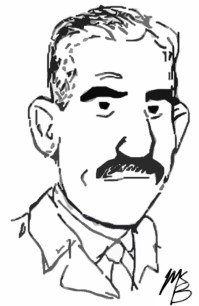
Brig. W.J. Megill

Brigadier W.J. Megill
Algonquin Regiment
5th Infantry Brigade

It was perfectly clear that the attack should have been called off at a very early stage in the morning. I suggested this not later than perhaps 8:00 or 9:00 o’clock. Instead the Corps commander was pressing the divisional commander and he was pressing us to get on with an attack which we knew was almost hopeless. Under these circumstances one does not quit. You do as much as you possibly can and hope that someone will see the light and give you some relief.

(Quoted in Copp, The Brigade, 88)

Born in Ottawa on 26 June 1907, William Jemmett Megill was a graduate of Queen’s University and RMC who had risen from the ranks of the Royal Canadian Corps of Signals which he joined in 1923. He was attending staff college in India when the Second World War began. Following general staff appointments with 3rd Division headquarters, he was promoted to brigadier with I Canadian Corps headquarters in June 1943. General Harry Crerar, described him as “the type of man who needs to experience in order to know. He is not what I would call imaginative … his lack of field experience definitely handicaps him.” To gain command experience, Megill request a revision in rank to lieutenant-colonel and was posted to the Algonquin Regiment in October 1943.

Continue reading

Maj. M.L. Troy

Major Leo Troy
Algonquin Regiment

In every lane, park and woodland you could see tanks, track to track, bullbozers, trucks, armoured cars, stretching for miles and miles. There was such an incredible amount of equipment you would think the little island would sink under its weight. And behind the vehicles was stored the greatest amount of ammunition in the world’s history, more than was used in the entire First Great War, and all in preparation for the invasion.

(Quoted in North Bay Nugget, 16 Oct 1945)

Born on 29 October 1894 in Chatham, New Brunswick, Martin Leo Troy was a physical education teacher and coach in North Bay, Ontario. A First World War veteran, he had served overseas with the Canadian Cyclists and remained active in the postwar militia. He helped to recruit the Algonquin Regiment and mobilized as “B” Company commander in 1940. He organized battalion sports and succeeded Lieutenant-Colonel J.B. Stewart before it embarked overseas in June 1943.

Continue reading

Lt-Col. J.B. Stewart

Lieutenant-Colonel J.B. Stewart
Algonquin Regiment

We may be a little short on material riches such as hat and shoulder badges, battle honours for our coat sleeves … But what we lack in some of these little things we make up in others—intangible, yet so apparent that we have but to pass before the people of our country and we are accepted for what we are—a great regiment.

(RSM Balfe Bradley, Winnipeg Tribune, 20 Nov 1941, 14)

Born on 3 February 1890 in Duluth, Minnesota, John Bain Stewart had belonged to the Queen’s Own Rifles of Toronto and worked as a contractor in North Bay, Ontario before the First World War. He was commissioned as captain and adjutant in the 159th Battalion in November 1915. Once overseas, he reverted to lieutenant to join the 4th Battalion, Canadian Railway Troops and later transferred to the 4th Canadian Mounted Rifles. After the war, Stewart joined the Algonquin Regiment, which perpetuated the 159th.

Continue reading

Lt-Col. G.P. Henderson

Lieutenant-Colonel G.P. Henderson
Algonquin Regiment
Royal Highlanders of Canada (The Black Watch)
Henderson

When war broke out medical officers turned him down because he was missing a toe, resulting from exposure in the north country … son of a British Consul in Italy, where he was partially educated, and speaks fluently English, French, and Italian.

(Quoted in Jarymowycz, The History of the Black Watch, Vol. 2, 56)

Gavin Paterson Henderson was born on 2 June 1904 in Livorno, Italy, where his Scottish family had operated a shipping business for three generations. Educated in Italy, Edinburgh and Switzerland, he moved to Canada as a young man, married in Montreal in 1930, and joined The Black Watch. Following overseas duties in the infantry and an anti-tank unit in 1941, he returned to be a senior instructor at RMC.

Continue reading