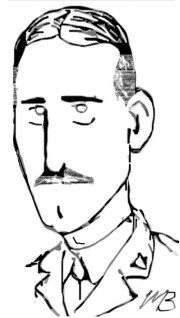
Lieutenant Colonel R.J.S. Langford
193rd (Nova Scotia Highlanders) Battalion
The Battalion, by means of its organization, is able to stand the shock of battle, to surmount confusion, to suffer casualties with the least injury to its efficiency. To abandon the organization is to destroy the fighting power and capacity for training.
(Langford, Corporal to Field Officer, 1940, 8)
Robert John Spinluff Langford was a professional soldier with the Royal Canadian Regiment. He was born in India on 9 July 1887. After Lieutenant Colonel John Stanfield, MP, temporarily assumed command of the Nova Scotia Highlander Brigade, Langford took over the 193rd, which he led to England in late 1916.
According to one account, “The high standard of efficiency to which the Battalion later attained was brought about by Major Langford’s enthusiastic and unremitting efforts.” When the Highlander Brigade was broken up, the 193rd was absorbed into the 17th Reserve Battalion. Langford transferred to the Headquarters staff of the 35th Division in the British Army.
Gassed in March 1918, he developed bronchitis and pleurisy, which forced his return to England. He commanded the military district at Kimmel Park before being struck off strength to Canada in September 1919.
Langford served as commanding officer of the Royal Canadian Regiment from 1929 to 1935. In 1925, he wrote, Corporal to Field Officer, a Canadian Army reference work and guide for officers and NCOs. He published a revised fourth edition after the outbreak of the Second World War in 1940. On the topic of discipline, he explained:
The aim and object of discipline, however, is not only to insure obedience to authority, but also to produce order and establish that cohesion between the individuals composing, a military force, which is essential to obtain complete success in whatever duty or operation it may be engaged in.
Such cohesion is the foundation of a mutual trust and reliance extending through all ranks from the highest to the lowest, besides securing a compliance by individuals with. the orders they may receive, and gives rise to an intelligent desire to carry out the instructions of superior authority, not only in the letter but also in the spirit, and, furthermore,, imparts a reliable courage which would otherwise be wanting in large bodies of men.
In a less serious vein, during the 1930s and 40s, Langford also wrote short stories collected in the book How I Won the War (1940) about a fictional officer named Wellington Marlborough Wolseley Smith. The Toronto Star book review found Langford’s “wide experience in the army enables him to give an air of plausibility even to the most incredible of Smythe’s exploits as well as to draw his various types of soldier characters with engaging cogency. But even more remarkable is the fact that an ex-officer of the permanent force should write with such literary fluency and with such delightful humor.”
He died on 28 June 1954.
 World War Graphic History