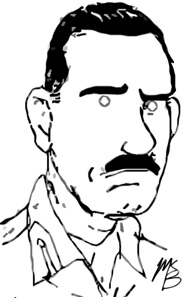
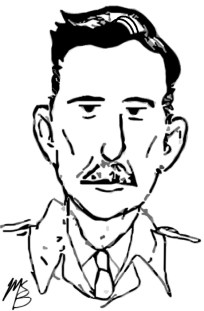
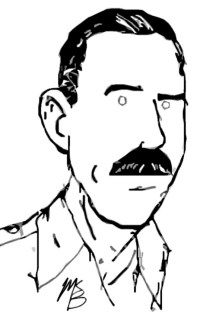
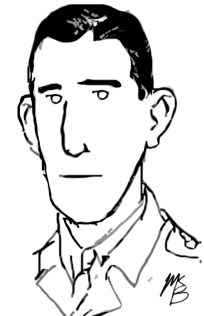
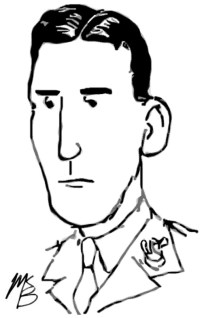
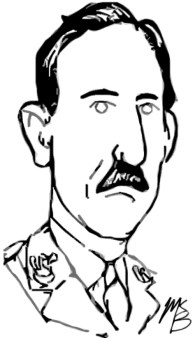
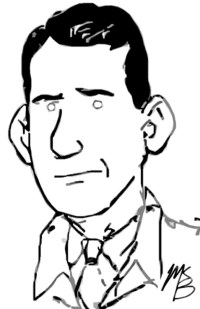
Lt-Col. D.G. Worthington

Lieutenant-Colonel Don Worthington
28th Armoured Regiment (B.C. Regiment)
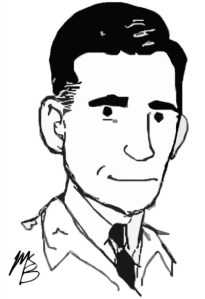
Lt.-Col. Worthington was a fearless, inspiring figure as he moved around the fire-swept square on foot, encouraging the men and organizing the defense … In the afternoon, he was hit by shrapnel when he was out on the perimeter trying to point targets for Canadian artillery. But he carried on. Late in the day he was killed and his regiment’s tribute to him is—there could not be a better commanding officer.

(Ross Munro, Vancouver Province, 4 Dec 1944)

Born on 3 March 1913 in Vancouver, Donald Grant Worthington attended the University of British Columbia and worked as a pharmacist with his brother Jack in the family business. A captain in the British Columbia Regiment since 1934, he mobilized with the unit in May 1940 alongside his younger brother. He went overseas with an advance party of the now redesignated 28th Armoured Regiment and in early 1943 gained combat experience serving the in North African campaign.
Continue reading

Lt-Col. E.P. Thompson

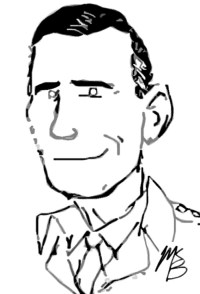
Lieutenant-Colonel Tommy Thompson
Queen’s Own Cameron Highlanders
ThompsonEP

A quick learner, quick at grasping new ideas. Very industrious and preserving; a hard quiet worker. Polite, conscientious in fulfilling obligations, helpful and considerate of other general liked. Has a well balanced and equable temperament. Has a very good knowledge of all arms and gets well in the tactical picture and makes sound appreciations and decisions.

(Final Report on Capt. Thompson, 19 Dec 1942)

Born in Winnipeg on 8 January 1921, Ernest Payson (Tommy) Thompson was a medical student at the University of Manitoba when he enlisted with the Queen’s Own Cameron Highlanders of Canada, having been a cadet of the unit as a teenager. Although regarded as too young to go overseas, the young lieutenant nevertheless joined the battalion before it embarked and arrived in England before to his twentieth birthday.

Continue reading

Maj. C.W. Ferguson

Major Bill Ferguson
Queen’s Own Cameron Highlanders
Ferguson

Hugh Young, the brigadier, had assured me that I’d have Ferguson for three months, at least three months in action, guaranteed … This guy, Hugh Young, had salted away as brigade major my 2 i/c. Three months in action? To hell with it, two days in action!

(Ross interview, 20 July 1979)

Born on 19 April 1916 in Mortlach, Saskatchewan, Clarence William Ferguson was an insurance agent in Winnipeg, commissioned as a lieutenant with mobilization in September 1939. He went overseas in March 1940 to attend the war staff college at Camberley, England. Now a captain, he returned to Canada for further staff training at the Royal Military College in summer 1942. While back home he married the daughter of former Cameron commanding officer, Lieutenant-Colonel Hugh Mackenzie. Ferguson reverted from the rank of major to go back overseas in December 1943.

Continue reading

Lt-Col. A.C. Gostling

Lieutenant-Colonel Alf Gosling
Queen’s Own Cameron Highlanders
GostlingAC

He expresses himself quite well in his own particular style. He has plenty of common sense and is practical. He has not got a very active brain and is not able to grasp essentials easily. He would react well to severe physical and metal pressure and would not get easily rattled. His good humour and solidness would be an asset in a crisis.

(Report on Maj. Gostling, 11 Apr 1940)

Born on 18 August 1903 in Mitcheldean, Gloucestershire, England, Alfred Capel Gostling was a radiotrician and captain in the Winnipeg Grenadiers, having been commissioned in the militia since 1925. He went overseas as major in the 2nd Infantry Brigade in December 1939 and served as assistant adjutant and quartermaster for the 1st Canadian Division. In February 1942, he transferred to the Queen’s Own Cameron Highlanders, succeeding Lieutenant-Colonel Gil Dudley.

Continue reading

Brig. E.L. Booth

Brigadier Leslie Booth
12th (Three Rivers) Tank Regiment
4th Armoured Brigade
Booth

It was strange but at about the time that Simonds and I were discussing that problem I became convinced that Boothie had a premonition that he would be killed. He certainly was not the same keen and cheerful man of the year before in Sicily … I looked for him to hear what was wrong,

(Kitching, Mud and Green Field, 213)

Born in Lancaster, England on 21 April 1906, Eric Leslie Booth was engineer for the Bell Telephone Company and prewar militia officer with the Mississauga Horse. In September 1939, he enlisted with the 1st Hussars, later redesignated the 6th Armoured Regiment, and went overseas as a major in late 1941. He served for several months as second-in-command of the 17th Lancers in North Africa before being appointed to command the 12th Tank (Three Rivers) Regiment in April 1943.

Continue reading

Maj. R.C. Irvine

Major Bobby Irvine
Saskatoon Light Infantry

I consider from the evidence that Major R.C. Irvine died from injuries in circumstances which do not indicate improper conduct as defined by Overseas RO 2022 or negligence on his part. I direct that no disciplinary action be taken.

(Court of Inquiry, 24 Jul 1944)

Born on 12 June 1911 in Sutherland, Saskatchewan, Robert Cyler Irvine was assistant manager with the Eaton department store in Regina. He transferred from the Regina Rifles to go overseas with the Saskatoon Light Infantry in December 1939. He served as platoon leader, adjutant, and quartermaster during training in the United Kingdom. Lieutenant R.C. Mitchell described him as “a glib organization man—the kind of person a farmer suspects of relying on his tongue to carry him rather than actual performance. Actually, later on, Bobbie served on Brigade staff and was considered a valuable man.”

Continue reading

Lt-Col. B.A. Sutcliffe

Lieutenant-Colonel Bruce Sutcliffe
Hastings and Prince Edward Regiment
Sutcliffe

From official information we have received your husband was killed in action against the enemy. You may be assured that any additional information received will be communicated to you without delay.

The Minister of National Defence and the members of the Army Council have asked me to express to you and your family their sincere sympathy in your bereavement.

(Gen. Letson to Nell Sutcliffe, 2 Aug 1943)

Born in Peterborough, Ontario on 27 October 1904, Bruce Albert Sutcliffe was a Toronto postal clerk and a sixteen-year member of the Hastings and Prince Edward Regiment. On the promotion of Lieutenant-Colonel H.D. Graham to brigadier in September 1942, command of the regiment passed to Sutcliffe. Ten months later, on 10 July 1943, he landed with the regiment in Sicily as part of Operation Husky. Within ten days Sutcliffe was dead.

Continue reading

Lt-Col. R.M. Crowe

Lieutenant-Colonel Ralph Crowe
Royal Canadian Regiment
Crowe

That evening, when our battalion rested, the CO, Ralph Crowe, another would-be Cavalier, with tears in his eyes reminded his senior subordinates that Billy’s [Major Pope] death should never have been; that it was an object lesson for all of us. We were not to expose ourselves needlessly. The Second-in-Command had no business stalking enemy armour and we, the company commanders, had even less business putting ourselves in positions of great danger when our men were supposed to be properly led by the sound application of our tactical training and by accepted techniques of command and control. He was so very right.

(Strome Galloway, The General Who Never Was, 142)

Born on 2 October 1911 in Guelph, Ontario, Ralph Marston Crowe was an instructor at the Royal Military College, having also graduated there in 1933. He was commissioned in the RCR and served two years with the Indian Army on the Northwest frontier in 1936-37. He left the staff of RMC to go overseas in December 1939. Following a posting to the 1st Canadian Division headquarters, in February 1940, he transferred to the Hastings and Prince Edward Regiment as a major.

Continue reading

Lt-Col. D.A. Mackenzie

Lieutenant-Colonel Don Mackenzie
48th Highlanders of Canada
MackenzieDA

For extraordinary heroism in connection with military operations against an armed enemy on 12 April 1945 … Lieutenant Colonel Mackenzie, realizing that this was the turning point of the battle, went forward fearlessly in the face of heavy enemy fire to make a personal reconnaissance in preparation for the second phase of the attack. His plan of attack, based on the information he gained, was eminently successful, and his unsurpassed leadership and daring resulted in the complete rout of the enemy.

 (D.S.C. citation, 27 Sept 1945)

Born in Kincardine, Ontario on 9 July 1914, Donald Alexander Mackenzie was a bank clerk and member of the 48th Highlanders since 1935. He was regimental transport officer during the battalion’s brief service in France in June 1940. He was soon promoted to captain then major and served as an aide to Lieutenant-General Bernard Montgomery in early 1942. He returned to Canada later that year for a staff officer course before being posted back to England for instructional duties in July 1943.

Continue reading

Lt-Cols. Jameson & McDonnell

Lieutenant-Colonel E.J. Jameson
Jameson
&
Lieutenant-Colonel John McDonnell
McDonnell
5th Bn., Leinster Regiment (Royal Canadians)

He was not the showy or popularity-seeking kind, but always pursued the even tenor of his path to duty. Reserved, rather taciturn, a somewhat lonely figure, he yet inspired confidence and esteem. Outwardly he appeared a man of care and silent sorrow, which rather belied his age and vigour. He knew his work, had confidence in himself and inspired it in others. Fearless and impartial, he never spared a subordinate, from a private upwards. But he never spared himself.

(Tribute to Lt-Col. Jameson in Whitton, The History of the Prince of Wales’s Leinster Regiment, vol. 2, 393)

Both majors who succeeded Lieutenant-Colonel E.F. Farrell in command of the 5th Battalion, Leinster Regiment would each later lead a battalion in the field before being killed in action. Born on 11 June 1875 in Dublin, Edmond James Jameson died of wounds on 27 March 1917 while in command 1/4th Essex Regiment during the First Battle of Gaza. Born on 2 November 1878 in Dublin, John McDonnell died with the 1st Inniskilling Fusiliers at Ypres on 29 September 1918.

Continue reading