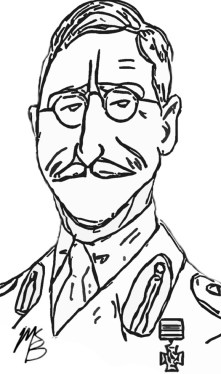
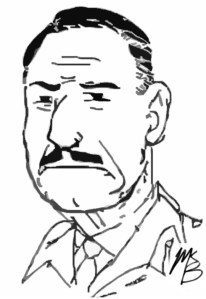
Lt-Gen. C. Foulkes

Lieutenant-General Charlie Foulkes
3rd Infantry Brigade
2nd Canadian Division
II Canadian Corps
I have come to the conclusion that attempts to limit the use of force by banning certain types of weapons or by partial disarmament including all types of nuclear weapons, does not appear to be the right answer to this dilemma. I take issue with those who say let us go back to conventional weapons, as if it was all right to settle disputes by conventional means when only soldiery get killed but the world is saved from destruction.

(National Post, 9 Mar 1963, 6)

Born on 3 January 1903 in Stockton-on-Tees, England, Charles Foulkes grew up in London, Ontario and joined the Royal Canadian Regiment after graduating from Western University in 1926. Following staff posts to militia district headquarters in Toronto and Kingston, he attended staff college at Camberley, England. At the outbreak of war in 1939, he was appointed brigade major when the 1st Division went overseas in December 1939. By September 1940, he was back in Canada as general staff officer for the newly formed 3rd Canadian Division.
Continue reading

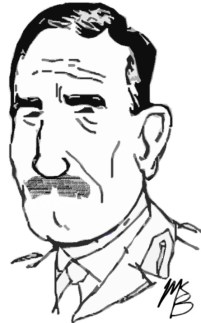
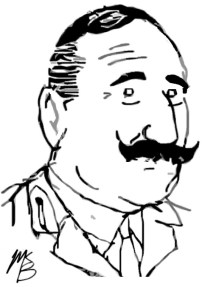
Lt-Gen. E.L.M. Burns

Lieutenant-General Tommy Burns
4th Armoured Brigade
2nd & 5th Canadian Divisions
II
Canadian Corps

Having thus confronted death, and learned that its presence does not paralyze, and having known that while fear may clutch, it does not necessarily strangle, I feel that I am a happier man. I reason (perhaps fatuously), What am I likely to experience that will be harder to bear than that which I have borne?

(Arlington B. Conway, “In Praise of War,” 1927, 391)

Born in Montreal on 17 June 1897, Eedson Louis Millard Burns graduated from the Royal Military College in 1914 and took a commission in the Canadian Engineers. He served as a staff officer in the 3rd Division in France where he was twice wounded and earned the Military Cross. In the 1920s, he worked as an instructor at RMC while continuing his own professional staff officer education. During the interwar, he wrote several articles on military science and defence issues as well as contributions to American Mercury under a pen name, “Arlington B. Conway.”

Continue reading

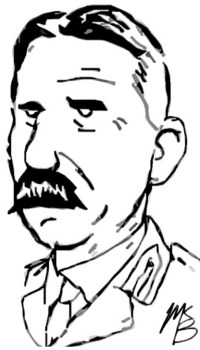
Maj. Gen. Steele

Major General Sir Sam Steele
2nd Canadian Division
Steeke

Climbed the high hill to where the 19th, 20th [Bns.] and engineers were busy digging trenches and completing them. They are doing very well indeed, all hands working with a will, but I thought what an awful thing it is to be obliged to do this for the sake of our freedom, and to enable us to kill other men.

(Gen. Steele diary, 1 July 1915)

Born on 5 January 1848 in Medonte Township, Upper Canada, Samuel Benfield Steele was among the first officers of the North-West Mounted Police and the first commanding officer of the Lord Strathcona’s Horse in the Boer War. His leadership during the Klondike Gold Rush and his memoirs contributed to linking his name with the iconic image of the Mountie. As Canada’s most famous policeman and soldier, Steele received an appointment to command the 2nd Canadian Division in May 1915.

Continue reading

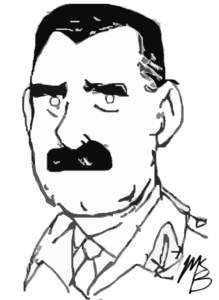
Lt. Gen. Turner

Lieutenant General Richard Turner, V.C.
2nd Canadian Division
Turner2

We are all very tired from days and nights of endless strain – with no sleep. I had men killed by enemy fire actually at the door of the house where my H.Q.’s was-to get to the Signal Dug Out-we knocked a hole in one side of the house, as it was too dangerous to pass outside.

  (Gen. Turner diary, 3 May 1915)

On 7 November 1900, Richard Ernest William Turner drove off an attack by Boer fighters near the Komati River. For his gallantry that day he was one of three Canadians to earn the Victoria Cross. Born in Quebec on 25 July 1871, Turner was the son of a Quebec politician and businessman. After his return from South Africa, Turner remained active in the Canadian militia until moving to the reserve list in 1912. At the outbreak of the Great War, he was recalled to service and appointed brigadier general.

Continue reading

Maj. Gen. Burstall

Major General Sir Henry Burstall
2nd Canadian Division
Burstall

General Sir H.E. Burstall who commanded the Canadian artillery in the late war, was reputed to have an iron nerve, and, in action, to have been one of the coolest men in the army. Nothing, it was said of him so quickly aroused his anger as to see a man give way to fear, even momentary fear, and he seldom let such action pass in silence.

 (Vancouver Daily World, 28 Oct 1922, 22)

Born on 26 August 1870 in Sillery, Quebec, Henry Edward Burstall was a graduate of the Royal Military College, Boer War veteran and Permanent Force artillery officer. He commanded the 1st Division Artillery from September 1914 until September 1915 when he was elevated to GOC of the Royal Canadian Artillery Corps. In December 1916, Burstall replaced Major General Richard Turner of the 2nd Canadian Division.

Continue reading

Maj. Gen. Loomis

Major General F.O.W. Loomis
13th (Royal Highlanders of Canada) Battalion
Loomis

We have laid the bodies of many of our best under rows of little wooden crosses. We love those comrades who have fallen; we remember their deeds, and recall their deaths with pride and joy, and we know that their souls go marching with us. We know that the spirit of devotion that animated them remains with us, and we feel that the enemy has no battalions, no gas, guns, shells, nor bombs which will dampen or deter this spirit of determination — the Canadian Spirit.

 (Loomis to W. F. Gibson, The Listening Post, 1 Dec 1917, 3)

Frederick Oscar Warren Loomis was a Montreal manufacturer and member of the militia since 1886. He was born in Sherbrook, Quebec on 1 February 1870. As commander of the Royal Highlanders, Loomis led the 13th Battalion to France in February 1915. He guided the Highlanders through the first major action at Second Ypres and was promoted to command the 2nd Brigade in January 1916.

Continue reading