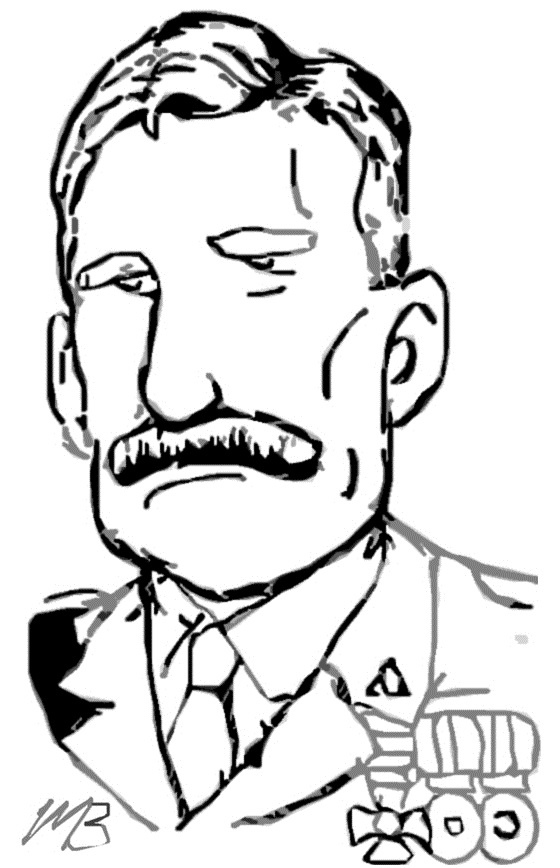
Brig. J.S.H. Lind

Brigadier J.S.H. Lind
Perth Regiment
12th Infantry Brigade
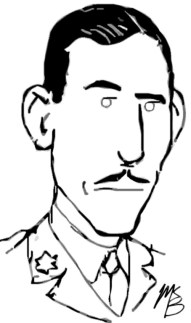
… one of the figures in the lead carrier was none other than the CO himself, Lieutenant-Colonel Lind. That a man of his rank should be right up at the sharp end was a welcome surprise … Later when we were in Army Reserve at Caiazzo, he had pinned to his tunic, the medal and ribbon of the [D.S.O.]. awarded for his leadership of the regiment in this action. In effect, we the ordinary guys in the ranks won it for him. But what was there for us to show for these efforts? Not a damn thing!

(Stanley Scislowski, Not All of Us Were Brave, 220)

Born in Owen Sound, Ontario on 17 November 1908, John Skiffington Heming Lind was a cement company executive and member of the St. Marys town council. A graduate of the Royal Military College, he had belonged to the militia since 1932. He relinquished his position as second-in-command of the Perth Regiment to attend the staff college at Camberley, England in 1940. By the time the regiment departed for England, Lind had been appointed a brigade major overseas.

Continue reading

Brig. Gen. MacBrien

Brigadier General James H. MacBrien
12th Canadian Infantry Brigade

The ending of war involves the most fundamental modification of the whole structure of society, and can only be brought about by a reversal of the general method of human life and the general method of nature which up to this time has been manifested in the survival of the fittest. I think that until we see a complete change of heart in human society we should prepare our sons to fight and quickly organize that they may have as chance of success. The league of nations as a means of definitely preventing war is about as likely to succeed as a proposal to abolish hunger and death.

(Maj. Gen. MacBrien in the Weekly Albertan, 1 Dec 1920, 2)

Born in Myrtle, Ontario on 30 June 1878, James Howden MacBrien was a North-West Mount Police constable when he joined the South African Constabulary during the Boer War. A few years after he returned to Canada, he was commissioned in the Royal Canadian Dragoons in 1910. In September 1914, he joined the 1st Canadian Division headquarters as a staff officer at the rank of lieutenant colonel. Two years later he replaced Lord Brooke in command of the 12th Infantry Brigade.

Continue reading

The Nobleman

Brigadier General Lord Brooke
4th and 12th Infantry BrigadesLordBrooke

All day long I had witnessed the tragedy of men “made in the image of God” bringing their utmost skill and science to the hateful task of mutual murder.

As an exhibition of scientific slaughter the firing was lacking in nothing. The range of the guns was exact, the shooting perfect. The shrapnel burst over the heads of the retreating troops, as it were in large patterns. There was no cover, no escape for the unhappy Russians. Under this awful hail of bullets the men dropped like wheat beneath the sickle of the reaper. Death most truly was gathering a rich harvest.

(Lord Brooke, An Eye-Witness in Manchuria, 1905, 131)

Born on 10 September 1882, Leopold Guy Francis Maynard Greville was the son of British Conservative MP Francis Greville, 5th Earl of Warwick (styled Lord Brooke) and Daisy Greville, Lady Warwick, a socialist socialite who had been mistress to King Edward VII. While a student at Eton, Lord Brooke ran away to fight in the Boer War. He was a press correspondent during the Russo-Japanese War and recounted his experiences in An Eye-Witness in Manchuria (1905).

Continue reading

The Police Chief

Lieutenant Colonel James Kirkcaldy, D.S.O.
78th (Winnipeg Grenadiers) BattalionKirkcaldy

For conspicuous gallantry and resourceful leadership. When one of his companies was held up by machine-gun fire, he took charge and overcame the opposition. Later, by aggressive fighting, he got his battalion forward, and formed a defensive flank, using a rifle himself and directing machine–gun and trench-mortar fire, and drove the enemy from their positions. His courage and fighting spirit were an inspiration to all.

(Kirkcaldy D.S.O. Citation, London Gazette, July 1918, 133)

James Kirkcaldy was born in Abdie, Scotland on 18 May 1866. After serving for over seven years in the Imperial Forces, he immigrated to Canada in 1891 and settled in Brandon, Manitoba. Shortly thereafter, the six-foot Scotsman was appointed the town’s chief of police, a post he held for the next thirteen years (1892—1905). A former member of the 12th Manitoba Dragoons and serving major with the 99th Rangers, in August 1914, Kirkcaldy enlisted in Louis Lipsett’s 8th Battalion at the rank of major.

Continue reading