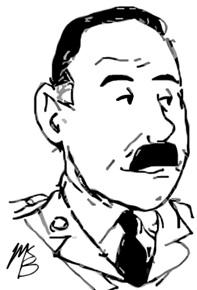
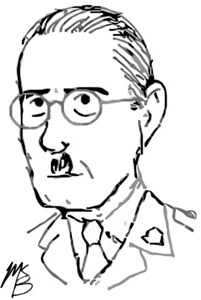
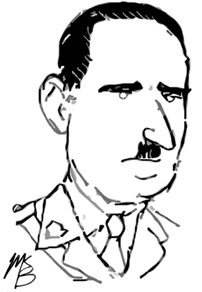
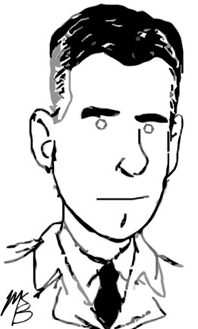
Lt-Col. C.M. McLean

Lieutenant-Colonel Charlie McLean
11th (Ontario) Tank Regiment
McLeanCM

Lt-Col. McLean has always shown the most outstanding qualities of leadership and resourcefulness and complete disregard of personal danger. Time after time he has rallied the men of his regiment to carry on under almost impossible conditions.

(D.S.O. citation, 10 Nov 1945)

Born in Virden, Manitoba on 17 March 1913, Charles Milton McLean was a prewar member of the Manitoba Dragoons and went overseas as an officer with the Fort Garry Horse in 1941. He joined the Ontario Regiment in Italy in January 1944 as second-in-command under the new CO and fellow westerner Lieutenant-Colonel Bob Purves.
Continue reading

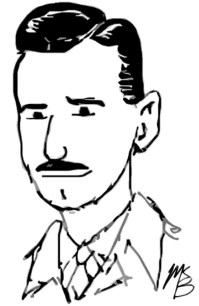
Lt-Col. R.L. Purves

Lieutenant-Colonel Bob Purves
11th (Ontario) Tank Regiment
Purves

The development of mass destruction weapons will lead away from great wars, where millions of men face each other. Instead we will have a continuation of smaller wars such as Korea, Indo-China, Palestine and Malaya—all aided and abetted by one or the other of the great power blocks.

(Purves in Toronto Star, 12 Nov 1954, 7)

Born in Victoria, British Columbia on 13 October 1910, Robert Lloyd Purves was a University of British Columbia graduate and schoolteacher in Calgary. Having belonged to the prewar reserve army with the Calgary Highlanders, he mobilized for active service in early 1941. He would serve with each of the three tank battalions in the 1st Canadian Armoured Brigade; as squadron commander in the 14th (Calgary) Regiment at Dieppe, second-in-command of the 12th (Three Rivers) Regiment, and commanding officer of the 11th (Ontario) Regiment.

Continue reading

Lt-Col. H.R. Schell

Lieutenant-Colonel H.R. Schell
11th (Ontario) Tank Regiment

This, the Tank Corps, are a unit that we expect will yet prove the deciding factor in the present conflict. The English have surpassed themselves in the molding of these tanks; they ate the work of many hands and many brains. We, the crews and operators, hope soon to have the opportunity of showing Germany how easily their once supposed invulnerable Panzer divisions can be routed and ruined. Most of use are very proud to have as our weapons the foremost allied tanks invented. They are the real thing and once in motion in actual battle, will prove a deadly stubborn foe.

(anonymous 11th Tank solider, Feb 1942)

Born in Oshawa, Ontario on 1 December 1912, Herbert Robson Schell was son of the city’s former mayor. He was one of a dozen officers to attend tank tactics training in England in late 1940. He served as second-in-command under Lieutenant-Colonel Murray Johnston during the long period of training in England from November 1942 until deployment with the 1st Army Tank Brigade after the invasion of Sicily in July 1943.

Continue reading

Lt-Col. M.P. Johnston

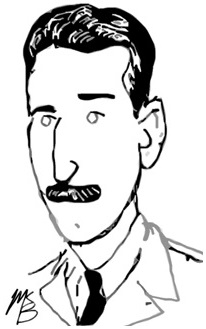
Lieutenant-Colonel M.P. Johnston
11th (Ontario) Tank Regiment
JohnstonMP

Well Murray, you know you have my heartfelt congratulations on your promotion, and we all feel that with you in Command, and Bob as 2 i/c, that you will make a team second to none. I again tell you how good I feel, when I see any of my old boys receiving promotions. I am sure it does me just as much good, as it does them.

(Col. Bob Smith to Johnston and Schell, 21 Jan 1943)

Born in Owen Sound, Ontario on 3 March 1908, Murray Pentland Johnston, was a reserve army officer with the Ontario Regiment since 1928 and an Oshawa menswear clothier. He was one of a dozen officers to attend tank tactics training in England in late 1940. Overseas he later served as squadron commander with the 9th Armoured Regiment (British Columbia Dragoon) before attached service with the British Army in North Africa. After transferring back to his own regiment, Johnston succeeded Lieutenant-Colonel G.Y. Masson of the Ontario Tanks in November 1942 with another original militia officer, Major Bob Schell, as his new second-in-command.

Continue reading

Lt-Col. G.Y. Masson

Lieutenant-Colonel G.Y. Masson
11th (Ontario) Tank Regiment
Masson

If we did something as pro-British as possible, such as adopting the Union Jack as the flag of Canada, we would be doing a much greater service to the empire. I feel the cause [of adopting a new national flag] could well be postponed until happier years.

(Masson in Windsor Star, 31 Jan 1939, 11)

Born in Detroit on 11 December 1895, George Yule Masson was an architect in Windsor, Ontario and a First World War veteran. Commissioned a lieutenant in Canada, he reverted to the ranks to go overseas as a gunner in 1917, and ended the war a cadet with the Royal Air Force. Until summer 1939, he was commanding officer of the Essex Regiment which had been re-designated at tank battalion in 1936.

Continue reading

Lt-Col. Pearson & Maj. Tosland

Lieutenant-Colonel E. Pearson
Pearson
&
Major A.L. Tosland
Tolson
Ontario Regiment

Both appointments come in the nature of promotions to the Oshawa Military Officers who have had many years of experience in Military Work, and their many friends in Oshawa wish them the best of success in their new posts.

(Oshawa Daily Times, 31 Dec 1940)

Born in Winchester, Hampshire, England on 18 September 1897, Edwin Pearson was a General Motors office clerk in Oshawa, Ontario when he enlisted in the 116th Battalion under the command of Lieutenant-Colonel Sam Sharpe in January 1916. After the battalion deployed to France in February 1917, Pearson rose through the NCO ranks. A year later he was recommended for a commission and rejoined the 116th as a lieutenant in September 1918. Twenty years later he was appointing commanding officer of the militia regiment which perpetuated the 116th.

Continue reading