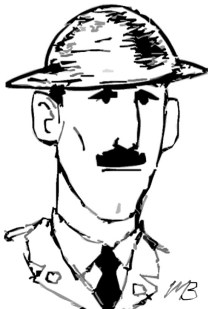
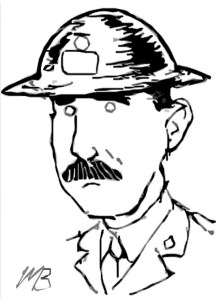
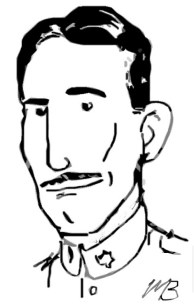
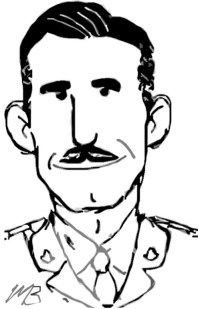
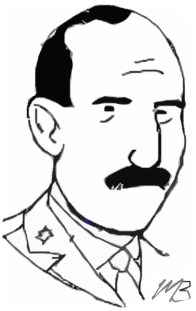
Brig. Gen. Ormond

Brigadier General Dan Ormond
10th (Fighting Tenth) Battalion
Ormond

I have no great hope, however, that he will prove a success in the position to which he has been appointed; my information is that he has not been successful in any of the other ventures over which he has had command.

 I consider that the remarks made by Brigadier-General Ormond are an example of red tape snobbishness and brass hat unctuousness. Fortunately there were not many men of this calibre holding high commands…

(R. Gray, Debates, 3 Apr 1933, 3649)

Daniel Mowat Ormond assumed command of the 10th Battalion at Second Ypres following the death of Lieutenant Colonel Russ Boyle. He became second-in-command when John Grant Rattray returned from England to take over the 10th. On relinquishing command in September 1916, Rattray endorsed Ormond as his successor. Currie replied, “You have a higher opinion of Ormond than I have, but I will take your word for it.” Rattray reassured Currie, “Ormond will not disappoint you.”
Continue reading

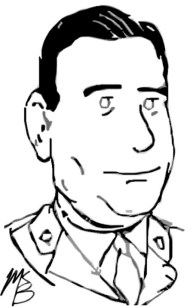
Lt. Col. Watson

Lieutenant Colonel G.K.W. Watson
190th (4th Winnipeg Rifles) Battalion
GWWatson

Civilians ought to remember that things which thrill them would not excite returned soldiers. They have seen too many strange unusual sights in France to he moved by flag-flapping and bugle blowing. No civilian, however old he might live lo be can see with the eyes of a man who has passed through hell and out again.

 (Watson, Winnipeg Tribune, 9 April 1919, 3)

George Kelsey William Watson was a Winnipeg insurance broker born in Wingham, Ontario on 12 January 1882. A member of the 90th Rifles, Watson enlisted as a captain with the 8th Battalion in September 1914. Wounded and shell shocked at Second Ypres, he was invalided to Winnipeg to raise the 190th Battalion. Continue reading

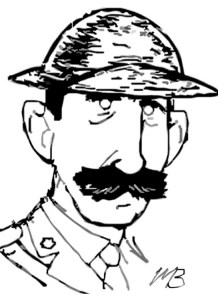
Lt. Col. Gilson

Lieutenant Colonel W.F. Gilson, D.S.O.
7th (1st British Columbia) Battalion
Gilson

Referring to the untrained men who won so brave a reputation, Col. Gilson said in talking with a German clergyman he used the word but could not induce him to alter his opinion: “How can you state Canada had no professional soldiers? These men are fully trained and regulars of the finest class.”

(Chilliwack Progress, 15 May 1919, 8)

Born in India on 1 May 1877, William Forbes Gilson was a veteran of the West African Frontier Field Force. Enlisting in the CEF as a sergeant, within two years Gilson rose to command the 7th Battalion. He was awarded the Distinguished Service Order on 18 October 1917, a D.S.O. Bar for actions of 8 August 1918 and a second D.S.O. Bar for gallantry on 2 September 1918. Continue reading

Lt. Col. Gardner

Lieutenant Colonel Stan Gardner, M.C.†
7th (1st British Columbia) Battalion
Gardner

Lieut.-Col. Gardner is known and respected not only as a fighting man and successful officer, but also a true friend to the soldier who does his duty as it should be done.

(Daily Colonist, 15 Sept 1916, 5)

Born in London, England on 22 August 1880, Stanley Douglas Gardner was a member of the 22nd London Regiment before immigrating to British Columbia. A veteran of the Canadian Mounted Rifles in the Boer War, he enlisted as a captain with the 7th Battalion in September 1914. Stanley was soon appointed battalion adjutant but he was seriously wounded at Festubert on 25 May 1915 and invalided to England. Continue reading

Lt. Col. Bickerdike

Lieutenant Colonel R. Bickerdike, D.S.O.
87th (Canadian Grenadier Guards) Battalion

Bickerdike

But I speak feelingly on this question, as I have a son, two grandsons and seven nephews at the front–that is, I had seven nephews at the front, but two have been killed and two badly wounded.

 (Robert Bickerdike, Sr., House of Commons Debates, 2 May 1917, 1015)

Robert Bickerdike Jr. was a graduate of McGill University and a Montreal civil engineer. Born on 30 September 1869, he was the son of Robert Bickerdike Sr., Liberal MP for St. Lawrence (1900—1917). The elder Bickerdike was a leading philanthropist, humanitarian and outspoken opponent of the death penalty. During the conscription debate of 1917, the elder Bickerdike broke with long-time friend Wilfrid Laurier in support of the Military Service Act.

Continue reading

Lt. Col. Chandler

Lieutenant Colonel W.K. Chandler
43rd (Cameron Highlanders) Battalion
Chandler

Instances of desertion have been limited to three cases all of which were men from desertion in the face of the enemy was to be anticipated, execution of the sentence of death would I submit be punitive only; the general state of discipline does not call for an example being made in this case.

(Chandler to General Horne, 1918)

William Kellman Chandler was born in Barbados, British West Indies on 1 November 1883. Sir His father, Sir William Kellman Chandler (1857—1940) was president of the Barbados legislative council. Educated at Cambridge, he moved to Winnipeg to become a barrister with the law firm of Cameron and Phillips. He joined the 43rd Cameron Highlanders in August 1914.

Continue reading

The Prisoner

Lieutenant Colonel J.F.H. Ussher
4th Canadian Mounted Rifles
Ussher

In view of the foregoing the people who are providing the taxes for this well-deserved bonus to the soldiers should insist that all strings to the payment should be removed. Don’t let some Government appointee be the sole judge– the soldier’s record of service must decide!

(Ussher to Globe and Mail, 18 Aug 1944, 16)

During the battle of Mont Sorrel on 2 June 1916, John Frederick Holmes Ussher became trapped in a collapsed tunnel during heavy German shelling. He was wounded and captured. He spent the next two and a half years a prisoner of war. Born in Toronto on 27 October 1872, Ussher was a stock broker and Boer War veteran. A nine year member of the Queen’s Own Rifles and ten year member of the 9th Mississauga Horse, he enlisted as major of ‘C’ Squadron in the 4th CMR. Continue reading

Lt. Col. Riley

Lieutenant Colonel Harold J. Riley
27th (City of Winnipeg) Battalion
Riley

For conspicuous gallantry and able leadership. During four days’ hard fighting, when his battalion was continuously making attacks at short intervals, his gallantry and indomitable energy inspired his men to their utmost efforts.

(Riley, D.S.O. Bar Citation, 11 Jan 1919)

Harold James Riley was the third commanding officer of the 27th Battalion. The son of prominent Winnipeg civic leader, Robert Thomas Riley, he was born on 29 November 1887. Riley was a graduate of University of Manitoba, a lawyer and amateur football and hockey player.

Continue reading

Lt. Col. Edwards

Lieutenant Colonel C.M. Edwards, D.S.O.
38th (Ottawa) Battalion
Edwards

“Where’s your uniform, Colonel?” asked a reporter as he spotted the light gray suit among the red tabs and brass of the inspection party.

 “I guess it’s scattered around among these gentleman,” answered the Colonel, “you know you can’t draw the old age pension and wear a uniform too… The only thing I hated to give up was the kilt,” said Col. Edwards turning away “I really miss that.”

 (Ottawa Citizen, 26 Aug 1957, 3)

Cameron MacPherson Edwards was a Ottawa wealthy lumberman with seventeen-years’ service in the 43rd Regiment. He was born in North Nation Mills, Quebec on 28 September 1881. One of the youngest colonels in France, Edwards was mentioned three times in dispatches and received two Bars to his Distinguished Service Order. Continue reading

Lt. Col. Grassie

Lieutenant Colonel William Grassie
43rd (Cameron Highlanders of Canada) Battalion
Grassie

When I was told that we must take over the line which had been held by a London detachment of 1,000 men, I said, “Well there is one consolation, every man I have is as good as ten of the men who have been holding the line. We will do it.

(Grassie interview, Winnipeg Tribune, 24 Jan 1918) 

A native of Scotland, William Grassie was born on 27 July 1872. He worked in Winnipeg as a real estate broker and was a former member of the 3rd Field Battery and 78th Cameron Highlanders. After Lieutenant Colonel Thomson of the 43rd Battalion was killed on 8 October 1916, Major Grassie assumed command.

Continue reading