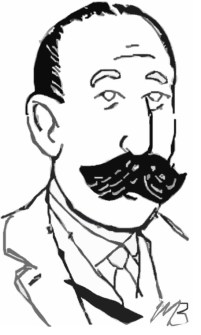
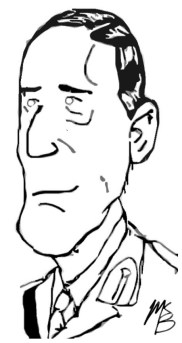
Lt-Col. White

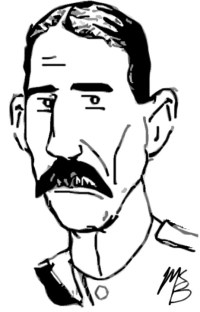
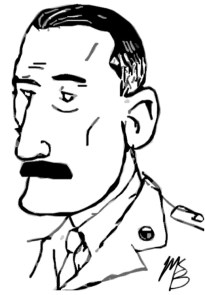
Lieutenant-Colonel S.R.L. White
1st Bn., Leinster Regiment (Royal Canadians)
White

The new colours which you have just present have yet to justify existence, but I have no hesitation in saying that we are willing to a man to do under them what we have done under the old ones, to keep them flying for the honour of the Regiment and the glory of the British Army, whether in this country or in any other where duty calls us to fight for our King and country.

(Col. White, 4 Feb 1913, in F.E. Whitton, The History of the Prince of Wales’s Leinster Regiment, vol. 1, 167)

Samuel Robert Llewellyn White was born in Blackrock, County Dublin, Ireland, on 4 June 1863. He was commissioned with the Leinster Regiment in 1885 and served as a captain during the Boer War, for which he was awarded the Distinguished Service Order. He became commanding officer of the 1st Battalion in 1911. As the unit was stationed in Fyzabad, India at the outbreak of the Great War, it did not arrive to France until December 1914.

Continue reading

The Royal Canadians

A Brief History of
The Prince of Wales’s Leinster Regiment
(Royal Canadians)

Despite the contradictory and rather absurd title the regiment still clings to the reminders of its Canadian origin, displays the Maple Leaf on all public occasions, and its band plays “The Maple Leaf” before God Save the Queen.

(Mrs. Thomas Ahern, “Historical sketch of the 100th Prince of Wales Royal Canadian Regiment,” 11 May 1900, 14)

If the Canadian Expeditionary Force could raise battalions nicknamed the “Irish Rangers,” the “Irish Fusiliers,” and the “Irish Guards” during the First World War, then why shouldn’t Ireland have had a British Army regiment known as the “Royal Canadians”?

Continue reading

Lt. Col. Franklin

Lieutenant Colonel W.H. Franklin, D.S.O.
Newfoundland Regiment and 1/6th Royal Warwick Regiment
Franklin

One gets heartily sick of this kind of fighting & the conditions are very trying. The line is much livelier the past 4 weeks & it looks as if the Germans would try one more big effort on this front soon, hope they will, as it would make our job easier. We are not far from the Somme so the past 2 weeks have been more trying.

 The present policy seems to be nightly raids from both sides. So far we have succeeded much better than the enemy at this game. I wish I had the Nflds were as they would be splendid at that kind of work.

 (Maj. W.H. Franklin to Governor Walter E. Davidson, 4 Feb 1916) 

Born in Lancashire, England in 1871, William Hodgson Franklin had immigrated to St. John’s, Newfoundland in 1891 and helped to organize a regiment on the outbreak of the Great War. He was commissioned as a captain but on arrival in England in October 1914, he transferred to the 1st Battalion, Suffolk Regiment. He deployed to France as a major with the 6th Battalion, Royal Warwick Regiment in March 1915. After a year, he assumed command of the battalion.

Continue reading

Brig-Gen. Sweny

Brigadier-General W.F. Sweny
4th Bn., Royal Fusiliers (City of London)
Sweny

The marriage of my father to Alice Roy took place October 28, 1885, and would have occurred at an earlier day had not opposition been made to this step on the ground of the deceased wife’s sister’s relationship, which in England, though not in Canada, was then a legal bar … [she wrote] “I consider that for me there can be no higher ideal than to become a mother to my sister’s two boys and to make their home what no other woman in the world could make it.” She always called herself our mother, instead of our aunt. 

(W.F. Sweny quoted in Montreal Gazette, 20 Feb 1925, 6)

Born in Belfast on 25 June 1873, William Frederick Sweny was the son of Colonel George Augustus Sweny, a veteran of the Indian Mutiny. After the death of his mother in 1880, he and his brother were cared for by his aunt who married his father in Toronto in 1885. After Sweny graduated from RMC, in 1893, he was commissioned in his father’s old regiment, the Royal Fusiliers (City of London). He served in South Africa and Egypt before he was attached to the Canadian militia in January 1914. He transferred back to the British Army at the outbreak of the Great War.

Continue reading

Lt. Gen. Alderson

Lieutenant General Edwin Alderson
Canadian Corps

Alderson

A great deal of my time is taken up in preventing men being appointed to command Brigades, Battalions, etc., who are not in the least fit, but who have influence. In most cases I have succeeded, and in others I have told them after they have been here a short time ‘I am very sorry, but it is my duty to tell you that you have not the experience, capacity, and above all, the personality to successful command men on active service,’ – and they have gone!

(Alderson to Robert Borden, 13 March 1916)

Sir Edwin Alfred Hervey Alderson was a professional British Army officer and first commander of the Canadian Corps. Born on 8 April 1859 in Capel St Mary, England, Alderson received his commission at seventeen and served in several African campaigns. He came out of semi-retirement after the outbreak of the First World War and was appointed to command the 1st Canadian Division in September 1914.  Due to disagreements about training, discipline, and officer selection, Alderson soon found himself subject to the vitriol and opposition of Canada’s bombastic militia minister Sir Sam Hughes. Continue reading

The One-Armed

Lieutenant Colonel D. F. Campbell, D.S.O., M.P.
2/7th Battalion, Duke of Wellington’s RegimentDFCampbell

I seldom press myself upon the House, and I will only to do so to-night for two or three minutes. I am actually one of only two soldiers left here to-night.

The thing is to get on with the War and banish everything that retards the progress of the War. I have had occasion several times to make criticisms of a military character during this War, but I have never done so in this House.

(Hansard, 10 Jan 1916, 1420)

Duncan Frederick Campbell was born on 28 April 1876 in in Simcoe, Ontario. After graduating from the University of Toronto in 1898, he received a commission to the Lancashire Fusiliers. Awarded the Distinguished Service Order for gallant service in the Boer War, Campbell retired from the Territorial Force in 1910. Following an unsuccessful political bid in the December 1910 British election, Campbell was elected Conservative Member of the British Parliament for North Ayrshire in a by-election one year later.

Continue reading

The Nobleman

Brigadier General Lord Brooke
4th and 12th Infantry BrigadesLordBrooke

All day long I had witnessed the tragedy of men “made in the image of God” bringing their utmost skill and science to the hateful task of mutual murder.

As an exhibition of scientific slaughter the firing was lacking in nothing. The range of the guns was exact, the shooting perfect. The shrapnel burst over the heads of the retreating troops, as it were in large patterns. There was no cover, no escape for the unhappy Russians. Under this awful hail of bullets the men dropped like wheat beneath the sickle of the reaper. Death most truly was gathering a rich harvest.

(Lord Brooke, An Eye-Witness in Manchuria, 1905, 131)

Born on 10 September 1882, Leopold Guy Francis Maynard Greville was the son of British Conservative MP Francis Greville, 5th Earl of Warwick (styled Lord Brooke) and Daisy Greville, Lady Warwick, a socialist socialite who had been mistress to King Edward VII. While a student at Eton, Lord Brooke ran away to fight in the Boer War. He was a press correspondent during the Russo-Japanese War and recounted his experiences in An Eye-Witness in Manchuria (1905).

Continue reading

Father Christmas

Lieutenant Colonel George B. Laurie
1st Battalion, Royal Irish RiflesLaurie

I used to be up at cockcrow when a small child on Christmas Day, to see what Santa Claus had brought me, and I shall be up early enough to-morrow in all conscience too, but for a different reason—standing to arms—so that I shall not get my throat cut.

Best of love to you for Christmas. Whilst you are in church I shall be in the trenches, but both doing our rightful duty, I trust.

(Lt-Col. Laurie to Wife, 24 Dec 1914)

On 25 December 1914, George Brenton Laurie was one of the few Canadian-born officers to witness the so-called Christmas truce in No Man’s Land. He recorded the encounter in a letter to his wife: “Then we saw both sides, English and German, begin to swarm out to meet each other; we thought it wiser to keep our men in, because we did not trust the Germans.” Suspicious, Laurie initially held his men back before going to investigate himself. As both side met, the Germans complimented the colonel on his battalion’s marksmanship and were eager to learn if the Canadian Division had arrived to the front yet. The armistice held for two days until both sides resumed the fighting.

Continue reading

The Aristocrat

Major General Jack Seely, M.P.
Canadian Cavalry Brigade Seely

It was at that time, when carrying out a smaller raid, that my horse got shell-shocked, though not myself, I hope, and fell on me and smashed up five bones in my poor old body. However, I managed to get back all right.

(Seely Speech, Empire Club of Canada, 4 Oct 1920)

John Edward Bernard Seely, 1st Baron Mottistone, was a British soldier and politician. Born on 31 May 1868 in Brookhill Hall, Derbyshire, he was the son of Sir Charles Seely (1833—1915), a long-serving Liberal Unionist MP. During the Boer War, Seely joined the Imperial Yeomanry and won the Distinguished Service Order. In 1900, he was elected to the House of Commons as a Conservative. In 1904, he switched to the Liberal Party and later became a cabinet minister in Prime Minister Herbert Henry Asquith’s Government.

Continue reading