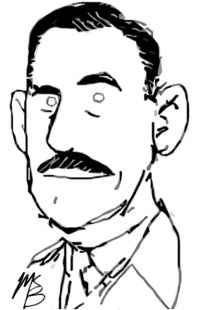
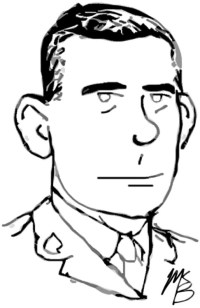
Lt-Col. H.C. Arrell

Lieutenant-Colonel H.C. Arrell
Royal Hamilton Light Infantry
Arrell

Major Arrell held court on the top floor of the convent. He explained to the attentive soldiers that their role was to stop the enemy if he attacked from the north. At all costs, they were to stop the Germans from overwhelming allied positions and gaining ground around Tilburg, Antwerp and Brussels. “In brief,” said a calm but somber Arrell, “we are a stand and die battalion, totally committed to stopping the enemy.”

(Kelly, “There’s a goddamn bullet for everyone …”, 285)

Born on 18 March 1914 in Caledonia, Ontario, Hugh Cameron Arrell graduated from the Ontario Agricultural Collage in Guelph and belonged to the Dufferin and Haldimand Rifles. In April 1940, he transferred as a lieutenant to the Royal Hamilton Light Infantry which went overseas that summer. He was promoted captain less than two years later and deployed to France with the regiment as a major in July 1944.
Continue reading

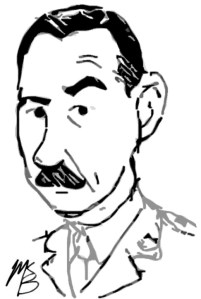
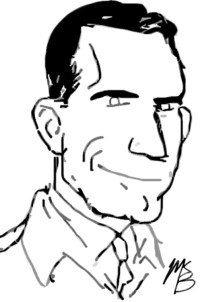
Lt-Col. G.M. MacLachlan

Lieutenant-Colonel G.M. MacLachlan
Royal Hamilton Light Infantry
MacLachlan

No scheme we ever did is anything like this for toughness, not so much in the sense of great forced marches but in the way of continual work, alarm, fatigue and nerve strain and unlimited dirt, cold and wet.

(MacLachlan letter, 23 Jan 1943)

Born on 4 June 1914 in Winnipeg, Graham Martin MacLachlan was a University of Toronto graduate, lawyer, and militia captain with the Royal Regiment of Canada. In January 1943, he was one of several Canadian officers selected to gain combat experience with the British Army in North Africa. After joining the 5th Battalion, Royal East Kent Regiment (The Buffs) in Tunisia, he wrote to a friend “Things have worked out wonderfully. I took a 2 1/c and at once stepped into a bit of fun. This bn is good and I have learned as much in 5 days as one learns in 3 mths in England.”

Continue reading

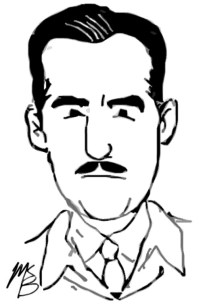
Lt-Col. W.D. Whitaker

Lieutenant-Colonel Denis Whitaker
Royal Hamilton Light Infantry
Whitaker

The ramp dropped. I led the thirty odd men of my platoon in a charge about twenty-five yards up the stony beach. We fanned out and flopped down just shorty of a huge wire obstacle. Bullets flew everywhere. Enemy mortar bombs started to crash down. Around me, men were being hit and bodies were piling up, one on top of the other. It was terrifying.

(Whitaker, Dieppe: Tragedy to Triumph, 243)

Born on 27 February 1915 in Calgary, William Denis Whitaker was a sportsman, soldier, equestrian, businessman, and historian. After attending the University of Toronto and RMC, where he excelled in hockey and football, he played quarterback for the Hamilton Tigers in the Ontario Rugby Football Union in the 1937-39 seasons. Having joined the city’s militia regiment, he mobilized for active service with the Royal Hamilton Light Infantry and went overseas in 1940. He would be one of the only officers to land at Dieppe and escape the beach unwounded.

Continue reading

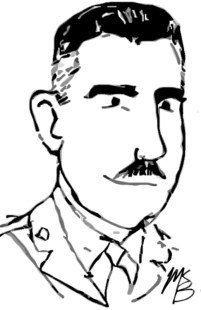
Brig. J.M. Rockingham

Brigadier John Rockingham
Royal Hamilton Light Infantry
9th Infantry Brigade
Rockingham

During the action, Lieutenant Colonel Rockingham completely embodied the qualities of the infantry commander. He showed great coolness, good judgement, determination and ability as a leader. His dash and offensive eagerness infected the whole battalion and contributed in no small degree to the success attained.

(D.S.O. citation, 2 Aug 1944)

Born on 24 August 1911 in Sydney, Australia, John Meredith Rockingham grew up in Canada, Barbados, England, and Australia before permanently settling in British Columbia in 1930. Commissioned for several years with the Canadian Scottish Regiment, he mobilized for overseas service in 1940. Two years later he transferred to the Royal Hamilton Light Infantry, which had sustained heavy losses in the Dieppe Raid of 19 August 1942. He became second-in-command and succeeded Lieutenant-Colonel J.J. Hurley in April 1943.

Continue reading

Lt-Col. J.J. Hurley

Lieutenant-Colonel J.J. Hurley
Royal Hamilton Light Infantry
Hurley

If the government of Canada intends to erect a war memorial in Europe in memory of her dead of the Second Great War, I suggest it be a living memorial, not another Vimy Memorial, which, however, is a beautiful piece of work.

(Quoted in Brantford Expositor, 11 Jun 1946, 2)

Born on 13 August 1897 in Brantford, Ontario, James Joseph Hurley was a First World War veteran, businessman and commanding officer of the Dufferin and Haldimand Rifles. When that regiment was not mobilized for active overseas service, Hurley reverted to major to embark with the Royal Hamilton Light Infantry as second-in-command. In England, he was promoted back to lieutenant-colonel to head of No. Army Tactical Training School.

Continue reading

Lt-Col. R.R. Labatt

Lieutenant-Colonel Bob Labatt
Royal Hamilton Light Infantry
Labatt

I hope you all came through safely. We will have to celebrate Dieppe every year at the mess after this … Little did I dream when I wrote the history of the Regt. that the biggest story was still to be told. I know from a very undistinguished experience in 1916 what a grim business “shows” infinitely smaller that your can be, and this makes one realize what a test you have come through … I wish I could be with you.

(E.D.H. Boyd to Labatt, 20 Aug 1942)

Born on 25 January 1903 in Wentworth, Ontario, Robert Ridley Labatt was the son of First World War battalion commander and pension commissioner Lieutenant-Colonel Robert Hodgetts Labatt (1864-1919). He attended RMC and took a commission with the Royal Hamilton Light Infantry (RHLI) in 1923. A stockbroker in civilian life, he also served as battalion adjutant from 1932 to 1936. Labatt succeeded Lieutenant-Colonel H.G. Wright in command of the RHLI in April 1940. The regiment departed for England that summer and Labatt would lead regiment ashore at Dieppe two years later on 19 August 1942.

Continue reading