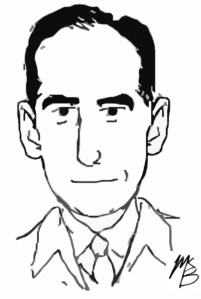
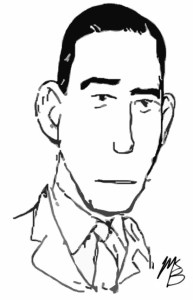
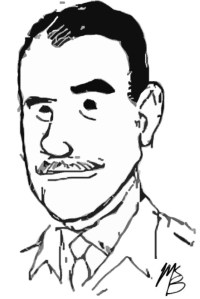
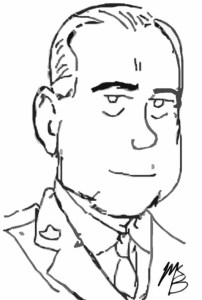
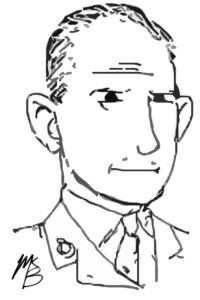
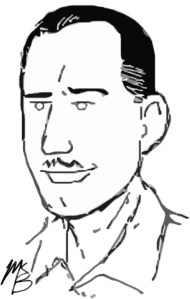
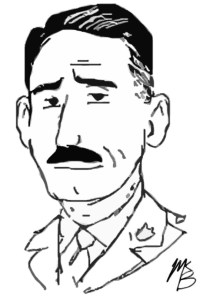
Lt-Col. R.A. Bradburn

Lieutenant-Colonel Bob Bradburn
Algonquin Regiment
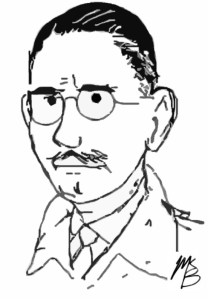
This officer has the knack of ‘rubbing people the wrong way.’ He is inclined to be positive in his ideas. He was NOT very popular with his fellow students. However, he seemed to recognize that he was at fault in some way & was seeking guidance. A big improvement was noted in his general attitude during the last month.

 (RMC Company Commanders Course report, 25 Sep 1941)

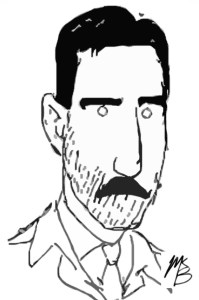
Born in Edmonton in 1909, Robert Archibald Bradburn was a golfer, sportsman, president of the city’s athletic club and militia officer. Commissioned in the 19th Alberta Dragoons since 1929, he mobilized for active service with the Edmonton Regiment in 1939 and went overseas as a captain in the South Alberta Regiment in 1942. The unit deployed as the 29th Armoured Reconnaissance Regiment to Normandy with the 4th Division in July 1944.
Continue reading

Lt-Col. A.J. Hay

Lieutenant-Colonel Art Hay
Argyll and Sutherland Highlanders of Canada
Algonquin Regiment

I knew when we landed in Normandy last July that I had with me the “fightingest” outfit in the Canadian Army and you have exceeded all my expectations. Though, to my bitter regret, I was not able to be with you after the middle of August last year, my thoughts and heart at least went with you.

(Hay, Teepee Tabloid, 19 Jul 1945, 2)

Born on 8 April 1909 in Killarney, Manitoba, Arthur John Hay was a Hamilton salesman and adjutant for Argyll and Sutherland Highlanders of Canada (Princess Louise’s). In September 1941, the battalion was dispatched for garrison duty in Jamacia, where Hay acted as instructor at the island’s tactical school. In May 1943, the A&S Highlanders were recalled to Canada in preparation of overseas service. As First World War veteran Lieutenant-Colonel Ian Sinclair was overage, Hay led the battalion to the United Kingdom in August 1943.

Continue reading

Brig. W.J. Megill

Brigadier W.J. Megill
Algonquin Regiment
5th Infantry Brigade

It was perfectly clear that the attack should have been called off at a very early stage in the morning. I suggested this not later than perhaps 8:00 or 9:00 o’clock. Instead the Corps commander was pressing the divisional commander and he was pressing us to get on with an attack which we knew was almost hopeless. Under these circumstances one does not quit. You do as much as you possibly can and hope that someone will see the light and give you some relief.

(Quoted in Copp, The Brigade, 88)

Born in Ottawa on 26 June 1907, William Jemmett Megill was a graduate of Queen’s University and RMC who had risen from the ranks of the Royal Canadian Corps of Signals which he joined in 1923. He was attending staff college in India when the Second World War began. Following general staff appointments with 3rd Division headquarters, he was promoted to brigadier with I Canadian Corps headquarters in June 1943. General Harry Crerar, described him as “the type of man who needs to experience in order to know. He is not what I would call imaginative … his lack of field experience definitely handicaps him.” To gain command experience, Megill request a revision in rank to lieutenant-colonel and was posted to the Algonquin Regiment in October 1943.

Continue reading

Maj. M.L. Troy

Major Leo Troy
Algonquin Regiment

In every lane, park and woodland you could see tanks, track to track, bullbozers, trucks, armoured cars, stretching for miles and miles. There was such an incredible amount of equipment you would think the little island would sink under its weight. And behind the vehicles was stored the greatest amount of ammunition in the world’s history, more than was used in the entire First Great War, and all in preparation for the invasion.

(Quoted in North Bay Nugget, 16 Oct 1945)

Born on 29 October 1894 in Chatham, New Brunswick, Martin Leo Troy was a physical education teacher and coach in North Bay, Ontario. A First World War veteran, he had served overseas with the Canadian Cyclists and remained active in the postwar militia. He helped to recruit the Algonquin Regiment and mobilized as “B” Company commander in 1940. He organized battalion sports and succeeded Lieutenant-Colonel J.B. Stewart before it embarked overseas in June 1943.

Continue reading

Lt-Col. J.B. Stewart

Lieutenant-Colonel J.B. Stewart
Algonquin Regiment

We may be a little short on material riches such as hat and shoulder badges, battle honours for our coat sleeves … But what we lack in some of these little things we make up in others—intangible, yet so apparent that we have but to pass before the people of our country and we are accepted for what we are—a great regiment.

(RSM Balfe Bradley, Winnipeg Tribune, 20 Nov 1941, 14)

Born on 3 February 1890 in Duluth, Minnesota, John Bain Stewart had belonged to the Queen’s Own Rifles of Toronto and worked as a contractor in North Bay, Ontario before the First World War. He was commissioned as captain and adjutant in the 159th Battalion in November 1915. Once overseas, he reverted to lieutenant to join the 4th Battalion, Canadian Railway Troops and later transferred to the 4th Canadian Mounted Rifles. After the war, Stewart joined the Algonquin Regiment, which perpetuated the 159th.

Continue reading

Lt-Col. J.F. Swayze

Lieutenant-Colonel Jim Swayze
Lincoln and Welland Regiment

All ranks are held together by the fear of having their peers realize that they too are afraid, particularly among those of the social system to which we belong … It’s very, very difficult to have them men come to the situation where you realize that you’re going to say “charge” and they’re going to get up and run across a field and fire their weapons at someone else and; at the same time, there’s a fair chance that they’re going to get hit.

(Swayze quoted in Hayes, “The Friction of War,” 218)

Born on 1 January 1916 in Niagara Falls, Ontario, James Fletcher Swayze was an athlete and graduate of McMaster University. He was commissioned with the Lincoln and Welland Regiment and served as company commander for much of the Northwest Europe campaign. In the final days of the war as the battalion pushed into Germany, Lieutenant-Colonel R.C. Coleman said to him “You put in the first attack of the Lincoln and Welland. Now I want you to put in the last.” As Swayze recalled, “And I took A company and moved forward a thousand yards and stopped and that was the last we made.”

Continue reading

Lt-Col. J.G. McQueen

Lieutenant-Colonel Jack McQueen
2nd Canadian Parachute Battalion
Lincoln and Welland Regiment

He looked like a real soldier, but he was one of the yellowest men in the army … But a regiment is only as good as its leaders, and out leader, Colonel McQueen, was simply no good. A good peacetime soldier and a disciplinarian, but he didn’t have the guts of a rabbit. And he could not plan a battle and carry it out. At Butcher Hill, he got down in a hole and would not come out … When we came down off the hill, he kept right on going, and we were all glad to see the end of him.

(Charles D. Kipp, Because We Are Canadians, 58)

Born on 7 July 1913 in Medicine Hat, Alberta, John Grant McQueen was supervisor with the Dominion youth training program and member of the South Alberta Regiment since 1927. Commissioned in 1935, he volunteered with the Calgary Regiment on the outbreak of the Second World War. In July 1942, he was recalled from the United Kingdom to join the joint Canadian-American 1st Special Service Force then training in Montana.

Continue reading

Lt-Col. C.A. Muir

Lieutenant-Colonel C.A. Muir
Lincoln and Welland Regiment

We aren’t a Field Unit yet and are still attached to Reinforcements but the Colonel and most of the old crowd are carrying on just as if we were back in Canada. I am one of the outcasts in the Unit because I want to train men to fight while this bunch of phoney peace-time soldiers run a social club.

(Anonymous officer’s letter, Sept 1943 censor report)

Born on 26 November 1896 in Glasgow, Scotland, Charles Andrew Muir moved to Canada as a teenager and settled in Hamilton. He enlisted with the 36th Battalion in April 1915 and reinforced the 4th Battalion in France. After a year at the front, he was put out of action by shrapnel at the Somme in October 1916. During the First World War, two brothers were wounded while another two were killed.

Continue reading

Lt-Col. R.S.W. Fordham

Lieutenant-Colonel R.S.W. Fordham
Lincoln and Welland Regiment

It is sometimes extremely difficult to make certain Refugees comfortable and happy in any sense of the words, as instance occur where they seem anxious to find fault and complain … Actually, many changes have been made of late for the benefit of Refugees, and it is probably correct to say that nowhere are they treated better than in Canada.

(Fordham quoted in Eric Koch, Deemed Suspect, 216)

Born on 9 May 1897 in London, England, Reginald Sydney Walter Fordham was a lawyer in Niagara Falls and a First World War veteran. He had joined the 98th Battalion as a lieutenant in December 1915 and joined the 13th Battalion in France at the end of September 1916. Less than two weeks later he went missing in action and spent almost the next two years a prisoner of war. He returned to law practice after the war and in July 1936 became commanding officer of the Lincoln and Welland Regiment.

Continue reading

Lt-Col. H.H.A. Parker

Lieutenant-Colonel Harry Parker
Lake Superior Regiment

The question of returning to Canada is one which is of great interest to all of us, and naturally there has been a lot of discussion about it. Unfortunately, the army is a great breeding place for rumours—mostly of the ‘latrine’ variety—and this subject has proved itself to be just as fruitful in the production of rumours as any that has ever been under discussion. So I’m going to ‘put you in the picture’, as far as I know it myself, to give you some idea of what the future holds.

(War diary, Fifty Forum, 20 Jul 1945)

Born on 25 May 1915 in Lockerbie, Scotland, Henry Hugh Alexander Parker was a University of Toronto graduate and insurance agent. He enlisted with the 48th Highlanders and went overseas with the 1st Division. He returned to Canada in 1942 to be an instructor at RMC before joining the staff of the 4th Armoured Brigade headquarters. He served as assistant adjutant and quartermaster-general of the brigade during the Normandy campaign. In September 1944, he was appointed second-in-command of the Lake Superior Regiment under Lieutenant-Colonel Bob Keane.

Continue reading