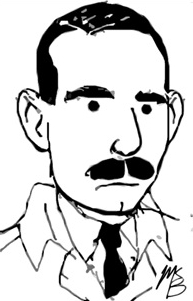
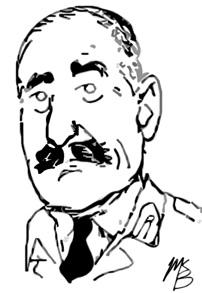
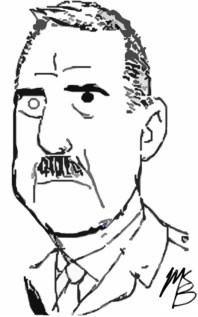
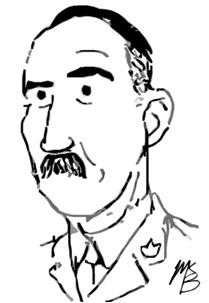
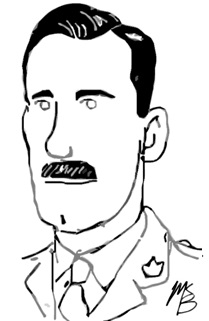
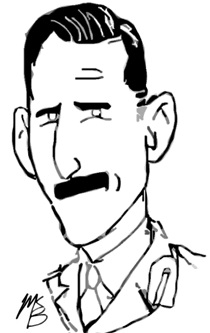
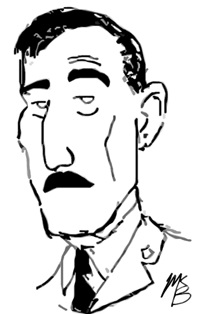
Lt-Col. C.A. Richardson

Lieutenant-Colonel Stoney Richardson
14th (Calgary) Tank Regiment
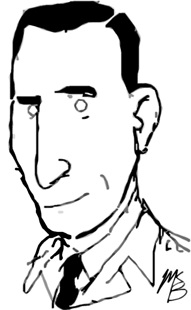
“He was unique in the army,” said Fred Ritchie, his second-in-command. “He was the ideal colonel; spit and polish didn’t impress him. He rolled dice with his boys, and still had their respect.”

(Maclean Kay, Globe and Mail, 29 Aug 2007)

Born in Vegreville, Alberta on 12 October 1908, Clinton Argue (Stoney) Richardson was a store grocer when he joined the Calgary Regiment on mobilization in February 1941. He earned a temporary commission prior to the unit going overseas in June 1941 and became regimental quartermaster. Known as “old stone face,” Richardson soon came to be nicknamed Stoney. He served with the Calgary Tanks for the whole duration of the war from mobilization in March 1941 to demobilization in December 1945 when he led the regiment home as commanding officer.
Continue reading

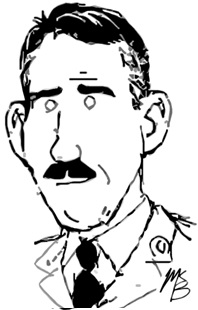
Lt-Col. C.H. Neroutsos

Lieutenant-Colonel C.H. Neroutsos
14th (Calgary) Tank Regiment
Neroutsos

There was such a tremendous loss of life that it will be very hard to treat it in an objective way. These are not tapes of historians, they’re merely tapes of a man who happened to be there with all his weaknesses and his emotions. And I do not know how far I want to go.

(C.H. Neroutsos tapes, undated)

Born in Victoria, British Columbia on 24 August 1904, Cyril Houlton Neroutsos was a McGill University graduate and marine and aviation representative for International Paints Canada Ltd. A prewar reserve officer in the machine gun brigade, in September 1939, he volunteered with the Three Rivers Regiment, which would be redesignated a tank battalion in the armoured corps. He served as second-in-command of the 12th Tank (Three Rivers) Regiment overseas while the Canadian tank brigade trained in the United Kingdom.

Continue reading

Lt-Col. J. Begg

Lieutenant-Colonel John Begg
14th (Calgary) Tank Regiment

It’s a personal war with this unit now. We were the first Alberta regiment and the first armored regiment to see action. Give us time to refit and we’re going back.

(Begg in Calgary Herald, 24 Aug 1942, 1)

Born in Lanarkshire, Scotland on 18 Mar 1899, John Begg had started in the Cyclists Corps in the First World War and commanded a tank regiment in the second. An accountant with the Canadian National Railway, he had been commissioned in the Calgary Regiment in 1922 and became a major in 1936 when it was redesignated a tank battalion. He served as second-in-command stationed with the “floating reserves” during the Dieppe Raid on 19 August 1942.

Continue reading

Lt-Col. J.G. Andrews

Lieutenant-Colonel Johnny Andrews
14th (Calgary) Tank Regiment
AndrewsJG

There is just one chance in a thousand that he is alive, but that is the way he would have liked to go if he had to go … I can well imagine John leaving his tank and leading a charge on the enemy pillboxes on foot. He was just that type.

(Andrews’ father to Toronto Star, 22 Aug 1942)

Born on 18 February 1909 in Elgin, Ontario, John Gilby Andrews had joined the Permanent Force in 1930, attended RMC, and was former instructor at the Armoured Fighting Vehicles School. On the formation of 1st Army Tank Brigade in March 1941, he was appointed brigade major and by December had succeeded Lieutenant-Colonel G.R. Bradbrooke in command of the Calgary Tank Regiment overseas.

Continue reading

Brig. G.R. Bradbrooke

Brigadier G.R. Bradbrooke
14th (Calgary) Tank Regiment
5th Armoured Brigade
Bradbrooke

 I think a made a success of every command I had. But what annoyed me was that I never was able to use those units, I never got into a fight. I never got into a battle. That was my disappointment in the Second World War.

(Bradbrooke, interview, 29 May 1980)

Born on 1 November 1896 in Blatchley, England, Gerard Renvoize Bradbrooke was a decorated First World War veteran and long serving army officer. A self-described “puny little runt,” he had first enlisted as bugler in November 1914, served as a machine gunner in the trenches, and was commissioned from the ranks in May 1917. Twice wounded, he earned the Military Cross at Passchendaele. “Mud was up to you knees,” he later explained. “I remember moving forward … and here were British infantry lying dead in waves.”

Continue reading

Lt-Col. W.K. Jull

Lieutenant-Colonel W.K. Jull
Calgary Highlanders
Jull

He went forward under heavy fire to reconnoitre the enemy’s dispositions. He succeeded in reaching his objective and brought back valuable information. Later, when the company on the left flank was held up by an enemy machine-gun nest, he rushed forward and succeeded in killing three of the crew and capturing the remainder, thus allowing the company to continue its advance.

(M.C. citation, 4 Oct 1919)

Born on 20 October 1891 in Rosen, Manitoba, Walter Kingsley Jull was a Calgary barrister and commanding officer of the Calgary Regiment since May 1938. As a law student he had enlisted with 31st Battalion in November 1914. He was three times wounded in action, earned a commission in February 1917, and received the Military Cross for “marked courage” in October 1918. Following the reorganization of the postwar Canadian militia, he became a captain in the Calgary Regiment in 1923 and second-in-command in 1931.

Continue reading

Lt-Col. D.E. Walker

Lieutenant-Colonel Drayton Walker
Saskatoon Light Infantry

We will NOT be neutralized. Nothing the enemy can do will be allowed to stop our fire. We have not the honour, nor do we have the sacrifices of hand-to-hand combat, but we can ensure that we will never be called upon in vain to answer a call for fire. Whatever the entails, whether it be selection of positions, preparation of gun or mortar sites or state of readiness, it will be done.

(Walker, Part 1 Orders, war diary, 16 Jan 1945)

Born on 16 May 1900 in Maple Creek, Saskatchewan, Drayton Earnest Walker was a Saskatoon teacher and militia officer. Commissioned in the Prince Albert Volunteers since 1922, he volunteered for active service with the Saskatoon Light Infantry at the rank of major in September 1939. He put his teaching skills to use instructing NCOs and new officers on military duties, Newly commissioned Lieutenant H.C. Mitchell wrote of this training under Walker’s guidance: “In three weeks we covered the rudiments of army life as for a machine gunner. I have always regarded that course as being the initial base upon which the record of our battalion was built.”

Continue reading

Lt-Col. A.W. Embury

Lieutenant-Colonel Alan W. Embury
Saskatoon Light Infantry

Mr. Embury charged that Socialism was the same whether it was national Socialism of Fascism or Nazism or the Russian Socialism “of our local talent.” The system had never worked in any place where tried and it meant the loss of personal and individual freedom and control and domination by the Socialists …. What sensible differences can there be between a pro-Russian Socialist and a Communist?

(Leader-Post, 1 May 1948, 10)

Born on 5 November 1907 in Regina, Saskatchewan, Alan Williams Embury was a Saskatoon lawyer, RMC graduate and son of First World War brigadier and judge J.F.L. Embury. He served as adjutant with Saskatoon Light Infantry overseas before transferring to the judge advocate general branch. His legal training served him well in many different roles in court martial proceedings as prosecutor, court member and judge advocate.

Continue reading

Brig. J.A. Calder

Brigadier J. Allan Calder
Royal Montreal Regiment
Saskatoon Light Infantry
1st Infantry Brigade

If I had known then what I know now, I would have refused the order. Of course, refusing an order is a “no-win” proposition, because it can never be proved what would have happened if the order had been carried out.

(Calder interview, quoted in Dancocks, D-Day Dodgers, 390)

Born in Montreal in 1908, James Allan Calder joined the Canadian Officer Training while a student at McGill University and was commissioned with the Royal Montreal Regiment in 1930. He went overseas as a battalion adjutant in December 1939 and took command in April 1941, succeeding Lieutenant-Colonel G. Victor Whitehead. In January 1943, Calder was promoted to colonel with the Canadian Reinforcement Depot in Italy. He reverted to lieutenant-colonel a year later when finally appointed to a battlefield command.

Continue reading

Maj. R.C. Irvine

Major Bobby Irvine
Saskatoon Light Infantry

I consider from the evidence that Major R.C. Irvine died from injuries in circumstances which do not indicate improper conduct as defined by Overseas RO 2022 or negligence on his part. I direct that no disciplinary action be taken.

(Court of Inquiry, 24 Jul 1944)

Born on 12 June 1911 in Sutherland, Saskatchewan, Robert Cyler Irvine was assistant manager with the Eaton department store in Regina. He transferred from the Regina Rifles to go overseas with the Saskatoon Light Infantry in December 1939. He served as platoon leader, adjutant, and quartermaster during training in the United Kingdom. Lieutenant R.C. Mitchell described him as “a glib organization man—the kind of person a farmer suspects of relying on his tongue to carry him rather than actual performance. Actually, later on, Bobbie served on Brigade staff and was considered a valuable man.”

Continue reading