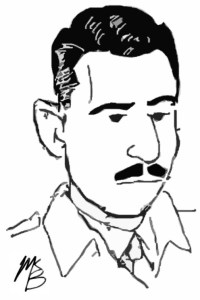
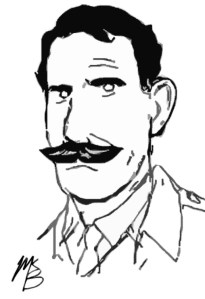
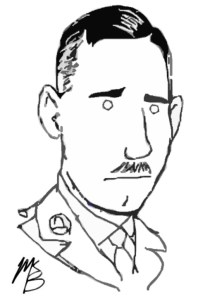
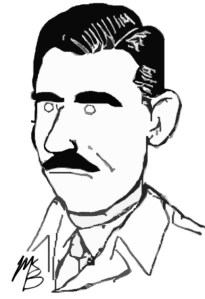
Lt-Col. F.M. Griffiths

Lieutenant-Colonel Frank Griffiths
Highland Light Infantry of Canada
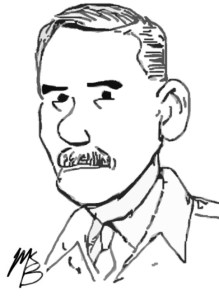
Although all good biographies start with date and place of birth, Nifty would be the most disappointed man in the would if one failed to refer to Niagara Falls. Griff, though small of stature has an enviable record as an athlete … His infectious good humour and endless supply of good jokes has helped us over many a blue day.

(RMC Review, Class of 1931, 30)

Born in Niagara Falls, Ontario, on 2 October 1909, Franklyn McCallum Griffiths was a graduate of the Royal Military College and an Osgoode Hall-trained lawyer in Niagara. He had belonged to the Lincoln and Weiland Regiment before the Second World War and transferred to the Royal Canadian Regiment in late 1939. He completed a course at RMC in 1942 and served as brigade major and staff officer when he went back to England.
Continue reading

Lt-Col. R.F. Shantz

Lieutenant-Colonel R.F. Shantz
Highland Light Infantry of Canada

There are a lot of jobs in England at the present time that could be done by women … I feel that more girls could have been enlisted a long time ago. If that had been the case, the Canadian army wouldn’t need the reinforcement it does today.

(Quoted in news clipping in HLIC War Diary, Apr 1944)

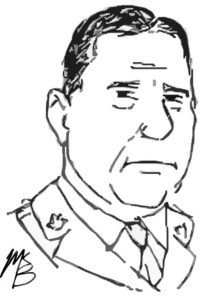
Born in Preston, Ontario on 24 June 1905, Robert Frederick Shantz was superintendent for the family foundry business and member of the Highland Light Infantry since 1924. He joined as drum major, was commissioned in 1925, promoted to captain in 1932, and promoted to major in 1935. He succeeded Lieutenant-Colonel H.W. Foster to take command of the battalion in February 1943.

Continue reading

Lt-Col. R.J. McPherson

Lieutenant-Colonel R.J. McPherson
Highland Light Infantry of Canada

Made of good, solid stuff … would do well despite conservative ideas and limited imagination.

(Bernard Montgomery quoted in English, Monty and the Canadian Army, 68)

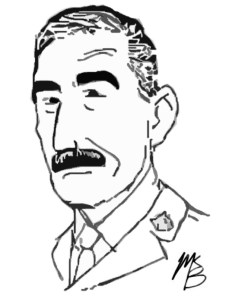
Born on 20 March 1906 in Puslinch, Ontario, Robert John McPherson was a prewar member of the Highland Light Infantry in Galt and mobilized as second-in-command in 1940. He succeeded Lieutenant-Colonel J.A. MacIntosh in January 1942. The next month, during his inspection of the 9th Infantry Brigade, General Bernard Montgomery, thought McPherson “good stuff” with promise to do well, although Monty also noted that the newly promoted colonel evidently lacked imagination.

Continue reading

Lt-Col. J.A. McIntosh

Lieutenant-Colonel J.A. McIntosh
Highland Light Infantry of Canada

A good Officer. Reliable and energetic. Even tempered and tactful, and can command men. Has worked very well during the Course, has gained much in self-confidence, and shows great improvement in expressing his intentions both verbally and on paper. With a little more experience should make a good C.O.

(Senior Officer School report, 16 Mar 1918)

Born on 10 December 1885 in Galt, Ontario, John Alexander McIntosh was an accountant and commanding officer of the Highland Light Infantry since 1937. He had enlisted with the 18th Battalion in November 1914. He deployed to France September 1915, was promoted to captain in January 1916 and became a major six months later. He served ten months as 18th Battalion second-in-command before he attended senior officer school. He was twice wounded, twice mentioned in despatches, and received the Distinguished Service Order.

Continue reading

Lt-Col. J.N. Gordon

Lieutenant-Colonel Neil Gordon
North Shore Regiment

But Gordon was right out in front of us, knowing full well what to expect, when they really started to open fire on us. We jumped off the tanks and kept on moving. Then they started to knock out tanks. I saw the major reach up to his face and then he kept on moving for a few minutes and then he went down. A bullet went through the side of his face, took all his teeth out and went out the other side.

(David Arksey quoted in Testaments of Honour, 295)

Born on 13 November 1914 in Toronto, James Neil Gordon was a graduate of Upper Canada College and a salesman. He joined the Queen’s Own Rifles in July 1940 and received a commission one month later. He commanded “D” Company on D-Day and suffered a wounded to the face on 11 June 1944. Major Ben Dunkelman of the QOR recalled seeing “his face swathed in heavy bandages, after being shot through both cheeks. He was unable to speak, though it was unclear whether this was caused by his injury or his sorrow—most of D Company, a fine body of men, had been lost in the first few terrible moments of the attack.”

Continue reading

Lt-Col. J.W.H. Rowley

Lieutenant-Colonel John Rowley
North Shore Regiment

As lieutenant-colonel, commanding the North Shore (New Brunswick) Regiment, I selected Major John Rowley, Cameron Highlanders of Ottawa, who won my heart on his first and only interview with me when he said, ‘Sir, I can have no greater honour bestowed upon me than to command a Canadian regiment in battle.’ He was a romantic, not bombastic, and what he did with his first command is unbelievable.

(Gen. J.A. Roberts, The Canadian Summer, 104)

Born on 2 December 1912 in Ottawa, John William Horsley Rowley had a law degree from Dalhousie University and was a barrister-at-law in the nation’s capital. He took a commission with the Cameron Highlanders of Ottawa in 1932 and was promoted captain in September 1939. Following garrison duty in Iceland in 1940-41, he served as instructor at the company commander school in England then took up staff duties with 3rd Division, 8th Infantry Brigade, and First Canadian Army in 1942.

Continue reading

Lt-Col. J.E. Anderson

Lieutenant-Colonel Ernie Anderson
North Shore Regiment

I am sure that at some time during the attack every man felt he could not go on. Men were being killed or wounded on all sides and the advance seemed pointless as well as hopeless. I never realised until the attack on Carpiquet how far discipline, pride of unit, and above all, pride in oneself and family, can carry a man even when each step forward meant possible death.

(Quoted in Will Bird, North Shore (New Brunswick) Regiment, 269)

Born on 24 August 1911 in Burnt Church, New Brunswick, James Ernest Anderson had a law degree from the University of New Brunswick. He joined the North Shore Regiment as a lieutenant in 1940 and served as “D” Company commander on D-Day, witnessing some of the some brutal fighting in Normandy. Nicknamed “Uncle Ern,” he rose to be second-in-command and succeeded Lieutenant-Colonel D.B. Buell when he was wounded on 10 August 1944.

Continue reading

Lt-Col. D.B. Buell

Lieutenant-Colonel Donald Buell
North Shore Regiment

My unit won the award for me. I’m a permanent force man myself—Royal Canadian Regiment—but I would not want any tougher men with me than those New Brunswickers of our unit. On D-Day they were told to take certain objectives and they did just that.

(Vancouver Sun, 24 Oct 1944, 3)

Born on 1 July 1905 in Brockville, Ontario, Donald Bowie Buell was an RMC graduate, Permanent Force officer with the Royal Canadian Regiment, and instructor at RMC. His father, grandfather, great-grandfather and great-great-grandfather had all been colonels in the Canadian army. In late 1939, he transferred from RMC to be general staff officer with national defence headquarters. Overseas he was next appointed second-in-command of the North Shore Regiment and replaced Lieutenant-Colonel J.R. Calkin in September 1942.

Continue reading

Lt-Col. J.R. Calkin

Lieutenant-Colonel J.R. Calkin
North Shore Regiment

During the attack north of Cambrai on the night of 8th October, 1918, he was in charge of a platoon detailed to secure bridgehead at Morenchies … He led his company across He led his company across under very heavy machine-gun fire, and, working to the right, captured the enemy posts which were holding Morenchies bridgehead. He did excellent work.

(M.C. citation, 17 Dec 1918)

Born on 6 January 1895 in Sackville, New Brunswick, James Ryan Calkin was town manager of Woodstock and long-time militia officer. He had enlisted with the 140th Battalion as a private and earned a field commission with the 26th Battalion in February 1917. He was three-times wounded in action and earned the Military Cross for leading an assault near Cambrai in October 1918. Following the First World War, he joined the Carleton and York Regiment and transferred to the North Shore Regiment to be second-in-command in 1940.

Continue reading

Lt-Col. J.A. Leger

Lieutenant-Colonel J.A. Leger
North Shore Regiment

The North Shore most regretted saying goodbye to Lt.-Col. Leger, who had given his all to make the unit a real Regiment. He had spent more than thirty years soldiering, knew every man, and the Unit was to him his very heart’s blood.

(Will Bird, North Shore (New Brunswick) Regiment, 119)

Born on 3 November 1889 in Saint-Louis de Kent, New Brunswick, Joseph Arthur Leger was foreman for the Canadian National Railway in Newcastle and later town councillor. He had been commissioned in the 26th Battalion and served in France in 1915. He returned home to become second-in-command of the 165th Battalion under Lieutenant-Colonel D’Aigle. After the Acadian-recruited unit was broken up, Leger returned to France as part of the Canadian Forestry Corps. He demobilized as a major but remained in the militia and took command of the North Shore Regiment in May 1938.

Continue reading