The Irish Champion

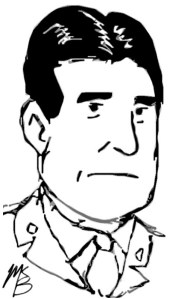
Lieutenant Colonel Harry Trihey
199th (Duchess of Connaught’s Own Irish Rangers) BattalionTrihey
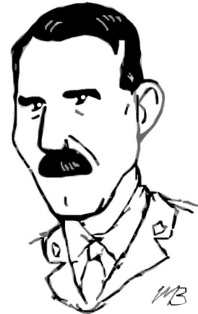
Moreover the confidence of those interested in the Regiment is absolutely in Colonel Trihey, Should his perhaps too hasty action result in his being deprived of its command and prevent his leading it to the front, the reward of the sacrifices he has made and is willing to continue to make, will be that he will be held up to the public as having deliberately deceived and misled these men.

(Doherty to Borden, 9 Feb 1917)

Henry Judah Trihey was an amateur hockey player for the Montreal Shamrocks between 1897 and 1901. Regarded as one of the best forwards of his time, Trihey won two Stanley Cups with the team and played a crucial role in defending the championship during three challenge games. He was born on 25 December 1877 in Berlin, Ontario. After his hockey career, he became a barrister in Montreal.
Continue reading

The Minister

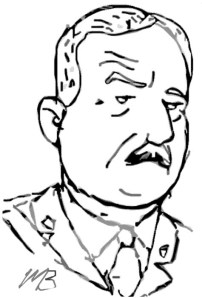
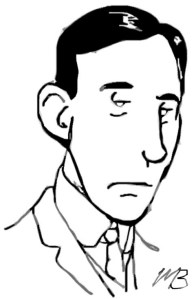
Lieutenant Colonel C. C. Ballantyne
245th (Canadian Grenadier Guards) BattalionBallantyne

Mr. HUGHES: The hon. gentleman on his return from overseas, was one of the most wrathy men I ever met.

Mr. BALLANTYNE: Disappointed.

Mr. MCMASTER: The remarks of the ex-Minister of Militia may be very interesting, but I would ask him to speak a little louder, so that we all may get the benefit of them.

Mr. HUGHES: I was saying that the present Minister of the Marine and Fisheries, on his return from England was—I will not say the maddest man, but one of the most intensely disappointed men that it has ever been my privilege to meet.

(Debates, 10 Apr 1918, 597)

Born on 9 August 1867, Charles Colquhoun Ballantyne was a Montreal industrialist and millionaire through marriage. He raised the 245th Battalion in late 1916 and departed for England with less than three-hundred volunteers in May 1917. After the breakup of his unit, Ballantyne became one of the hundreds of unemployed senior officers in London.

Continue reading

The Undead

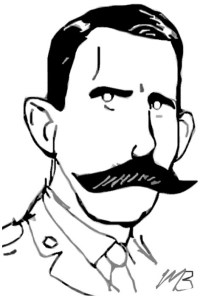
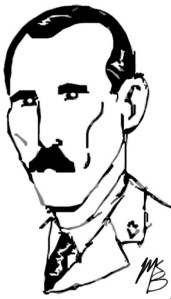
Lieutenant Colonel Joseph A. Dansereau
69th (Canadien-Français) Battalion

I made Lieutenant Dansereau my acting adjutant. He was my scout master and signalling officer, and when I went into the trenches either he or one of the other young rascals would step up smartly and start a conversation when I was passing a dangerous spot. I noticed that these escorts always got between me and the German lines so that if a bullet came they would get it first. This touched me very deeply but I made them stop it. No commanding officer was ever served more devotedly by his officers than I have been.

(J. A. Currie, The Red Watch, 1916, 176)

Born on 15 November 1890 in Montreal, Joseph Adolphe Dansereau was the son of Clément-Arthur Dansereau (1844—1918), influential Liberal journalist and editor of La Presse. A graduate of the Royal Military College and member of the Corps of Guides, the twenty-five year old Dansereau was one of the youngest CEF colonels when he was appointed to raise the 69th Battalion from Montreal in July 1915.

Continue reading

The Unlucky

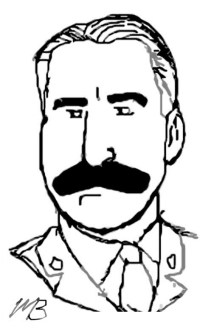
Lieutenant Colonel Victor C. Buchanan, D.S.O. †
13th (Royal Highlanders of Canada) BattalionBuchanan

We then start to dig in where Col. Buchanan and Maj. Peterman had been buried but find their dead bodies. They must have died instantly. Apparently something must have exploded the gasoline and the shock brought in the weakest part of the dugout.

(Lieut. H.A. McCleave, 13th Bn., Diary, 28 Sept 1916)

During heavy German bombardment on the evening 26 September 1916, a shell struck the 13th Battalion headquarters. The explosion killed several senior officers including Lieutenant Colonel Victor Carl Buchanan. It was his forty-seventh birthday.

Continue reading

The Operagoer

Lieutenant Colonel F. S. Meighen

14th (Royal Montreal Regiment) & 87th (Canadian Grenadier Guards) Battalions

Meighen

Colonel Meighen was a very thorough and painstaking officer, very much loved by his men. Several companies of his battalion were French Canadians and they fairly worshipped him. He was a model trench commandant, never tired of strengthening the works, and always ready himself to do anything that he asked of his officers or men. He had made an excellent battalion out of his corps, and as we had alternated with them in the trenches until this turn, we knew their worth.

(Col. J. A. Currie, 15th Bn. The Red Watch, 1916, 199)

Frank Stephen Meighen was a Montreal businessman, mining director and patron of the arts. He was born on 26 December 1870 in Perth, Ontario. After inheriting the family fortune after the death of his father, Meighen pursued various business interests in Montreal. As a trained pianist, he held a particular interest for arts and culture. He founded the Montreal Opera Company, but it only ran for three seasons between 1910 and 1913.

Continue reading

The Good Neighbour

Lieutenant Colonel Levi Jerome Gilbert
117th (Eastern Townships) BattalionGilbert

A CALL TO ARMS

There is not a neighborhood in the Townships where it should be impossible to raise a section, and a section so raised would be a “CHUM SECTION.” Each MAN would be a neighbor, would share the same tents, drill and march side by side, befriend each other throughout the campaign and, let us trust, come home again together rejoicing in perils safely passed, but shared in common, and in a common participation which is surely coming if we all do our Duty.

(117th Citizens Recruiting Association pamphlet, 1 December 1915)

Born on 2 June 1870, Levi Jerome Gilbert was a civic leader in Sherbrooke, Quebec and a gentleman militia officer with the 58th Compton Regiment in the 7th Hussars. As commander of the 117th Battalion, Gilbert recruited volunteers from the Eastern Townships region of Quebec, which included Sherbrooke, Magog and Cowansville.

Continue reading

The Grandson

Lieutenant Colonel J.A.R. de Salaberry
230th (Voltigeurs Canadiens-Français) BattalionDe Salaberry

I thought the name DeSalaberry would thrill the people of Quebec, but let us be frank and tell the story… he was practically assaulted by the parish priest… I thought the grandson of the hero of Chateauguay was entitled to some recognition and he got it. But everywhere there was a hidden hand.

(Sam Hughes, Debates, 8 April 1918, 411)

Joseph Alexandre René de Salaberry was the grandson of Charles de Salaberry, the famous War of 1812 military leader. During the American invasion of Lower Canada in 1813, Colonel de Salaberry led the Canadien militia defence of Montreal. For his victory at Chateauguay, he became a celebrated war hero in the history of Quebec.

Born on 2 July 1870 in Chambly, Quebec, J.A.R. de Salaberry was a graduate of Laval University, a lawyer and advocate with the King’s Counsel. At the outbreak of the First World War, he enlisted at Valcartier in the 2nd Battalion. Following frontline service in France, de Salaberry returned to Canada in order to recruit a French Canadian unit.

Continue reading