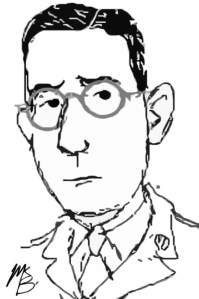
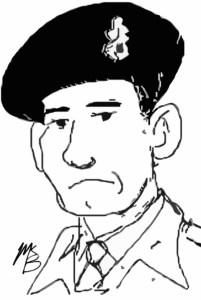
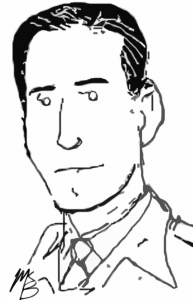
Lt-Col. T. Hart Dyke

Lieutenant-Colonel T. Hart Dyke
Hallamshire Battalion, York and Lancaster Regiment

It was now getting most difficult to find men to accept the added responsibility and danger of leadership. There was little to offer in return for what one asked of them. Rank and money meant little these days. A dozen times they had escaped improbably. Long ago the few surviving men in the rifle companies had been bound to realize the odds against them remaining unharmed. But the honour and good name of the battalion meant much to them.

(Hart Dyke, Normandy to Arnhem: A Story of the Infantry)

Born on 19 February 1905 in Chaman, British India, Trevor Hart Dyke attended Marlborough College then the Royal Military College at Sandhurst. He took a commission with Queen’s Royal Regiment in 1924 and served with the 2nd Battalion in India and the Sudan. He volunteered with the King’s African Rifles in the 1930s in Keyna and Uganda until he rejoined the Queen’s Regiment in 1936. Having completed staff college at Camberley, he held posts with the War Officer and staff assignments at brigade and division levels.

Continue reading

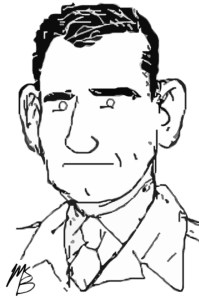
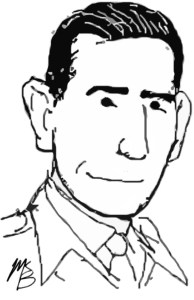
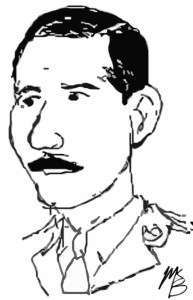
Lt-Col. A.W.H.J. Montgomery-Cuninghame

Lieutenant-Colonel A.W.H.J. Montgomery-Cuninghame
11th Battalion, Royal Scots Fusiliers

As the name ‘Big Monty’ might imply, Lt.-Col. Montgomery-Cuninghame was an awesome figure. Well over six feet tall and built like a giant, he was a forceful and thrusting leader of the Battalion … Of course, some of the methods he had formulated to attain the present discipline and dedication to the job in hand, had not always met with the instant approval of the rank and file.

(Kenneth West, An’ It’s Called a Tam-o’-shanter)

Born on 28 October 1905 in Chelsea, Middlesex, England, Alexander William Henry James Montgomery-Cuninghame was heir to Baronet of Corsehill. His father Sir Thomas (1877—1945), earned the Distinguished Service Order in the Boer War and his grandfather Sir William James (1834—1897), received the Victoria Cross in the Crimean War. Following the family’s military tradition, the younger Montgomery-Cuninghame took a commission in the Royal Scots Fusiliers.

Continue reading

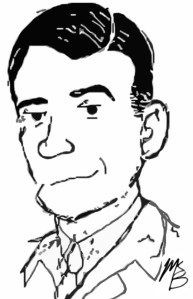
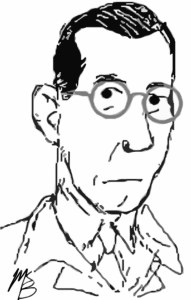
Lt-Col. J.E.G. Hay

Lieutenant-Colonel Scrappy Hay
5th/7th Battalion, Gordon Highlanders

Lt Col Hay commanding the bn, during the whole of this time was always where the fighting was at its thickest. With complete disregard to his own safety he moved from one defensive position to another under heavy fire extolling the men and encouraging them. During the whole of the time of the action which last 48 hours he had hardly any sleep at all.

(D.S.O. citation, 31 Aug 1944)

Born on 31 May 1912 Surrey, England, James Eric Goldwin Hay took a commission with the Gordon Highlanders after attending the Royal Military College at Sandhurst. He commanded a battle training school before the 51st Division embarked for North Africa. During the Second Battle of El Alamein on 25 October 1942, Hay took command of the 1st Gordon Highlanders when Lieutenant-Colonel Horatius Murray was put out of action and another major also named James Hay was badly wounded in a mine blast.

Continue reading

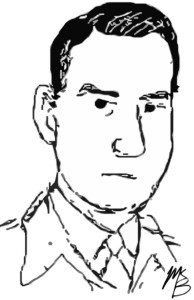
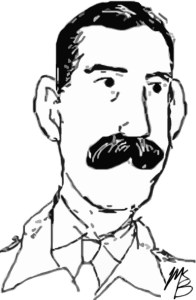
Lt-Col. J.C. Meiklejohn

Lieutenant-Colonel John Meiklejohn
7th Battalion, Argyll and Sutherland Highlanders

We spent the night in considerable trepidation. Three times the carriers tried to come up, but couldn’t manage it … Lieutenant “Sailor” Sills, of Stirling, my last remaining officer, said he would go direct them. They must have been German carriers. Anyway, the last we heard was a shout “Up the Argylls,” the roar of a grenade. He hasn’t been heard of since.

(Meiklejohn quoted in Richmond Times-Dispatch, 10 Jan 1943, 40)

Born on 28 March 1904 in Northwood, Middlesex, England, John Cusance Meiklejohn worked in the London officer for the Scottish Amicable Life Assurance Society. He belonged to the Territorial Army, serving as a captain with the Argyll and Sutherland Highlanders. He commanded a company in the 7th Battalion during the Second Battle of El Alamein. After securing his objective on 26 October 1942, he found the Germans now had his group surrounded. Meiklejohn gathered two hundred soldiers from other companies and held out for forty-eight hours. After rescue by British tanks, he remarked to the press, “I wouldn’t like to go through it again.”

Continue reading

Lt-Col. C.F. Cathcart

Lieutenant-Colonel C.F. Cathcart
7th Battalion, Black Watch

Lying flat on the hard gravelly desert, with shells falling all around and whizzing over one, was one of the nastiest sensations I have ever had. Never have I made myself so flat, never have I prayed so hard that one would not land on me.

(Quoted in Tess Monteith, “From the Moon to Kirkcaldy,” Red Hackle, 22)

Born on 26 March 1912 in Annan, Dumfries-shire, Scotland, Charles Frederick Cathcart was educated at Sedbergh School in Cumbria, North West England and commissioned in the Black Watch. His heroism at Second Battle of El Alamein in October earned a Distinguished Service Order although he was only an acting captain with the 7th Battalion. Leading two companies, Cathcart stormed Miteiriya Ridge and held the position despite heavy casualties and suffering terrible wounds himself. After being evacuated to hospital, he later reflected of the battle: “It’s a bit hard, having had three of the worst days of the battle, to miss the smashing up of the German army.”

Continue reading

Lt-Col. J.A. Hopwood

Lieutenant-Colonel John Hopwood
1st Battalion, Black Watch

I was standing there on top of this bloody tank and suddenly I felt a red hot pain in my chest and I was on the ground. Horrible noise. And I thought hell … I thought that’s the death rattle isn’t it [laughs] and I thought I was dead. And I felt very sorry for everybody at home, they’d miss me, that sort of thing. And then I realized I wasn’t dead, fortunately.

(J.A. Hopwood, interview, Feb 1987)

Born on 26 January 1910, John Adam Hopwood joined the Black Watch in 1930 after attending Eton College and Sandhurst. “I think I might have gone to the Royal Navy,” he later reflected, “but being me of course I put it off too late – procrastinated— so army was the next best thing.” He served as second-in-command of the 7th Battalion, Black Watch and earned the D.S.O. for heroism at Wadi Akarit in April 1943. When one company wavered after its officers were knocked out, Hopwood took charge of the advance. The citation credited his “actions which were carried out with the highest degree of resourcefulness, courage and determination were undoubtably responsible for the forward Coy reaching its objective.”

Continue reading

Lt-Col. G.W. Dunn

Lieutenant-Colonel George Dunn
2nd Battalion, Seaforth Highlanders

Major Dunn as Bn 2nd in command was with me at the former Bn HQ. As bn HQ was about to advance it was shelled and many personnel were casualties … I was wounded also. Maj. Dunn was a tower of strength during that crisis and throughout the rest of the night. He re-organised a scratch Bn HQ, re-organised communications, re-organised people to deal with casualties, and by his calmness and coolness in very difficult circumstances was of outstanding help in getting things going again.

(D.S.O. Bar citation, 21 Dec 1944)

Born in Lanarkshire on 27 March 1914, George Willoughby Dunn was a graduate of Glasgow University, a solicitor and Territorial Army officer, commissioned into Royal Scots Fusiliers in 1935. He served with the 5th Black Watch as a company commander in North Africa and was wounded at the Second Battle of El Alamein in October 1942. He then earned the Military Cross for leading an assault on a hill strongpoint at Wadi Akarit in April 1943: “He exposed himself continuously without fear for his own life and his complete disregard for his own safety made possible the taking and holding of this feature. Throughout Major Dunn has been an inspiration to all who serve under him.”

Continue reading

Lt-Col. A.J.A. Arengo-Jones

Lieutenant-Colonel Tony Arengo-Jones
1/4th Battalion, King’s Own Yorkshire Light Infantry

Commanders at every level up to battalion will be required to pay attention to such tactical principles as the need to bring maximum, accurate fire on enemy positions from as many different directions as practicable; bold flanking and infiltration movements undertaken whenever the circumstances are propitious; reducing the risk of casualties by having as few men as possible moving in the attack at any one time, and the employment of deception to conceal the direction from which the final assault is launched

(Arengo-Jones, “An Exchange of Ideas,” Infantry, Sep-Oct 1966, 6)

Born on 17 August 1915 in Somerset, Gloucestershire, Anthony James Arengo Arengo-Jones was a graduate of Cheltenham College and rugby player. After attending Royal Military College, Sandhurst he took a commission with the Gloucestershire Regiment in 1936. He served at Dunkirk in command of an anti-tank company. He returned to France after the Normandy invasion as brigade major with the 160th Infantry Brigade.

Continue reading

Lt-Col. T.W.A.H. Harrison-Topham

Lieutenant-Colonel T.W.A.H. Harrison-Topham
1/4th Battalion, King’s Own Yorkshire Light Infantry

On New Year’s Day Lieut.-Colonel Harrison Topham, who had led the Battalion so gallantly from Normandy to Nijmegen, was unfortunately compelled to relinquish command owing to ill-health

(Harold Carmichael Wylly, History of the King’s Own Yorkshire Light Infantry, 156)

Born on 23 August 1903 in Greenwich, London, Thomas William Amyas Harrison Harrison-Topham was the son of Colonel Thomas Harrison-Topham who won the D.S.O. as a captain in Burma during the 1891-92 campaign. The younger Harrison-Topham took a commission with the King’s Own Yorkshire Light Infantry in 1924, served on the North West frontier in India, was promoted to captain in 1935. and became acting major in April 1940.

Continue reading

Lt-Col. E.D. Wardleworth

Lieutenant-Colonel E.D. Wardleworth
1/4th Battalion, King’s Own Yorkshire Light Infantry

Wuzzle Wardleworth had taken over as C.O. He was very good; why he was several times replaced after temporary command I shall never know. He moved the companies around fairly frequently in order to give everyone a turn in the comparatively quiet rear positions.

(Lewis Keeble, “A Worm’s Eye View: The 1/4 K e View: The 1/4 KOYLI in Normandy YLI in Normandy,” CMH, 6)

Edmund Douglas Wardleworth was born on 24 October 1914 in Sheringham, Norfolk, the same day his father, a Royal Army Medical Corps lieutenant, mysteriously drowned while on active service in France. The younger Wardleworth was commissioned into the King’s Own Yorkshire Light Infantry in 1935. He was aide-de-camp to the governor of Burma from 1938 to 1941. He fought as a company commander with the 2nd Battalion, KOYLI during the Japanese invasion of Burma in the 1941-42 campaign. When the commanding officer and second-in-command became casualties, Captain Wardleworth took over during fierce fighting in late February 1942.

Continue reading