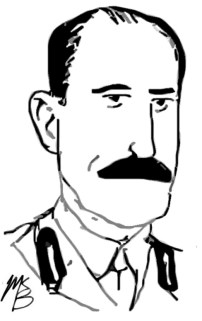
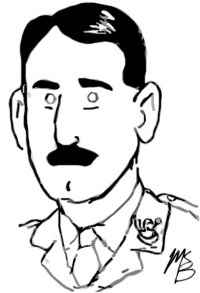
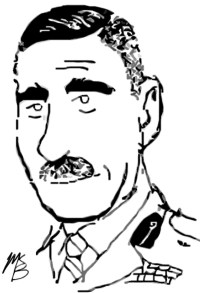
Lt-Col. W.B. Hendrie

Lieutenant-Colonel Bill Hendrie
48th Highlanders of Canada
Hendrie

This is the worst and most ignorant C.O. I have met in my service in the Army. He is completely ignorant of how to train a battalion. He does not train his officers. He does not train his N.C.Os. His individual training is badly organized and men are bored with it; he admitted that this was so.

(Gen. Montgomery, “Notes on Inf. Bdes of Canadian Corps,” 3 Feb 1942)

Born in Hamilton on 6 March 1902, William Brown Hendrie was son of Colonel William Hendrie (1863—1924) who had commanded the 48th Highlanders from 1911 to 1913. He worked for the family transport business, Hendrie & Co., and had served with his father’s regiment since the 1920s. He was a company commander during the aborted Second British Expeditionary Force to France in June 1940. That November, he married Betty Scale (1916—2009), daughter of a British Army colonel, who he had met some months before while stationed in England.

Continue reading

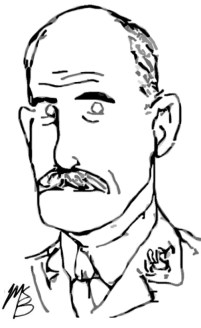
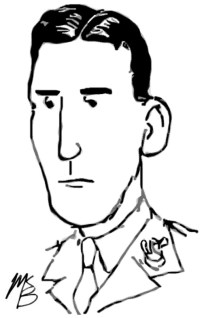
Brig. W.W. Southam

Brigadier Bill Southam
48th Highlanders of Canada
6th Infantry Brigade
Southam

His voice was exceedingly cheerful throughout … There wasn’t a quiver in it and occasionally he would make some wisecrack. He was the same old boy through it all. We kept in contact with the brigadier all the time and between 1 and 2 o’clock he sent a message saying he could see some troops surrounded and out of ammunition down the beach and they were surrendering.

(Quoted in The Province, 24 Aug 1942, 22)

Born in Toronto on 11 September 1901, William Wallace Southam was a graduate of RMC and grandson of prominent Canadian newspaper publisher William Southam. He joined the family business as vice-president and managing director. Having belonged to the 48th Highlanders since 1922, he became second-in-command of the 1st Battalion on mobilization in September 1939. He participated in the aborted Second British Expeditionary Force to France, which ended in the battalion making a desperate escape by train in June 1940.

Continue reading

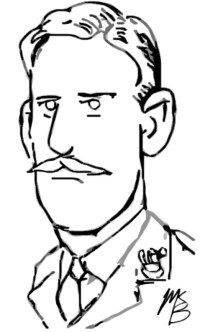
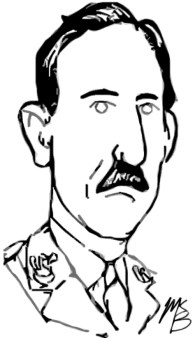
Brig. E.W. Haldenby

Brigadier Eric Haldenby
48th Highlanders of Canada
9th Infantry Brigade
Haldenby

The people are simply magnificent. They do not complain. They realize that they are the front line of British defences and it was amazing the way they sprang into action when the air attack on Britain started. There is no panic or alarm … Germany will never succeed in breaking the spirit of the British.

(Haldenby quoted in Globe and Mail, 11 Oct 1940)

Born in Toronto on 5 June 1893, Eric Wilson Haldenby was an architect and First World War veteran. He had been commissioned with the 48th Highlanders and enlisted with the 92nd Battalion in August 1915. He served on the front with the 15th Battalion, earning a promotion to captain and the Military Cross for gallantry at Vimy Ridge and Hill 70.

Continue reading

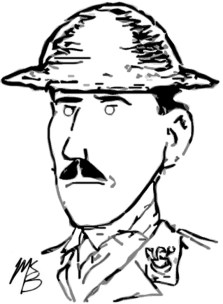
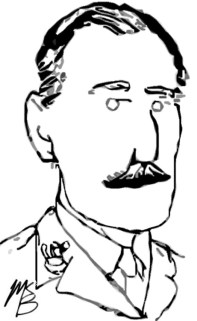
Col. Humphreys

Colonel E. Thomas Humphreys
1st Bn., Leinster Regiment (Royal Canadians)
Humphreys

The officers of the First Battalion, Leinster regiment, known from their historical connection with the Dominion as the Royal Canadians, which regiment has just disbanded after presenting their colors to the King at Windsor Castle, are giving their regimental plate and trophies in trust to the Canadian Government “until the regiment is again raised, as a token of their regards for the Great Dominion, which gave birth to the battalion.”

(The Expositor, 29 Jun 1922, 1)

Born in London in Dover, Kent on 5 November 1878, Edward Thomas Humphreys graduated from Sandhurst in 1898 and was  commissioned with the Lancashire Fusiliers. He served in the Boer War and in France, Salonika and the Middle East during the Great War. In May 1918, he was promoted to command the 179th Brigade in the 60th Division, Egyptian Expeditionary Force. In September 1919 he transferred from the Lancashires to take command of the 1st Battalion, Leinster Regiment.

Continue reading

Lt-Col. Raynsford

Lieutenant-Colonel R.M. Raynsford
1st Bn., Leinster Regiment (Royal Canadians)
Raynsford

As you are no doubt aware we, the “Royal Canadians” together with other Irish regiments are being disbanded. I am hoping you may see your way to use your powerful influence to assist us in our efforts to be retained in the British army as the Prince of Wales’s Royal Canadian Regiment, our original title.

While all ranks desire the honor of still representing Canada, I have a personal interest as my wife is the grand daughter of Sandfield Macdonald, the first Prime Minister of Ontario.

(R. M. Raynsford to the prime minister, Ottawa Journal, 14 Mar 1922, 6)

Born in London on 19 May 1877, Richard Montague Raynsford married twenty-three-year-old Daphne Mildred Pemberton in England in April 1911. The daughter of an Indian Army colonel, she was the granddaughter of John Sandfield Macdonald (1812–1872), Ontario’s first premier after Canadian Confederation in 1867. The son of a Madras Army colonel, Raynsford was commissioned a second lieutenant in the Leinster Regiment in 1897, served in the Boer War and was adjutant in the 4th Battalion until 1908.

Continue reading

Lt-Col. Wildblood

Lieutenant-Colonel E.H. Wildblood
1st Bn., Leinster Regiment (Royal Canadians)
Wildblood

The following are the considered opinions submitted by the Court …

That the situation at present obtaining in Palestine is exceedingly dangerous and demands firm and patient handling if a serious catastrophe is to be avoided.

(Maj-Gen. Palin, Brig. Wildblood, and Lt-Col. C.V. Edwards, Palin Commission, 1920)

Born on 2 May 1878 in Cheshire, England, Edward Harold Wildblood was a solider, sportsman, and big game hunter. He fought as a trooper in Roberts’ Horse during the Boer War and was commissioned with the Leinster Regiment in 1900. He served with the 1st Battalion in the heavy fighting at Ypres through to its deployment on the Salonika front. By early 1917, he had succeeded Lieutenant-Colonel J.D. Mather in command.

Continue reading

Lt-Col. H.W. Weldon

Lieutenant-Colonel Henry Weldon
2nd Bn., Leinster Regiment (Royal Canadians)

The Regiment has unfortunately lost some most valuable officers … all of whom had done splendid work, which would have brought recognition had they been fortunate enough to survive.

(Weldon to Maj. Gen. Prior in Whitton, The History of the Prince of Wales’s Leinster Regiment, vol. 2, 174)

Born in Dublin on 2 November 1878, Henry Walter Weldon was commissioned a lieutenant in 1900 and served in South Africa. He was adjutant for the 1st Leinsters and temporarily took command after Second Ypres following the death of Lieutenant-Colonel C. Conyers on 12 May 1915. He served with the battalion now under the command of Lieutenant-Colonel J.D. Mather on the Salonika front in 1916.

Continue reading

Maj. Frend

Major J.R. Frend
2nd Bn., Leinster Regiment (Royal Canadians)

Heavy hostile shelling of TEMPLEUX QUARRIES commenced about 11:30am until 12:30pm. Extremely accurate. Lt. Col. Murphy, DSO, MC [and others] were in HQ mess attending to wounded when a shell dropped right in their midst killing the CO … Shelling was kept up at intervals of 50 minutes throughout the day & night. Major J.R. Frend assumed command of Bn. at 1 pm.

(2nd Bn. Leinster Regiment War Diary, 6 Nov 1917)

Following the death of Lieutenant-Colonel A.D. Murphy, Major John Roberts Frend took command of the 2nd Leinsters. He was born on 7 February 1883 in Cloghjordan, Tipperary. He served in the Boer War and joined the Leinster Regiment before emigrating to Australia in 1909. On the outbreak of the Great War, he rejoined his old regiment and served with the 2nd Leinsters in France.

Continue reading

Lt-Cols. Jameson & McDonnell

Lieutenant-Colonel E.J. Jameson
Jameson
&
Lieutenant-Colonel John McDonnell
McDonnell
5th Bn., Leinster Regiment (Royal Canadians)

He was not the showy or popularity-seeking kind, but always pursued the even tenor of his path to duty. Reserved, rather taciturn, a somewhat lonely figure, he yet inspired confidence and esteem. Outwardly he appeared a man of care and silent sorrow, which rather belied his age and vigour. He knew his work, had confidence in himself and inspired it in others. Fearless and impartial, he never spared a subordinate, from a private upwards. But he never spared himself.

(Tribute to Lt-Col. Jameson in Whitton, The History of the Prince of Wales’s Leinster Regiment, vol. 2, 393)

Both majors who succeeded Lieutenant-Colonel E.F. Farrell in command of the 5th Battalion, Leinster Regiment would each later lead a battalion in the field before being killed in action. Born on 11 June 1875 in Dublin, Edmond James Jameson died of wounds on 27 March 1917 while in command 1/4th Essex Regiment during the First Battle of Gaza. Born on 2 November 1878 in Dublin, John McDonnell died with the 1st Inniskilling Fusiliers at Ypres on 29 September 1918.

Continue reading

Lt-Col. Colquhoun

Lieutenant-Colonel J.C. Colquhoun
6th Bn., Leinster Regiment (Royal Canadians)
Colquhoun

“Once a Leinster always a Leinster.”

(Whitton, The History of the Prince of Wales’s Leinster Regiment, vol. 2, 96)

Born in Perthshire, Scotland on 31 December 1870, Julian Campbell Colquhoun was the second son of Colonel William Campbell Colquhoun of Clathick Estate. After finishing school, he joined the 2nd Battalion, Leinster Regiment, was promoted to captain in 1898, and served in the Boer War. He retired to the reserve of officers in 1907 but immediately reported for duty in August 1914. He was posted to the new 6th {Service) Battalion under the command of Lieutenant-Colonel John Craske.

Continue reading