Lieutenant-Colonel G.M. Wilkins
6th Battalion, North Staffordshire Regiment
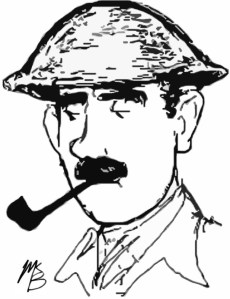
This officer showed untiring energy and devotion to duty the during the period his company was in the line … His platoon localities were under observation and close range fire from enemy localities throughout the whole period. In addition two of his posts were subjected to continuous shell fire for long periods during which two men were killed and several wounded. Major Wilkins by continuously visiting these posts and assisting in the evacuation of wounded showed total disregard for his personal safety and set a very excellent example to his company.
(M.C. citation, 11 Jul 1940)
Born on 11 June 1901 in Bedford, Bedfordshire, Gilbert McCartney Wilkins attended Royal Military College, Sandhurst before being commissioned with the North Staffordshire Regiment in 1922. From 1926 to 1932, he was seconded to the King’s Africa Rifles, and rose to the rank of major by 1938. He commanded a company with the 2nd Battalion, North Staffordshire Regiment during the battle of France. He was wounded in action on 21 May 1941 and earned the Military Cross.
By late 1943, Wilkins commanded the 6th Battalion, North Staffordshire. It deployed to France in late June 1944 as part of the 59th (Staffordshire) Division. One North Staffordshire officer recalled of the early campaign, “We had spent the whole war in the UK. We were pretty fit and hard trained but the majority had no battle experience. It was with, perhaps, a little over-confidence that we approached our task in Normandy.”
Twenty-year old, Czechoslovak-born Ján Hoch, who went on to become the powerful media tycoon Robert Maxwell, joined the battalion under another name, Leslie du Maurier. Armed with a PIAT, he recalled at one point, “I was shaking. I just couldn’t hold it. I was so afraid I was going to die.” After Wikins gave him a bottle of gin, “I took a swig. It was the first alcohol I’d ever drunk. And I knocked that tank out.” Evidently impressed with Du Maurier, especially after he infiltrated enemy lines in a stolen SS uniform, Wilkins recommended him for a commission.
Shortly thereafter Wilkins was killed by enemy shelling on 17 August 1944. By the end of the month the 59th Division would be disbanded and the battalion was to be broken up to reinforce other units.
 World War Graphic History