Lieutenant-Colonel Ken Exham
7th Battalion, Duke of Wellington’s Regiment
6th Battalion, Royal Welch Fusiliers
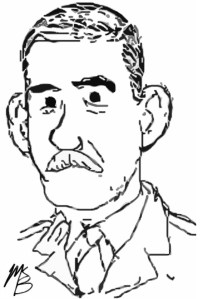
The Army is well aware of the responsibility the country has placed on us in the form of National Service. The whole ting must be examined against one factor—that the Army exists to fight. It does not exist to do a job for the Ministry of Education or the Ministry of Education.
(Quoted in Birmingham Evening Mail, 23 Jun 1954)
Born on 17 September 1903 in Greenwich, London, Kenneth Godfrey Exham attend the Royal Military College, Sandhurst and took a commission with the Duke of Wellington’s Regiment (West Riding) in 1923. As a qualified Russian interpreter, he was posted to the British Military Mission in Moscow from 1941 to 1943. He then commanded 7th Battalion, Duke of Wellington’s Regiment for a short time from August to October 1943 followed by the 9th Battalion, Worcestershire Regiment stationed in the United Kingdom from October 1943 to May 1944.
During the Battle of Normandy, Exham served as general staff officer with 21st Army Group until posted to the 6th Battalion, Royal Welch Fusiliers in October, replacing Lieutenant-Colonel R.J.F. Snead-Cox. He earned the D.S.O. during the Ardennes offensive, after he was called forward from the reserve to take over 158th Infantry Brigade after the death of Brigadier Gwynne Brian Sugen on 4 January 1945: “By his very successful handling of this very large Bde Gp he showed outstanding qualities of coolness, resource and judgment and the acceptance of responsibilities far above the average.”
He left the 6th Royal Welch Fusiliers in March on being posted back to general staff of 21st Army Group. In August 1945, he took command of 56th Infantry Brigade and in June 1946 he became deputy secretary of the Allied Control Commission in Germany. Following an appointment to command 151st Brigade, he became deputy director of military training with the War Office. He ended his military career as general officer commanding Nigerian Military Forces in 1959.
Exham died in Bicester on 28 February 1974.
 World War Graphic History