Lieutenant-Colonel Fraser Eadie
1st Canadian Parachute Battalion
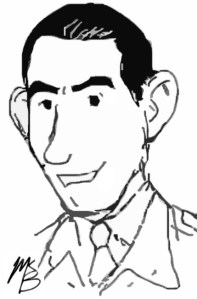
I always believed that I must lead them or I couldn’t live with myself. The only way to be promoted was if I was held in good esteem by my men. I never asked them to do anything I wouldn’t do myself.
(Quoted in Bernd Horn, Intrepid Warriors, 245)
Born in Winnipeg on 20 July 1917, George Fraser Eadie worked for the Ford Motor Company and played hockey before enlisting with the Royal Winnipeg Rifles as a second lieutenant in 1940. He had joined the army rather than pursue an opportunity to play for the Chicago Black Hawks. After advancing to captain and then major, he qualified as a paratrooper and volunteered for the newly formed 1st Canadian Parachute Battalion in 1942.
In later years, Eadie remarked: “We called ourselves the forgotten battalion, and nobody was very happy about it. Very few Canadians were aware that we even had a parachute battalion. The Canadian army really had nothing to do with us, ever.” The battalion was attached to of 3rd Parachute Brigade, British 6th Airborne Division.
He dropped with the unit behind enemy lines on 6 June 1944 and fought throughout the Normandy campaign. He became acting second in command after the wounding of Major Jeff Nicklin at the end of July and assumed temporary command from Lieutenant-Colonel G.F.P. Bradbrooke at the end of August. The battalion soon thereafter returned to England for reinforcement and retraining. He reverted to deputy after the recovery of Nicklin and the unit deployed back to France in December 1944.
Eadie assumed again command on 24 March 1945 after Lieutenant-Colonel Nicklin was killed in action following a drop. He led the Canadian paratroopers for the rest of the war, participated in the liberation of Bergen-Belsen concentration camp and advanced the furthest east in Germany of any Commonwealth unit. For his leadership as the two-time commanding officer, Eadie earned the Distinguished Service Order:
Lt.Col. Eadie joined the 1st Canadian Parachute Battalion in Normandy in August 1944 and assumed temporary command of the Battalion at Annebault during the advance to the Seine. His leadership and determination to pursue and get to grips with the enemy inspired his men enabling them to achieve a series of outstanding successes until the Division was withdrawn from the Seine on 3rd September 1944.
Lt.Col. Eadie carried out his duties as second-in-command of the Battalion during the battles in the Ardennes in December 1944 to January 1945 with great distinction, and on dropping over the Rhine on 24th March 1945 he immediately had to assume command of the Battalion on the death of the Commanding Officer on the DZ. His brilliant handling and inspiring leadership of his Battalion enabled them in spite of heavy opposition and considerable casualties to capture all their objectives and inflict tremendous losses on the enemy.
Throughout the campaign until 10th May Col. Eadie’s inspiring leadership and utter disregard of danger enabled his Battalion to kill and rout the enemy wherever they found them. The battles of Greven, Dortmund-Ems Canal and Ricklingen Bridge, and the rapid advance of his Battalion to Wismar on the Baltic are instances where his outstanding leadership had a decisive influence on the result of the engagements.
Following demobilization, he resumed his career at Ford but remained active in the reserve army and served as commanding officer of the Winnipeg Light Infantry.
He died in Oakville on 11 August 2003.
 World War Graphic History
Hi Matt, very cool you’ve been covering the 1 Can Para COs lately – I’m off to England